Bavarian Music Academy
CastleMarktoberdorf
Marktoberdorf Castle
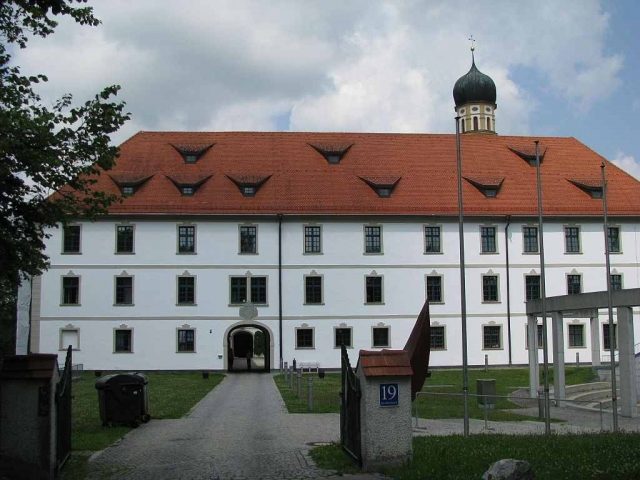
A castle in Oberdorf is mentioned for the first time in 1424. In the years 1515-1517, the Augsburg Prince-Bishop Heinrich von Lichtenau erected a late Gothic new building, for which we unfortunately lack both visual material and descriptions. Its expansion took place in 1598/99. Primarily, it was a hunting lodge, where Emperor Max I (1493-1519), a passionate hunter, was a frequent and welcome guest. This castle stood until 1722. The strictly Gothic building no longer fit into the era of cheerful Baroque, and so Prince-Bishop Alexander Sigismund, Count Palatine by Rhine (1690-1737) had the castle demolished and the current Baroque castle built. Johann Georg Fischer, the master builder from Füssen born in Oberdorf, was commissioned with the new construction. At that time, the west building with the main portal and 9 window axes, the south wing with 26 and the east wing with 12 axes were erected. ...
In 1761, the building was expanded by Prince-Bishop Joseph, Landgrave of Hesse (1740-1768), by adding guest apartments, closing the courtyard that was still open to the north, and creating a simple gate on the east side. The castle now had 72 rooms.
Both the builder of the castle and his successor were known to enjoy staying at Oberdorf Castle. The last of the Prince-Bishops, Elector Clemens Wenzelaus, Prince of Poland and Lithuania born at Hubertusburg Castle in Saxony and Duke of Saxony, had a particular fondness for the market town and its castle. He was responsible for the magnificent lime tree avenue laid out in 1774, which the city administration is very keen to preserve. Later research revealed that the avenue was probably built on classical ground and that the Roman road Kempten - Epfach passed through here.
After his expulsion from the Archdiocese of Trier during the turmoil of the French Revolution and the loss of his Electorate, Clemens Wenzelaus retreated to his Prince-Bishopric of Augsburg. He spent the summer months here at the castle until the end of his life, always accompanied by his youngest sister Princess Maria Kunigunde Dorothea, who acted as Electress there. It was also she who went with him into exile in Oberdorf and, eleven years after his death, had a burial chapel in the classical style built with her niece Maria Amalia, the widowed Countess Palatine of Palatinate-Zweibrücken, at the east choir of the Oberdorf parish church [see east of the church in the photo], which still stands today.
Oberdorf Castle also fell victim to secularization in 1802, where Clemens Wenzelaus was also deprived of his sovereignty in the Prince-Bishopric. Although the castle was left to him for free use until the end of his life and he was also granted lower jurisdiction in the market town, the Bavarian state took over the castle from Markt Oberdorf as early as 1812 and established its royal authorities there - the district court and in 1820 the rent office. In 1862, it also became the seat of the district administration.
The castle, high above the town, remains its landmark and has been given a meaningful purpose again through the establishment of the Bavarian Music Academy, for whose foundation the town can only be congratulated.
Source Text
Take Mobile History with you
You are reading this text for free. Premium adds what matters on the road: descriptions read aloud, sites found through your camera, whole regions taken offline.
- Every description, including the ~17,700 Premium sites
- Audio guide: have descriptions read to you on location
- AR finder: see sites through your camera, with distance and bearing
- Unlimited saved sites
14 days free, then from €2.99 a month. Cancel anytime.
Source: Wikipedia · Licence: CC BY-SA 4.0
This description draws on the facts documented in the linked Wikipedia article; Wikipedia content is licensed under CC BY-SA 4.0. Wording and editing: Mobile History.
Location: 47.7797, 10.6219