To be privately owned
CastleMarkt Wald
Markt Wald Castle
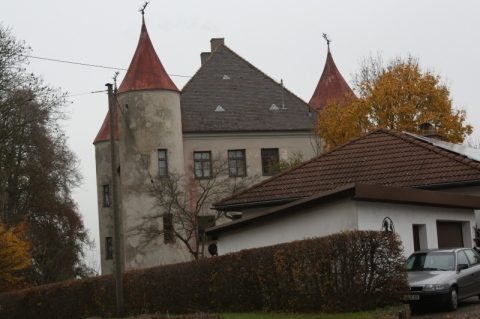
The castle at the northeast end of the village, situated on the western slope of the Neufnachtal valley, is a three-story, almost square building with a hip roof and two round towers at the northwest and northeast corners, as well as a round tower in the middle of the south side. Its core dates back to the reconstruction in the 17th century. In 1477, the former "Schloss zum Pürgel (Bürgle) was disarmed and rendered defenseless," until then the official residence of Welfian retainers and the Lords of Riedheim. In a feud between the Riedheims, first mentioned as local rulers in 1474, and Duke Wolfgang of Bavaria over the lordship of Schwabeck, the castle was destroyed.
Konrad I von Riedheim subsequently had a new castle built in the Irmatshofen district on the forest. Under his son Konrad II von Riedheim, the castle was destroyed during the Peasants' War in 1525. In the division agreement of the Riedheims from 1536, in which Konrad II's sons, Wilhelm IV and Hans Konrad, divided the inheritance of Angelberg and Irmatshofen, it states that "the castle construction in Irmatshofen is not yet completed." This must have been the building that was called "the old castle" around 1835, then a residential house next to the current castle, owned by the lordship. The Urbarium of 1588 contains the first detailed description of the buildings and other possessions of the rulers.
On July 1, 1578, shortly before his death, the childless last Riedheimer, Christoph Adam, sold the castle and estate of Irmatshofen with "all appurtenances for 115,000 guilders" to Archduke Ferdinand of Austria. In 1588, the Archduke handed over the encumbered lordship to his sons, Cardinal Andreas, Bishop of Constance and Brixen, and Karl, Margrave of Burgau, "as free property" in exchange for the transfer of Ambras Castle and Lordship (near Innsbruck). It was they who extracted the "market right" from their cousin Emperor Rudolf II in Prague in 1593. In the following year, 1579, the castle was dilapidated. The archducal court architect Albrecht Luchese assessed the castle complex, and his cost estimate for the restoration amounted to 1,484 guilders. Whether this structural renewal took place is not known.
In 1636, (probably Swedish) soldiers devastated the castle, which from then on remained in poor structural condition for over a century despite numerous planned renovations. On March 8, 1660, a new pledgee moved into the castle; the previous lord of the castle, whose representation was held by the respective administrator, Archduke Ferdinand, had pledged the Irmatshofen lordship property for 60,000 guilders to Count Leopold Fugger von Babenhausen.
In the following decades towards the end of the 17th century, numerous expert opinions on the structural condition of the building were submitted and many restorations were considered, including in the period from 1660 to 1680, during which master mason Hans Zwölfer and master carpenter Georg Wachter from Irmatshofen and Sohler were paid 738 guilders. In 1695, the castle was collapsing; the estimate made at that time already amounted to 3,042 guilders. The descendants of the aforementioned craftsmen, Barthelmä Zwölfer and Jakob Wachter, carried out the demolition of the endangered masonry and the restoration of the roof truss in 1699 for 717 guilders, after a gable had collapsed due to a storm and the "Täfer" (paneling) had been broken through.
The description of the Vorderösterreichische Pfandherrschaft, presumably created in 1719, for the first time mentions only three castle towers, while the urbars from earlier centuries speak of four towers. Furthermore, the individual buildings, both inside and out, were subject to constant changes due to ongoing restorations. The fact that the administrator, as representative of the lordship, had his seat in the castle is evidenced by sources from various periods, which consistently speak of an "Ambst-" or "Pflegerstube" (official or administrator's room). Moreover, it should be noted that in addition to "low justice," i.e., the punishment of thefts, violations of "corvée and in-kind payments," disregard of property transfer fees ("Laudemium"), refusal of "Brautlauf" (a traditional wedding custom), and withholding of income from "Bier-Umbgeld" (beer tax) of the "Tafernwirthe" (innkeepers), "high justice," i.e., capital punishment and blood ban from the Riedheim era, meaning the punishment of serious crimes such as murder and "Todtschlag" (manslaughter), was also the responsibility of the administrator on behalf of the landlord.
When total ruin was feared in 1725, Michael Stiller from Ettringen, among others, along with an Innsbruck court architect Georg Anton Gumpp, prepared floor plans for a new building as an official residence in 1726 and 1730. However, as they could not decide on this new building, the dilapidated castle burned down in 1735. While one source reports it was caused by lightning, another sees a connection with a rebellion of the subjects, in which the Fugger lords failed to fulfill a number of obligations they owed to their peasants, and the outraged inhabitants set fire to the castle.
The thorough reconstruction, which gave the castle its present appearance, was carried out between 1747 and 1748. Empress Maria Theresia's military topographer mentions the activity of a master builder: "...to the castle, for which the lordship has appointed a master builder." The total cost of the construction was considerably high at 6,481 guilders. The master mason was again Michael Stiller, who alone worked 102 days on the stucco. The parish register of 1750 reveals the name of the administrator under whose aegis the castle was completely rebuilt. "Cod: ao. (Anno) was under H. fern. Antoni v. Dilger, Pfleg. here the lordly castle newly rebuilt." At this time, the castle was the central economic hub of the Irmatshofen and Sohler districts, and the subjects "frohnen" (performed corvée labor) on the "Kasten (Stadel)auf das Schloß" (granary/barn at the castle). And so it says elsewhere: "...and most of the meadows, along with 120 Jauchart (acres) of arable land... belong together, which the subjects, as well as the meadows to mow, and other work must perform and cultivate in corvée services for the castle."
Regarding the village and castle of Irmatshofen itself, the Theresian Military Topographer stated in 1750: "Irmazhoffen
on the forest. A market town, in which there are 2 Preystätt, a Zapfen Wirth (innkeeper) and 65 hearths, which is called Soler at the lower inn A. Irmazhoffen; where the castle B. Wald, and where the church C. stands." That the castle possessed a so-called "Schweizerey" (dairy with cheese production) is learned a few lines later: "This castle, with a dairy, lies on a hill, is newly built, and the prospect is grand and pleasant." The then landlord and the legal status of the lordship are also authentically named: "from this market town and castle the lordship, Irmatzoffen aufm Wald, takes its name, which as a redeemable Imperial-Royal pledge lordship is handed over to Count Fugger zu Wellenburg for 600,000 fl (guilders), of which, however, only 32,000 fl are said to be liquid." ...... "The subjects, all of whom are collectable in Ehingen."
Around 1770, the house chapel received its charming decoration with stucco by Andreas Henkel and frescoes by the famous painter Johann Baptist Enderle from the Rococo period. The ceiling painting, a Christmas fresco, deserves special attention. In return for military support in the Bavarian War of Succession in 1779 on the side of Austria against the Prussians, during which young men from the local village of Wald were conscripted as soldiers, the Counts Fugger von Babenhausen received from the Austrian imperial house "...castle and lordship of Irmatshofen as a 'manorial fief' against payment of 32,000 guilders, confirmed on January 17, 1781." A kitchen wing added in the later 19th century was demolished again in 1963. In 1903, the Giltstadel (tax barn) at the castle was partially, and in 1905 completely, demolished. The exterior of the castle was renovated in 1964. Today it serves as the Count Fugger's chief forestry office.
Take Mobile History with you
You are reading this text for free. Premium adds what matters on the road: descriptions read aloud, sites found through your camera, whole regions taken offline.
- Every description, including the ~17,700 Premium sites
- Audio guide: have descriptions read to you on location
- AR finder: see sites through your camera, with distance and bearing
- Unlimited saved sites
14 days free, then from €2.99 a month. Cancel anytime.
Source: Wikipedia · Licence: CC BY-SA 4.0
This description draws on the facts documented in the linked Wikipedia article; Wikipedia content is licensed under CC BY-SA 4.0. Wording and editing: Mobile History.
Location: 48.1408, 10.5855