To be privately owned
CastleRemagen
Marienfels Castle
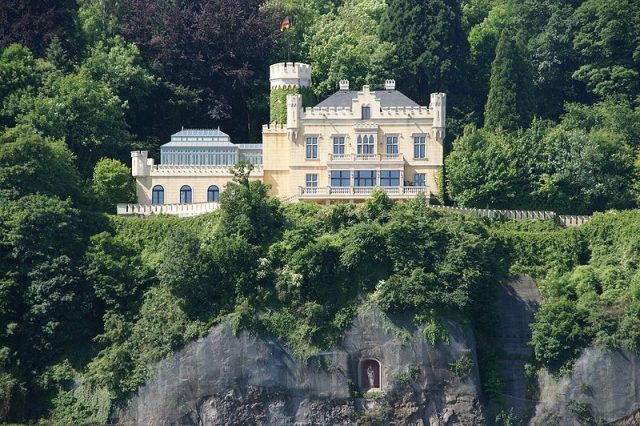
Marienfels Castle originated from a villa predominantly built in the Neo-Gothic style in Remagen, a city in the north of Rhineland-Palatinate. The castle, with its approximately 800 square meters of living space across 18 rooms, is surrounded by a wooded park of about 100,000 square meters. It is located between Remagen city center and the Unkelbach district, above Federal Highway 9 and the Cologne-Koblenz railway line on the left bank of the Rhine. Marienfels Castle is listed as a cultural monument and is designated as a monument zone, including its furnishings, outbuildings, and park.
The foundation stone of Marienfels Castle was laid on May 14, 1859; the architect was the Cologne engineer-colonel Carl Schnitzler. However, the Cologne cathedral master builder Ernst Friedrich Zwirner, who built the Apollinariskirche in Remagen, is often mistakenly named as the architect of Marienfels Castle. In August 1860, the client, Uerdingen sugar manufacturer Eduard Frings, moved into the residence as a second home. The main house was completed in the spring of 1861, while the construction of the outdoor facilities and the entrance portal (no longer existing today) dragged on until 1863; the entire complex was only completed in 1874 and had cost 87,670 Thaler (around 4.5 million Euros in today's purchasing power) without inventory by then. None of the original inventory remains in the castle today. This included some significant works of art, such as the portraits of Eberhard III. Jabach and his wife Anna, née Reuter, painted around 1600 by Gortzius Geldorp, which are now on loan at the Rheinisches Landesmuseum in Bonn. The inventory was divided among the Frings heirs Guido Mengen from Viersen, Henriette Tilmann née Herbertz from Dortmund, and Max[imilian] and Gustav Scherbius.
The castle itself passed into the ownership of the Cologne industrialist Otto von Guilleaume in 1907. He renovated it and had a bathroom and a flush toilet installed. Von Guilleaume was also the owner of the hunting lodge Calmuth, now owned by Frank Asbeck, in the nearby Calmuthtal, where the Internationale Film-Union later established its operations. In 1936, the building was purchased by the door manufacturer Otto Becher. He had a large terrace built on the Rhine side of the castle.
Subsequently, the building was owned by the Klinik Sanatorium Schloss Marienfels company and served as a sanatorium. In 1949, Marienfels Castle became the headquarters of the Fischerkoesen film studio, which was considered the most famous animation studio in Germany at the time. It had about 20 employees and primarily produced animated commercials; the owner was Hans Fischerkoesen, who also resided in the castle. In 1952, the company moved to Bad Godesberg (Mehlem district). In 1975, the property came into the possession of Paul Spinat, then owner of Drachenburg Castle. He had the southern single-story extension added.
On March 14, 1988, the terrace built in 1936 began to slide. Several cubic meters of scree had detached and slipped below the veranda. Due to heavy rainfall, the structure, built on loose ground, had started to move. The scree avalanche had broken through a protective wall of wooden planks, which had been erected to protect the heavily trafficked Federal Highway 9 running below the castle. The federal highway was closed for a month for safety reasons. Earthworks specialists from Essen examined the rock and proposed a series of stabilization works. Subsequently, the drainage of the terrace was redirected; the veranda was secured against slipping with concrete beams.
In 1989, the building contractor and "castle collector" Herbert Hillebrand acquired the castle in the name of his daughter Katharina. The castle was renovated for several years at a cost of around eight million DM and adapted to the owners' needs (installation of a swimming pool, whirlpool, and sauna). With expert advice from the State Office for Monument Preservation, the castle almost regained its original Neo-Gothic architecture. From 1994 to 1996, Hillebrand rented the castle to the Republic of Kazakhstan as the building for its embassy chancery, employing 14 diplomats and 50 other staff members (→ List of diplomatic missions in Bonn). Subsequently, the castle was used by Hillebrand's daughter Katharina.
On November 16, 2004, entertainer Thomas Gottschalk acquired the castle for 3.5 million Euros. He had the building renovated and moved in during the summer of 2006. A glass house was built on the southern single-story extension. In 2012, the castle, including furnishings, was for sale for 6.2 million Euros plus brokerage fees and, as announced at the end of January 2013, found a new owner as Frank Asbeck's second castle.
Legend+
The name of the castle goes back to a legend. The devil, it is said, does not like the castle because he was once driven out from here. He is said to have lived in a cave in the mountain on which the castle stands, when he was not in his grandmother's cave. Before the construction of the castle, the builder had a semicircular grotto built in a rock crevice, in which he placed a statue of the Mother of God; it was intended to counteract the popular belief of the devil's abode, and it gave the castle its name.
Take Mobile History with you
You are reading this text for free. Premium adds what matters on the road: descriptions read aloud, sites found through your camera, whole regions taken offline.
- Every description, including the ~17,700 Premium sites
- Audio guide: have descriptions read to you on location
- AR finder: see sites through your camera, with distance and bearing
- Unlimited saved sites
14 days free, then from €2.99 a month. Cancel anytime.
Source: Wikipedia · Licence: CC BY-SA 4.0 · Image: http://de.wikipedia.org/wiki/Datei:Schloss_Marienfels_2.jpg
This description draws on the facts documented in the linked Wikipedia article; Wikipedia content is licensed under CC BY-SA 4.0. Wording and editing: Mobile History.
Location: 50.5889, 7.2106