WHU - Otto Beisheim School of Management
CastleVallendar
Marienburg Castle
The Historic Building: A Journey Through Time+
From Medieval Fortress to Baroque Palace+
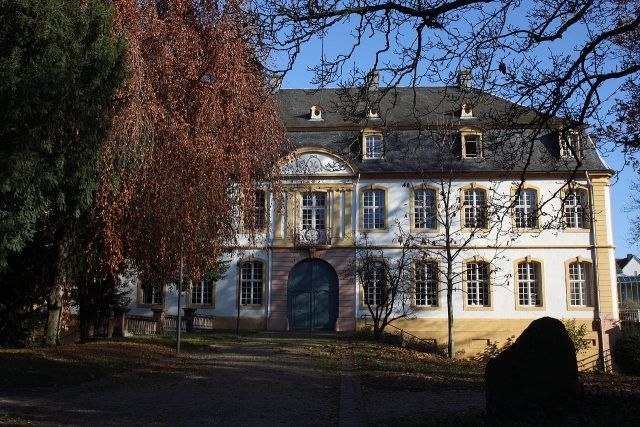
The castle was built in 1773 by the Counts of Sayn on the walls of an old castle.
Before the current baroque palace stood, a medieval fortress dominated the strategically important hill. Its origins date back to the 12th century. Over the centuries, the fortress was expanded and rebuilt several times, reflecting the changing military and architectural demands of the respective eras.
In the mid-18th century, the old fortress no longer met the representative requirements of the Counts of Sayn. They decided to demolish the dilapidated walls and erect a modern palace in their place. The construction work, which began in 1773, lasted several years. The result was an impressive baroque palace that still characterizes the townscape today.
Architectural Features and Interior Design+
The palace is a three-winged complex with a central main building and two side wings that enclose a courtyard of honor. The facade is characterized by clear lines and elegant proportions. The central risalit, crowned by a triangular gable, emphasizes the main entrance.
Inside, numerous rooms with original stucco work, frescoes and valuable furniture have been preserved. Particularly noteworthy are the "Great Hall," which served as a ballroom and banqueting hall, and the "Count's Apartment" with its richly decorated private rooms.
A Place of Culture and History+
Today, the palace houses a museum that provides insights into the history of the building and its former inhabitants. Visitors can explore the magnificent state rooms, admire historical exhibits and learn more about the life of the nobility in the 18th and 19th centuries.
In addition to the museum, the palace also regularly hosts cultural events such as concerts, exhibitions and lectures. The historic ambience provides a unique setting for these events and makes them a special experience.
The Palace Garden: A Green Oasis+
Surrounding the palace is a spacious garden that invites you to stroll and relax. The garden was laid out in the 18th century as a baroque pleasure garden and later transformed into an English landscape garden. Today, it combines elements of both styles and offers a diverse flora and fauna.
Numerous sculptures, fountains and pavilions adorn the garden and create a harmonious overall picture. From various viewpoints, visitors can enjoy picturesque views of the palace and the surrounding landscape.
Future Prospects: Preservation and Development+
The preservation of the historic building and its continuous development as a cultural and tourist attraction are central concerns. Extensive renovation measures are regularly carried out to preserve the building for future generations.
At the same time, new concepts are being developed to make the palace even more attractive to visitors. These include interactive exhibitions, digital offerings and educational programs that bring history to life in an engaging way.
Visitor Information
The palace is open to visitors all year round. Information on opening hours, admission prices and current events can be found on the official website.
Guided tours are offered regularly, providing deeper insights into the history and architecture of the palace. For groups, individual tours can also be arranged by appointment.
A small café in the palace courtyard invites you to linger and offers refreshments. The museum shop offers a selection of souvenirs, books and regional products.
Take Mobile History with you
You are reading this text for free. Premium adds what matters on the road: descriptions read aloud, sites found through your camera, whole regions taken offline.
- Every description, including the ~17,700 Premium sites
- Audio guide: have descriptions read to you on location
- AR finder: see sites through your camera, with distance and bearing
- Unlimited saved sites
14 days free, then from €2.99 a month. Cancel anytime.
Source: Wikipedia · Licence: CC BY-SA 4.0 · Image: http://de.wikipedia.org/wiki/Datei:Vallendar_Marienburg_65.JPG
This description draws on the facts documented in the linked Wikipedia article; Wikipedia content is licensed under CC BY-SA 4.0. Wording and editing: Mobile History.
Location: 50.4004, 7.6134