Museum
CastleLudwigslust
Ludwigslust Palace
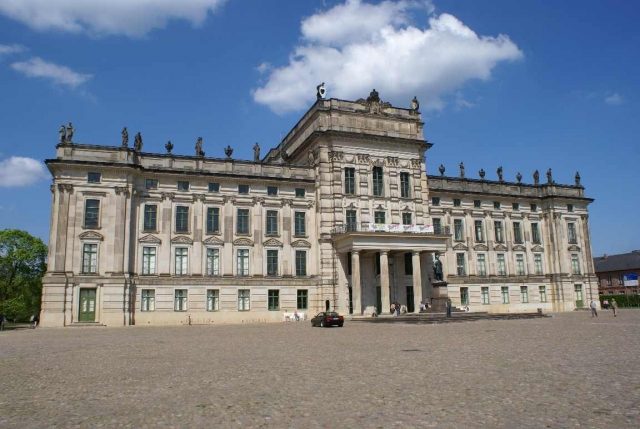
Ludwigslust Palace, a magnificent Baroque ensemble, rises in the town of the same name in the state of Mecklenburg-Vorpommern. Once the main residence of the Dukes of Mecklenburg-Schwerin, it is now an important museum and an outstanding example of Baroque architecture in Northern Germany, often referred to as the “Mecklenburg Versailles”.
History+
The palace's origins date back to the 14th century when a manor village called Klenow existed on this site. Duke Christian Ludwig II planned a hunting lodge here from 1721, but its construction was initially interrupted by conflicts with Duke Karl Leopold. After Karl Leopold's removal, construction could resume from 1731 under the direction of architect Johann Friedrich Künnecke. In 1754, the hunting lodge was named Ludwigslust. Under Duke Friedrich the Pious, Ludwigslust was expanded into the main residence from 1763. Inspired by the French Versailles, a grand palace complex with a court church and a systematically planned town was created. Construction of the residential palace, under the direction of Johann Joachim Busch, began in 1772 and was occupied in 1777. To save costs, innovative materials such as papier-mâché, the so-called “Ludwigsluster Carton”, were used. After the death of Friedrich the Pious in 1785, the Baroque garden was transformed into an English landscape garden under Friedrich Franz I. In 1837, Duke Paul Friedrich moved the court back to Schwerin, giving Ludwigslust the status of a summer residence. After World War I, the palace served as the residence of the ducal family until the end of World War II. During the GDR era, it housed district authorities before being gradually converted into a museum and renovated from 1986.
Location+
Ludwigslust Palace is located in the town of Ludwigslust in the district of Ludwigslust-Parchim, in the federal state of Mecklenburg-Vorpommern, Germany. It is situated at an elevation of approx. 42 meters above sea level.
On site+
Today, Ludwigslust Palace houses a museum that is part of the State Museum Schwerin. Visitors can explore the historic rooms and significant collections, including architectural models and busts. The palace and its extensive park are open to the public and continue to undergo restoration.
Nearby+
- Prinzpalais zu Ludwigslust (Residence), approx. 0.2 km away
- Alte Burg Neustadt-Glewe (Castle), approx. 9.1 km away
- Neues Schloss Neustadt-Glewe (Palace), approx. 9.2 km away
- Gutshaus Neese (Manor House), approx. 11.0 km away
Take Mobile History with you
You are reading this text for free. Premium adds what matters on the road: descriptions read aloud, sites found through your camera, whole regions taken offline.
- Every description, including the ~17,700 Premium sites
- Audio guide: have descriptions read to you on location
- AR finder: see sites through your camera, with distance and bearing
- Unlimited saved sites
14 days free, then from €2.99 a month. Cancel anytime.
Source: Wikipedia · Licence: CC BY-SA 4.0 · Image: Roland Neubert, Halle (Saale)
This description draws on the facts documented in the linked Wikipedia article; Wikipedia content is licensed under CC BY-SA 4.0. Wording and editing: Mobile History.
Location: 53.3248, 11.4882