Museum
CastleEdenkoben
Ludwigshöhe Castle
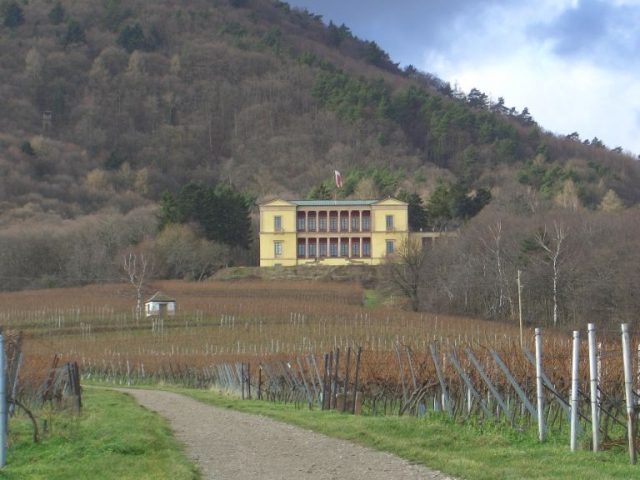
The Villa Ludwigshöhe, often simply called the Ludwigshöhe locally, near Edenkoben in Rhineland-Palatinate, is a small castle and the former summer residence of King Ludwig I of Bavaria.
West of the small South Palatinate town of Edenkoben and the municipality of Rhodt, the Villa Ludwigshöhe is located on the eastern edge of the Palatinate Forest with a wide view over the Rhine plain. The Rietburgbahn, a chairlift, runs from the valley station near the villa, where there is also a public car park, up to Rietburg on the northeast slope of the Blättersberg. The villa is accessible by motor vehicle via a paved road that leads from Edenkoben up to the Ludwigshöhe (3 kilometers) and from there down again to Rhodt (1.5 kilometers). Below the villa, the Southwest German Football Association operates its Edenkoben sports school.
Construction History+
In 1843, King Ludwig I decided to have a summer villa built in the Palatinate, which then belonged to Bavaria and from which his father Maximilian I originated. It was to be located on the edge of the Haardt mountain range. In 1845, the necessary plots of land at the foot of Rietburg were acquired from the municipalities of Edenkoben and Rhodt.
The construction of the castle, inspired by Italian designs in classical style, began with the laying of the foundation stone in 1846. The work, based on the plans of the architect Friedrich Wilhelm von Gärtner, was carried out by the master builder Joseph Hoffmann from Ludwigshafen am Rhein. The completion of the building dragged on until 1852. Initially, the architect had died in 1847, which is why Leo von Klenze had taken over the further construction management; moreover, in 1848 the king had abdicated in favor of his son Maximilian II.
Ludwig I stayed in the villa every two years during the summer months of July and August, where he also celebrated his birthday. His last visit to the villa dates from 1866.
Building+
Originally, the building ensemble included, in addition to the Königsbau, as the actual castle is also called, a Cavalier's building and a stable. The Cavalier's building is still present, the stable is no longer.
The two-story main house consists of four cuboid buildings grouped at right angles around an atrium towards the cardinal directions. The east-facing front of the main house is vertically structured by two superimposed rows of columns. While the lower row features Doric columns, the upper row consists of columns of the Ionic order. On the north side, a veranda is attached, resembling a covered terrace.
The Pompeian wall paintings by Joseph Schwarzmann in various of the villa's 62 rooms are preserved to this day; the mosaic floors based on Roman models have also survived. In 1899, Adalbert Hock from Aschaffenburg repainted the walls of the dining room with Pompeian motifs.
Usage+
Especially for visits by the former Bavarian king, the Edenkoben station, opened in 1855 on the Palatinate Maximilian Railway, received a large reception building that was based on the architectural style of the villa. During the National Socialist era, to promote tourism, a 1.8-kilometer branch line of the Palatinate Oberlandbahn was built, connecting the Edenkoben depot of the interurban tram with the Villa Ludwigshöhe. The line was opened on April 9, 1936. It was shut down again on May 17, 1954, after the gradual discontinuation of the Oberlandbahn had begun.
In 1975, the state of Rhineland-Palatinate acquired the castle from the Wittelsbach family for 1.9 million DM and restored it at a cost of 5.7 million DM. It is used for concerts, especially in cooperation with the Villa Musica Foundation. In addition, the villa houses the Max Slevogt Gallery, scientifically supervised by the Mainz State Museum, with 130 works. Changing exhibitions of paintings are also organized. In 2007, the Hinder/Reimers collection with 1588 ceramic exhibits from the 20th century found its permanent home in the vaulted cellar. Since the same year, an open-air café located to the southeast is open on weekends and public holidays in good weather, offering guests a view of the Rhine plain.
The Villa Ludwigshöhe is open during the summer half-year from April to September inclusive, except Mondays, with hourly guided tours. The number of annual visitors is 40,000 people. The castle administrator is Andreas Spieß, who was entrusted with this task by the General Directorate for Cultural Heritage Rhineland-Palatinate in 2002.
Every year at the end of August, King Ludwig I's birthday is celebrated with the castle festival.
Take Mobile History with you
You are reading this text for free. Premium adds what matters on the road: descriptions read aloud, sites found through your camera, whole regions taken offline.
- Every description, including the ~17,700 Premium sites
- Audio guide: have descriptions read to you on location
- AR finder: see sites through your camera, with distance and bearing
- Unlimited saved sites
14 days free, then from €2.99 a month. Cancel anytime.
Source: Wikipedia · Licence: CC BY-SA 4.0 · Image: http://de.wikipedia.org/wiki/Datei:Schloss_Villa_Ludwigsh%C3%B6he.jpg
This description draws on the facts documented in the linked Wikipedia article; Wikipedia content is licensed under CC BY-SA 4.0. Wording and editing: Mobile History.
Location: 49.2770, 8.0872