The Castle can be visited
CastleKassel
Löwenburg Castle (Kassel)
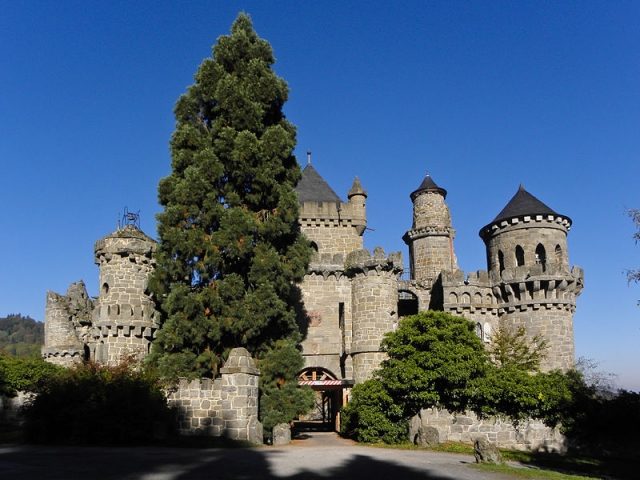
The Löwenburg is a pleasure palace built from 1793 onwards in Kassel's Wilhelmshöhe Mountain Park.
The castle, built as an artificial castle ruin, stands above Wilhelmshöhe Palace in the southern part of the Mountain Park and thus south of the Wilhelmshöhe Palace-Hercules line of sight at approximately (350 m above sea level) on the eastern edge of the Hoher Habichtswald. The Löwenburg served its builder Landgrave Wilhelm IX of Hesse-Kassel as a private retreat and is also his burial place. In terms of art history, the complex is considered groundbreaking, as one of the first significant buildings of Neo-Gothic architecture in Germany.
The castle, modeled after a hilltop castle, was built according to designs by Heinrich Christoph Jussow between 1793 and 1801, centuries after the actual construction phase of castles in Germany. It is an imitation of a medieval knight's castle and was deliberately built as an artificial ruin, romanticizing history. Initially planned only as a ruinous tower with an outbuilding, a complete castle complex eventually emerged, grouped around an inner courtyard. The complex served as a residence for the Landgrave and his beloved Karoline von Schlotheim. In 1821, he was finally buried himself in a crypt beneath the castle chapel. From the beginning, the Löwenburg was built from Habichtswald tuff, which is not very weather-resistant, but was available near the construction site and easy to work with.
Second World War and its Consequences
Until 1945, the Royal Air Force carried out several attacks on the city of Kassel, which was important for the National Socialist war economy due to its armaments industry. The keep of the Löwenburg was largely destroyed (only the stair tower with some wall remains survived) and large parts of the complex were severely damaged. The reconstruction in the post-war years was rather pragmatic and characterized more by functionality than by fidelity to detail. The work is still not completed. The keep has not been rebuilt, but this is intended for the coming years.
Furnishings+
The interiors consist of four princely living apartments in a Baroque style. An armory contains numerous historical weapons and plate armor from the 16th and 17th centuries. The castle chapel is equipped with numerous objects from medieval churches in the North Hessian region and has a crypt with the Landgrave's tomb under the choir. Numerous furnishings from the historical collection, which were evacuated during the war, are still in depots or on display at Friedrichstein Castle. Their return is only planned once the reconstruction of the castle is complete. The interiors can be visited as part of guided tours.
Take Mobile History with you
You are reading this text for free. Premium adds what matters on the road: descriptions read aloud, sites found through your camera, whole regions taken offline.
- Every description, including the ~17,700 Premium sites
- Audio guide: have descriptions read to you on location
- AR finder: see sites through your camera, with distance and bearing
- Unlimited saved sites
14 days free, then from €2.99 a month. Cancel anytime.
Source: Wikipedia · Licence: CC BY-SA 4.0
This description draws on the facts documented in the linked Wikipedia article; Wikipedia content is licensed under CC BY-SA 4.0. Wording and editing: Mobile History.
Location: 51.3114, 9.4086