Cultural Events
CastlePotsdam
Lindstedt Castle
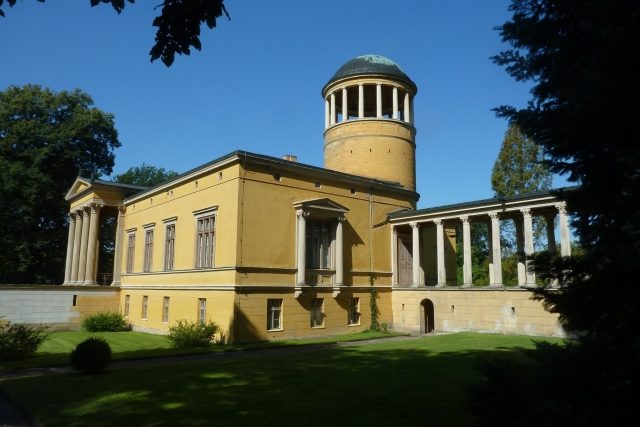
Lindstedt Palace is a palace belonging to the ensemble of palaces and gardens of Potsdam, which was built under Frederick William IV from 1858 to 1861.
The Lindstedt estate belonged to ancestors of Loriot (Vicco von Bülow) from 1803 to 1828, from whom Frederick William III acquired it in 1828 as a small country estate. This served for carp breeding, and remnants of the pond systems are still present today. The property is located northwest, about 800 m from the New Palace, directly on Lindstedter Chaussee.
Already since the purchase of the Lindstedt estate, Frederick William IV first dealt with plans for a retirement residence at this location. For decades, he participated in the planning for the conversion of the house with over 100 drawings.
The baroque outwork was to become a magnificent antique-style villa. Ultimately, only a minimal variant of the project was realized.
Despite the involvement of Ludwig Persius, Ludwig Ferdinand Hesse, August Stüler, and Schinkel's pupil Ferdinand von Arnim, the planning stretched over many years.
Description+
The late-classical complex consists, in addition to the main building, of a tower with a superimposed belvedere and a temple-like annex with a high flight of stairs. A colonnade connects the building with Lindstedter Chaussee and establishes a connection to the landscape. The mentioned building parts appear disjointed in their entirety and reflect the builder's longing for Italian classicism.
The regular garden designed by Lenné offers perspectives on the palace and views of the landscape.
Due to its elevated position, there is a view of the domes of the New Palace building ensemble.
Usage+
It is said that Frederick William IV had the palace built as a retirement residence. Whether this would ever have come to pass is questionable, however. After the king's death, the palace belonged to the inheritance of the queen dowager. Only his successor and brother William I had the construction completed.
Later, the property was leased to various state officials. During the reign of Emperor William II, the palace also served as a quarantine station during cholera and tuberculosis epidemics. Thus, some of the imperial family's children were educated at Lindstedt Palace.
After 1918, Hindenburg left the palace to the former Chief of the General Staff Erich von Falkenhayn as a hereditary lease. He died there in 1922, with his family continuing to live in the palace until 1944. Erich von Falkenhayn was buried in the nearby Bornstedt Cemetery.
Inhabited by private individuals until the 1950s, Lindstedt served the Botanical Institute of the Potsdam University of Education in the 1950s and the Institute of Forensic Medicine in Potsdam since the 1980s.
Since 1996, the palace has been managed by the Prussian Palaces and Gardens Foundation Berlin-Brandenburg and belongs to the overall ensemble of palaces and parklands in the Potsdam-Berlin cultural landscape, which has been under UNESCO World Heritage protection since 1990.
Today it serves for events of various kinds and can be rented from the SPSG.
For the film Resident Evil, the palace served as a backdrop for the entrance to a secret underground laboratory complex.
Take Mobile History with you
You are reading this text for free. Premium adds what matters on the road: descriptions read aloud, sites found through your camera, whole regions taken offline.
- Every description, including the ~17,700 Premium sites
- Audio guide: have descriptions read to you on location
- AR finder: see sites through your camera, with distance and bearing
- Unlimited saved sites
14 days free, then from €2.99 a month. Cancel anytime.
Source: Wikipedia · Licence: CC BY-SA 4.0 · Image: Joachim Schneeleopard
This description draws on the facts documented in the linked Wikipedia article; Wikipedia content is licensed under CC BY-SA 4.0. Wording and editing: Mobile History.
Location: 52.4100, 13.0108