To be privately owned
CastleLimberg
Limberg Castle
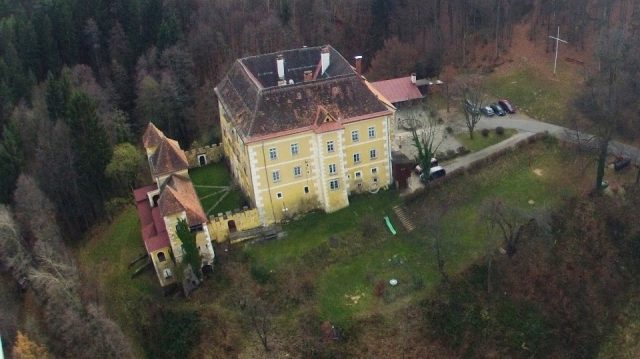
The predecessor of today's building was a fortified house, which was probably erected towards the end of the 12th century. The builders may have been the Leibnitzer. In any case, they were Salzburg ministeriales. A castle is first mentioned in a document from 1244 under the name Lindenperch.
In 1279, a part of the castle belonged to Hartnit von Leibnitz, who sold a quarter share to Otto Ungnad von Weißenwolf. The following year, with the consent of the Archbishop of Salzburg, he succeeded in acquiring the remaining lordship from Haertlein von Vinchenstein and retaining it as a free allod. Towards the end of the 13th century, Otto pledged the castle to the Bishop of Seckau, who finally bought it in 1300.
Just five years later, the diocese sold the house Lindenberch to Hartnid von Pettau, who had it administered by his ministeriales. After their extinction around the middle of the 14th century, the related Metnitzer family was entrusted with the fief. After the extinction of the Pettau family in 1438, the Habsburgs became the feudal lords. Even under them, the Metnitzers were able to keep the castle. The already outdated fortified building Limberg was converted into a contemporary Renaissance residence. After Andreas Metnitzer's death in 1590, Limberg fell to the Carinthian main line of the Metnitzer family.
In 1602, the castle passed to Kaspar Kempinski. In 1648, Georg Christian Graf Saurau, who owned the neighboring Schwanberg, bought the lordship. Graf Saurau handed over the castle to Maria Rosina von Falbenhaupt, who was related to the Kempinskis by marriage. In 1659, the lordship was pledged to the administrator of Limberg and Schwanberg, Martin Mayer, and sold in 1663. In 1661, the castle passed to Johann Urban von Grattenau. Johann Urban had a large-scale renovation of the castle carried out.
His heirs sold the lordship in 1682 to Johann Heinrich von Jarizburg. He could not pay the purchase price but also did not want to leave the castle. Only in 1720 did Johann Heinrich von Jarizburg give up and leave the castle, which had already become a semi-ruin. Ortenhofen received the princely fief in 1730 and had his manorial seat splendidly furnished. In 1820, Johann I Prince of and to Liechtenstein bought Limberg, in whose family it remained until 1933. Then it came into the possession of the Styrian Youth Welfare Organization. In 1938, Steirische Versicherungs AG acquired the castle and had the interiors modernized.
After the end of the war, Limberg was first occupied and plundered by Bulgarians and then by Tito partisans. In 1948, the "Jugendhilfe" (Youth Welfare) received its holiday home back. Today, the castle belongs to the Association Styrian Youth Welfare and is used as a scout center.
Take Mobile History with you
You are reading this text for free. Premium adds what matters on the road: descriptions read aloud, sites found through your camera, whole regions taken offline.
- Every description, including the ~17,700 Premium sites
- Audio guide: have descriptions read to you on location
- AR finder: see sites through your camera, with distance and bearing
- Unlimited saved sites
14 days free, then from €2.99 a month. Cancel anytime.
Source: Wikipedia · Licence: CC BY-SA 4.0 · Image: http://www.wehrbauten.at
This description draws on the facts documented in the linked Wikipedia article; Wikipedia content is licensed under CC BY-SA 4.0. Wording and editing: Mobile History.
Location: 46.7432, 15.2105