Nursing home
CastleVienna (Wien)
Liesing Castle
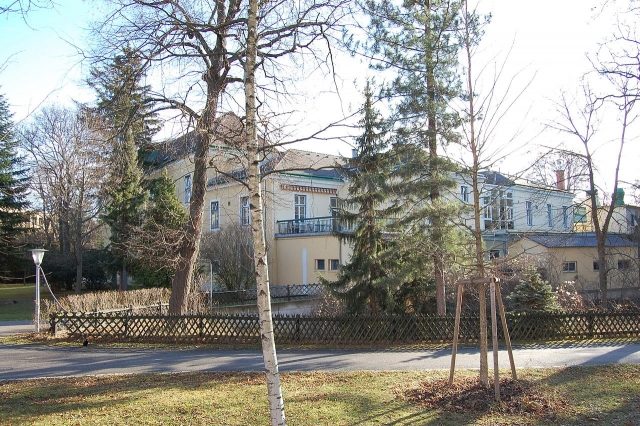
Liesing Castle is located in the 23rd district of Vienna, Liesing, at Perchtoldsdorfer Straße 6. It was surrounded by a large park. The former moated castle has not been preserved in its entirety.
Liesing Castle was first mentioned in a document in 1387 as an estate named "Hausgraben" or "Auhof". From 1415 to 1435, it was owned by the local judge Georg Zeitlas and subsequently belonged to the pastor Andreas Plank von Gars, later Chancellor of Albrecht II. He gifted the estate to the Dorotheerkloster in Vienna. The two Turkish sieges in 1529 and 1683 severely damaged the estate. During the Second Siege of Vienna by the Turks, it was almost completely destroyed. According to a legend, only the hazelnut tree in the castle park was spared. This legend also served as the inspiration for the Liesing coat of arms, which shows a three-leaved hazelnut branch with four fruits above a blazing fire and the year 1683.
The estate was rebuilt soon after. At the beginning of the 18th century, it was expanded into a castle, where Emperor Charles VI presumably also stayed. After the now-castle was relinquished by the church, it first fell to Joseph Edler von Kurzböck and in 1732 to the court jeweler Valentin von Mack. His descendants, however, went bankrupt with the business and finally sold the castle in 1848 to Moriz Mandeles, who tried to rent out the property. For a time, around 1857, a care facility for mentally disabled children was housed here. Friedrich, the son of Moriz Mandeles, finally had to sell Liesing Castle to the City of Vienna in 1876 due to lack of money. The city converted the castle into an old people's home. Liesing Castle is still owned by the City of Vienna today and houses the Liesing Geriatric Center.
From October 12, 1924, to September 5, 1925, Liesing Castle and its properties formed a separate local municipality, Neu-Liesing.
Between 2009 and 2012, the City of Vienna built a new building for the Geriatric Center for 67 million Euros, which occupies more than a third of the park area. Already in July 2006, a citizens' initiative "Save Liesing Castle Park" was founded with the intention of saving the park and the castle. During construction work for the redesign of the castle as a geriatric center, a historic wall was found but destroyed by the construction work. It was 4–5 m deep and extended for 50 m.
Take Mobile History with you
You are reading this text for free. Premium adds what matters on the road: descriptions read aloud, sites found through your camera, whole regions taken offline.
- Every description, including the ~17,700 Premium sites
- Audio guide: have descriptions read to you on location
- AR finder: see sites through your camera, with distance and bearing
- Unlimited saved sites
14 days free, then from €2.99 a month. Cancel anytime.
Source: Wikipedia · Licence: CC BY-SA 4.0 · Image: http://commons.wikimedia.org/wiki/File:Schloss_Liesing.JPG
This description draws on the facts documented in the linked Wikipedia article; Wikipedia content is licensed under CC BY-SA 4.0. Wording and editing: Mobile History.
Location: 48.1339, 16.2798