Cultural Events
CastleKobern-Gondorf
Liebieg Castle
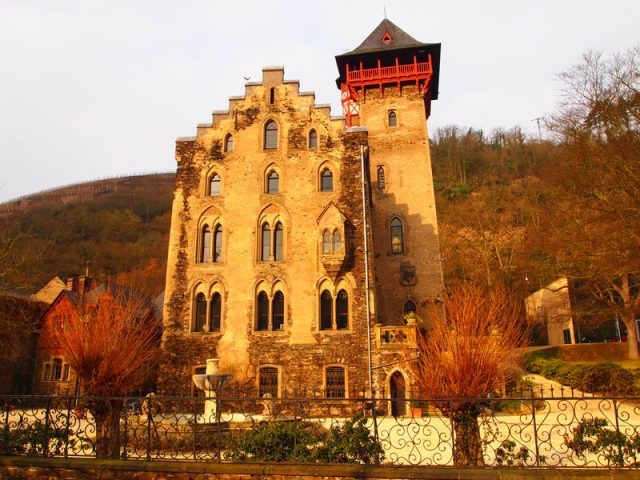
Since the end of the 19th century, Niederburg in Gondorf on the Moselle in Rhineland-Palatinate has been known as Schloss Liebieg (also Schloss Liebig). The castle is a protected cultural monument under the Monument Protection Act (DSchG) and is listed in the monument list of the state of Rhineland-Palatinate.
Knight Marsilius von Gondorf, Schultheiß in Trier and Münstermaifeld, presumably had a castle built on the site of the present castle between 1255 and 1272. Marsilius from the Koblenz patrician family von der Arken acquired the complex in 1322/36. From 1493 to 1762, the Eifel noble family Muhl von Ulmen owned the castle before it was inherited by the Lords von Hees.
After the nationalization of the castle ruins at the end of the 18th century by the French administration, the complex came into the possession of the Koblenz merchant Haßlacher through auction, and in 1830 to the Koblenz banker Simon Clemens. Johann Peter Clemens had it converted into a neo-Gothic country estate by the Cologne architect Vincenz Statz in 1859/60. Around 1900, a Neo-Romanesque extension was added by the von Liebieg family.
Johann Peter Clemens' daughter Angelika married Baron and Imperial Councillor Theodor von Liebieg, who came from Reichenberg in Bohemia, in 1879. Through her, the so-called Niederburg came into the possession of the von Liebieg family and later received their name. At the end of the 19th century, under the leadership of Theodor's younger brother Heinrich, the company, consisting of textile, porcelain, chemical, and mechanical engineering factories, among others, was the largest in the Habsburg Danube Monarchy. The Liebiegs, ennobled in 1868, were among the very wealthy families in Europe and became known as art collectors and patrons (see also Liebieghaus in Frankfurt am Main). Together with his wife Angelika, Theodor was a promoter and member of the Rhenish Historical Society, a society of Rhenish nobility and propertied bourgeoisie to strengthen Rhenish identity in the Prussian-dominated Rhineland.
Angelika von Liebieg was a dedicated amateur archaeologist and collector of medieval artworks. Large parts of her collection of excavation finds (around 1400 graves of the Roman-Germanic mixed population from the Migration Period and the early Middle Ages were uncovered in the castle park between 1878 and 1890) and artworks (crafts, sculptures, stained glass) from the 13th to 18th centuries, housed in the castle, were sold from the 1930s onwards, including to the Hessian State Museum Darmstadt. The last pieces of the collection and interior furnishings went into the art and antiques trade in 1972. After the economic decline of the von Liebieg family, particularly due to the expropriation of their possessions in the former Czechoslovakia, the castle was subject to changing uses.
Since the early 1990s, the complex has been in private ownership and is used for events and the presentation of antiques, modern furniture, and art.
The chapel built in the park in 1892 originally served as the burial place for the von Liebieg family. In 2010, the Federal Constitutional Court ruled that the prohibition of the demolition of the castle chapel, which had been legally separated from the property, was lawful for reasons of monument protection.
Architectural Development+
The appearance of the medieval estate before its transformation in 1859/60 is documented, among other things, by a drawing made in 1841 by the archivist Leopold von Eltester. According to this, the side facing the Moselle had a three-story main building above a cellar. Immediately adjacent was a narrow, square tower, which received an upper floor with a hip roof and a gallery during the renovation in 1859/60.
Take Mobile History with you
You are reading this text for free. Premium adds what matters on the road: descriptions read aloud, sites found through your camera, whole regions taken offline.
- Every description, including the ~17,700 Premium sites
- Audio guide: have descriptions read to you on location
- AR finder: see sites through your camera, with distance and bearing
- Unlimited saved sites
14 days free, then from €2.99 a month. Cancel anytime.
Source: Wikipedia · Licence: CC BY-SA 4.0 · Image: http://www.wehrbauten.de/thread.php?threadid=612
This description draws on the facts documented in the linked Wikipedia article; Wikipedia content is licensed under CC BY-SA 4.0. Wording and editing: Mobile History.
Location: 50.2938, 7.4610