Golf club
Hotel
CastleNeckarwestheim
Liebenstein Castle
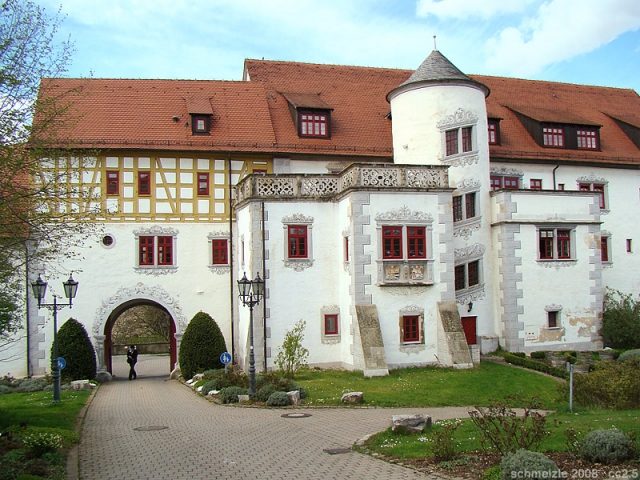
Liebenstein Castle, south of Neckarwestheim in the Heilbronn district in northern Baden-Württemberg, dates back to the medieval castle of the Lords of Liebenstein. It came into the sole possession of Württemberg in 1678 and into the possession of the municipality of Neckarwestheim in 1982. The complex is now used by a golf club.
Liebenstein Castle is located about one kilometer south of Neckarwestheim on a narrow, steeply sloping ridge. The Neckar valley runs two to three kilometers west of the castle hill. The Neckarwestheim nuclear power plant is located northwest between the castle and the Neckar.
Seat of the Lords of Liebenstein
A branch of the Lords of Liebenstein came from southern Alsace in the course of the 11th century, where they had their ancestral seat, which fell to the Counts of Pfirt around 1300. The oldest verifiable ancestor of the Neckarwestheim line is Reinhard von Liebenstein, mentioned around 1200, to whom and whose son Albrecht I, the construction of the oldest part of Liebenstein Castle near Neckarwestheim on former possessions of the Counts of Lauffen, who died out in 1212, is probably attributed between 1200 and 1250. According to dendrochronological investigations, the keep, as the oldest part of the castle, was built between 1230 and 1240.
Around the Lower Castle with its western main building and keep in Romanesque style, for which there was little space on the narrow ridge, a moat and a curtain wall with battlements were drawn. In 1225, the Itzinger Hof in the nearby Seebronnental was built. Shortly before his death, Albrecht I, with the consent of his son Albrecht II, founded a Dominican nunnery at Itzinger Hof in 1261, which was also the burial place of the Lords of Liebenstein until 1666. Around 1290, the Itzingen monastery merged with the Benedictine nunnery in Lauffen.
Under the sons of Albrecht II, several family lines emerged. From Konrad I († 1363) descended the Ottmarsheim line, the Heinrich line, and the line of the upper and lower houses, the latter named after their shares in Liebenstein Castle and formed during the division of inheritance after the death of Peter I in 1445 between his sons Peter II and Konrad. In 1500, Peter III von Liebenstein was the progenitor of the upper house, Hanns III the progenitor of the lower house.
The upper castle was extensively rebuilt between 1525 and 1600 into its present appearance with a distinctly residential character. Hall-like rooms, roof terraces, a stair tower, bay windows, a castle kitchen, a house chapel, as well as the outbuildings Zehntscheuer (tithe barn), Meierei (dairy), Fruchtkasten (granary), Altes Bandhaus (old cooperage), Neues Bandhaus (new cooperage), Schmiede (forge), Backhaus (bakehouse), Schafhaus (sheepfold), and Heubäulein (small hay barn) in picturesque Renaissance architecture gave the estate a representative character.
From 1590 to 1599, the castle chapel was built in Renaissance style on behalf of Bernhard von Liebenstein († 1596) by the Heilbronn master builder Jacob Müller. He also created the Liebenstein double tomb in the Bönnigheim church on behalf of Bernhard's son Albrecht († 1608). The tomb of Conrad von Liebenstein († March 4, 1620) in the castle chapel was once in Itzingen Monastery.
Most of the secular Liebenstein family members were mostly in Württemberg service: Friedrich I and Hans V were Württemberg councillors in the 15th century, Bernhard († 1596) and Albrecht († 1608) were chief bailiffs in Lauffen am Neckar, Philipp († 1637, upper house) was Württemberg chief bailiff in Vaihingen an der Enz. Emperor Ferdinand confiscated part of the upper castle in 1631 because Philipp had too strongly supported the Swedes in the Battle of Nördlingen. After the castle briefly belonged to the Count of Trauttmannsdorff, who was the emperor's leading minister after Wallenstein's death, the upper castle was returned to the Lords of Liebenstein in 1639.
With the death of Friedrich Albert von Liebenstein in 1657, the male line of the upper branch died out. The estates were inherited by Philipp Konrad I of the lower house, who thus united the entire family property. His three sons Philipp Reinhard, Philipp Konrad II, and Philipp Albrecht formed a community of heirs in 1666. After the death of Philipp Reinhard, the eldest of the brothers, a dispute arose around 1670 between Philipp Konrad II and Philipp Albrecht, which led to the owner of the lower house no longer leaving through the upper gate, but having a gate for a path into the valley cut through the wall next to the castle chapel himself.
Sole possession of Württemberg from 1678
On September 4, 1673, Philipp Albrecht sold the upper castle, about two acres of the lake, and half of the lordship to Duke Eberhard III of Württemberg (1628–1674) for 50,000 guilders and 230 ducats. On May 28, 1678, Philipp Konrad II exchanged his remaining half of the lordship and the lower castle with the House of Württemberg for the other half of the village of Köngen near Esslingen with its front castle and all appurtenances, plus an additional 13,000 guilders. Duke Eberhard III paid as buyer from his private purse and was the owner of the entire Liebenstein lordship with Liebenstein Castle, Kaltenwesten, Ottmarsheim, Itzingen monastery and hamlet, half of Holzweiler, as well as estates and revenues in Ilsfeld and Auenstein. Württemberg established a staff cellar there to administer the property. In 1773, the Liebenstein family tried in vain to contest the sale of the Liebenstein lordship from 1673/78 through a sensational lawsuit.
During the War of the Palatine Succession, around 5000 French soldiers advanced on Besigheim in 1693. The bailiff of Besigheim had stored some of his documents at Liebenstein Castle. The plundering soldiers found all the documents and destroyed them.
Around 1800, the House of Württemberg attempted to sell the castle chapel for demolition. Since no buyer was found, the chapel was left to decay. In 1807, the remains of the Itzinger Hof were sold for demolition.
On June 8, 1812, the Liebenstein domain was ceded to the Oberfinanzkammeramt of Großbottwar through an exchange agreement. The contract was already reversed in 1819. The royal Hofdomänenkammer (Court Domain Chamber) again administered the estate and leased the property with 390 acres of land for 4765 guilders annually to two farmers. At that time, the castle consisted of two buildings. The two tenants lived in the former hunter's house, the other building was the residence of the court chamber forester. The remaining buildings on the estate were used as dwellings for employees and as stables. The royal Hofdomänenkammer also took over the Itzinger Hof with another 107 acres of land in 1846/49.
In September 1840, the Swabian poet Eduard Mörike visited Liebenstein Castle. In 1843, Liebenstein became a member of the Neckarwestheim church and school association. In 1851, the tenants committed to training twelve poor boys as farmhands. These had to work unpaid from the age of 14 to 18 and received free board, clothing, and lodging.
In 1884, the court chamber's forestry office was housed in parts of the castle. In the remaining part lived two families with a total of 43 people. The agricultural domain was managed at that time, according to the report of the then mayor, by approximately 60 to 80 workers. In 1892, the number of castle residents was still 23.
In 1914, the front exterior of the castle chapel was renovated.
On April 12, 1945, French artillery shelled the castle, which was occupied by German soldiers, from the direction of Bönnigheim. Of six shells, four hit the tower and two hit the castle building, but without injuring anyone. After the Second World War, the castle and its outbuildings offered a new home to 46 displaced persons.
The dilapidated castle chapel was thoroughly renovated from 1972 to 1976.
Possession of the Municipality of Neckarwestheim since 1982
In 1982, the Hofkammer sold the castle and 14.5 hectares of land to the municipality of Neckarwestheim, which transferred it to the Trägerverein Schloss Liebenstein Sport-, Kultur- und Freizeitanlagen GmbH und Co. KG. On September 14, 1982, the Golf- und Landclub Schloss Liebenstein e. V. was founded, and the development of the grounds into a 27-hole golf course began.
After a thorough building survey, the renovation and conversion of the upper castle into a hotel and restaurant, along with the golf club's club rooms, followed until 1985. The keep was restored and made accessible in 1987. 110 steps lead to the observation platform.
Take Mobile History with you
You are reading this text for free. Premium adds what matters on the road: descriptions read aloud, sites found through your camera, whole regions taken offline.
- Every description, including the ~17,700 Premium sites
- Audio guide: have descriptions read to you on location
- AR finder: see sites through your camera, with distance and bearing
- Unlimited saved sites
14 days free, then from €2.99 a month. Cancel anytime.
Source: Wikipedia · Licence: CC BY-SA 4.0 · Image: https://commons.wikimedia.org/wiki/File:Schloss-liebenstein-001.jpg
This description draws on the facts documented in the linked Wikipedia article; Wikipedia content is licensed under CC BY-SA 4.0. Wording and editing: Mobile History.
Location: 49.0365, 9.1941