Conference center
CastleLöwenberger Land - Liebenberg
Liebenberg Castle
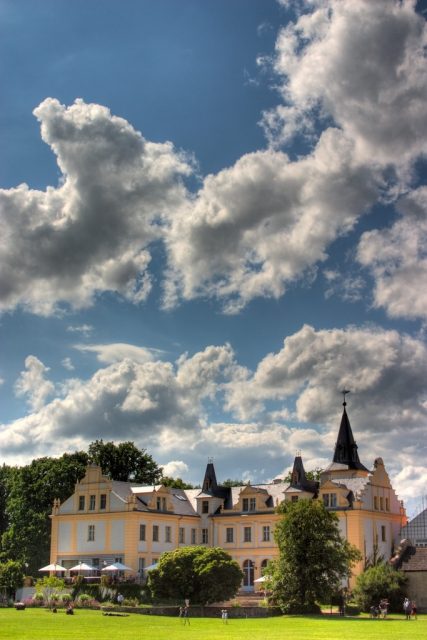
Liebenberg Castle is a former manor house in the north of the state of Brandenburg. It is located in the Liebenberg district of the municipality of Löwenberger Land.
Until the End of the Second World War
The noble family von Bredow developed Liebenberg into a knight's estate in the 16th century. From 1652, the Cleves noble family von und zu Hertefeld brought the estate to prosperity. The castle emerged from a manor house built no later than 1743, which was extended in a historicizing style between 1875 and 1906. The former Baroque garden was transformed into a landscape park in the 19th century, based on designs by Peter Joseph Lenné. In 1908, the Seehaus (Lake House) was added. The basis for the agricultural use of the surroundings has been attributed to the Cleves chief huntsman Jobst Gerhard von und zu Hertefeld since the 17th century, whom Theodor Fontane described in volume five, "Castles of the Wanderings through the Mark Brandenburg," as "epoch-making for the cultural history of the Mark."
The most famous Liebenberg lord of the castle, Philipp Fürst zu Eulenburg und Hertefeld, was a diplomat and close confidant of Emperor Wilhelm II. In the Liebenberg forests, known for their abundance of game, they hunted together until Eulenburg fell victim to a campaign by the anti-monarchist journalist Maximilian Harden, who accused him of homosexuality (Harden-Eulenburg Affair).
During the Nazi era, Hermann Göring came as a guest to hunt. Libertas Schulze-Boysen, granddaughter of Philipp zu Eulenburg, married Harro Schulze-Boysen in the castle church on July 16, 1936. The couple belonged to the Red Orchestra resistance group.
Era of Socialism
After the end of the Second World War, Liebenberg belonged to the Soviet Occupation Zone. Liebenberg Castle and the entire estate were expropriated without compensation and transferred by the Soviet Military Administration in Germany to the Socialist Unity Party of Germany (SED). The castle was converted into apartments, apprentice accommodations, offices, storage, a hairdresser's salon, a doctor's office, and a kindergarten. The castle chapel was used by the management for celebrations. As an SED party enterprise, the estate had to supply the corresponding organizations in East Berlin.
The attractive Seehaus had been a restricted area since the late 1940s and was guarded by the Feliks Dzierzynski Guard Regiment. The property received its own electricity and water supply and a direct telephone line to East Berlin. It was a holiday resort for the Central Committee of the SED and hosted, among others, Wilhelm Pieck, Otto Grotewohl, Walter Ulbricht, a Soviet ambassador, and state guests. The Liebenberg Forest was declared a state hunting ground in 1964. In the era of Erich Honecker since 1971, only subordinate or former members of the Central Committee came to the Seehaus for holidays, which was guarded by a special unit of the German People's Police.
In the course of the Wende and peaceful revolution in the GDR, demonstrators marched in front of the Seehaus in December 1989, demanding access ("We want in," "We are the people"), which was granted to a delegation.
Since German Reunification
In 1991, the Treuhandanstalt took over the estate and put it up for sale in 1996. The residents of Liebenberg were allowed to purchase the houses they inhabited. Around the turn of the millennium, Deutsche Kreditbank (DKB) took over the remaining estate property. The castle became a hotel and the Seehaus a conference center; a gallery, museum, and farm shop were established on the estate. The fields are leased. In 2005, the DKB-Stiftung für gesellschaftliches Engagement (DKB Foundation for Social Engagement) took over the estate. It maintains it according to the principles of monument preservation and "promotes art, music, historical documentation, science, and education here."
Take Mobile History with you
You are reading this text for free. Premium adds what matters on the road: descriptions read aloud, sites found through your camera, whole regions taken offline.
- Every description, including the ~17,700 Premium sites
- Audio guide: have descriptions read to you on location
- AR finder: see sites through your camera, with distance and bearing
- Unlimited saved sites
14 days free, then from €2.99 a month. Cancel anytime.
Source: Wikipedia · Licence: CC BY-SA 4.0 · Image: http://commons.wikimedia.org/wiki/File:HDR_Schloss_Liebenberg.jpg?uselang=de
This description draws on the facts documented in the linked Wikipedia article; Wikipedia content is licensed under CC BY-SA 4.0. Wording and editing: Mobile History.
Location: 52.8943, 13.2586