Cultural facilitie
CastleGränichen
Liebegg Castle
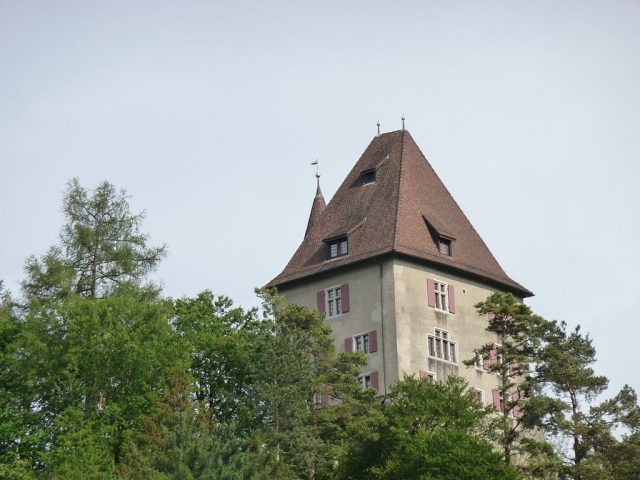
Liebegg Castle is a small castle south of Gränichen in the canton of Aargau, Switzerland. It is located on a 70-meter-high rocky outcrop above the Wynental valley at an altitude of 510 m above sea level and originated from a medieval castle. Next to Liebegg Castle is the cantonal agricultural vocational school, which opened in 1958.
The castle was built during the second half of the 12th century, when a branch of the Lords of Trostburg split off and established a new ancestral seat at a distance of only half a kilometer. These Lords of Liebegg, first mentioned in 1241, were a ministerial family of the Counts of Habsburg-Laufenburg, later of the main Habsburg line. The first building was replaced by the "new castle" in the second half of the 13th century.
The Liebegg dominion included the village of Gränichen, Schöftland Castle with its associated dominion, the lower court over Birrwil, and the church patronage in Schöftland and Birrwil. From 1318 to 1371, the Knights of Glarus from Zurich held half of the dominion. From 1415, Liebegg was under the rule of the city of Bern.
The Liebegg family died out in 1433, and their property passed by inheritance to the Lords of Luternau. These were an old noble family from Luthern near Willisau and, from the 16th century, belonged to the most influential families in the city of Bern. In 1596, Augustin von Luternau was in financial difficulties: he sold the usage rights to the forest to the villagers of Gränichen and the castle to the city of Brugg. Only two months later, however, he bought the castle back.
In 1602, the distinguished Escher family from Zurich acquired the Liebegg dominion. In 1616, they were followed by the Graviseth family from Heidelberg. From 1668 to 1709, the dominion was owned by the closely related Lords of Landenberg and returned to the Graviseth family through an exchange. Through marriage to a Graviseth daughter, Liebegg came into the possession of the influential von Diesbach family from Bern in 1764.
After the French invasion in March 1798, the Diesbachs lost their dominion rights, and the castle became purely real estate. After the industrialist Hunziker family from Aarau bought the castle in 1875, it underwent a thorough renovation until 1907. In 1946, the castle became the property of the Canton of Aargau and today serves as a conference and cultural center.
Buildings+
The double castle complex today shows no visible parts from the Middle Ages. At the highest point of the hill spur was once the "old castle," which was separated by a moat from the slightly lower "new castle." In place of the old castle, the "Luternauhaus" was built in 1561/62, a residential building in the late Gothic style. It has only partially survived, as the south wing had to be demolished in the 19th century due to dilapidation. The "new castle" was completely redesigned in 1617/18 and converted into a Baroque residential castle. During an earthquake in 1817, the west wall of the residential wing collapsed and had to be rebuilt a few meters back. This part has a classical style.
Take Mobile History with you
You are reading this text for free. Premium adds what matters on the road: descriptions read aloud, sites found through your camera, whole regions taken offline.
- Every description, including the ~17,700 Premium sites
- Audio guide: have descriptions read to you on location
- AR finder: see sites through your camera, with distance and bearing
- Unlimited saved sites
14 days free, then from €2.99 a month. Cancel anytime.
Source: Wikipedia · Licence: CC BY-SA 4.0 · Image: http://commons.wikimedia.org/wiki/File:Castle_of_Liebegg.JPG?uselang=de
This description draws on the facts documented in the linked Wikipedia article; Wikipedia content is licensed under CC BY-SA 4.0. Wording and editing: Mobile History.
Location: 47.3363, 8.1177