Museum
Apartments
CastleLichtenberg
Lichtenberg Castle
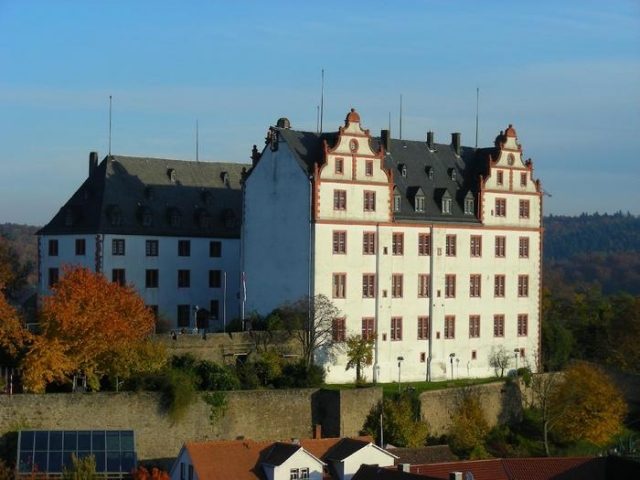
Lichtenberg Castle is located in the South Hessian municipality of Fischbachtal, in the district of Lichtenberg, at an altitude of 278 m.
In the 12th century, the Counts of Katzenelnbogen built a medieval castle on the site now occupied by the castle. A documented mention of Lichtenberg Castle dates back to 1228: Count Diether IV of Katzenelnbogen still called himself comes (count) de Lichtenberg at the regional court in Heppenheim.
In 1312, Emperor Henry VII granted his loyal Count Diether VI of Katzenelnbogen, as a reliable supporter of the Empire, for his faithful services rendered to him and the Empire in Italy, the grace that his castle Lichtenberg with the village of Bieberau situated below it, together with all inhabitants, should enjoy the rights of a city and citizens of Oppenheim by virtue of his imperial authority. He granted the village of Bieberau a weekly market to be held on Tuesdays, whose visitors were under his protection and that of market freedom. The Emperor further allowed the Count to keep twelve Jews in Lichtenberg-Bieberau.
In 1323, Count Palatine Adolf allowed Count Diether VII of Katzenelnbogen to endow his wife Katharina with Lichtenberg Castle and the adjacent part of the County of Katzenelnbogen, which he held as a fief from him. At this time, his mother Katharina of Kleve inhabited Lichtenberg as her dower, which subsequently led to the loss of the castle for the Katzenelnbogen family. It was not until 1393, after the death of Henry of Sponheim, that it returned to the possession of the Katzenelnbogen family.
In 1360, Emperor Charles IV granted Count Henry of Sponheim, married to Adelheid of Katzenelnbogen, the rights of the city of Lindenfels and a weekly market for Lichtenberg Castle and town.
In 1398, Count Johann IV of Katzenelnbogen promised his wife Anna to endow her with half of Lichtenberg with its appurtenances, which he held as a pledge, after his father Count Diether VIII had promised it to her.
In 1422, Count Philipp of Katzenelnbogen wrote to Schenk Konrad the Elder, Lord of Erbach, and Hans Kämmerer the Elder, that they and their fellow riders had plundered Bieberau and other villages belonging to Lichtenberg and had caused him great damage.
After the death of the last Count of Katzenelnbogen, Philipp I, in 1479, the Landgraves of Hesse inherited his possessions, including Lichtenberg Castle. The construction of an outwork in 1503 served for better defense. The outwork can still be visited.
In 1570, master stonemason Jakob Kesselhuth from Kassel began, on behalf of Landgrave Georg I of Hesse-Darmstadt, to convert the castle into a palace. Lichtenberg was the first Renaissance palace in the South Hessian region and thus served as a model for other buildings in the region (for example, Darmstadt Castle).
Due to the "healthy air," the Landgrave's family enjoyed staying in Lichtenberg. The castle became a starting point for hunting and, at times, also the dower residence of the Landgravines.
During the Thirty Years' War, the Landgrave's family temporarily took up permanent residence in Lichtenberg for protection against passing armies and the rampant plague in Darmstadt.
Lichtenberg Castle and fortress were never captured during the Thirty Years' War; only supplies had to be "handed over" to opponents. However, most villages in the Fischbachtal were deserted after the war due to raids and epidemics.
In the following period, the castle was inhabited less and less by the Hessian Landgraves and their families. The Katzenelnbogen building (former north wing and remaining part of the former castle complex in the area of the upper castle) collapsed in 1845, after having suffered severe damage in a storm days earlier. The half-timbered building was largely demolished and the current castle terrace was built in its place. The foundations of the building are still present under the castle terrace. They were temporarily exposed in 2010 and examined by archaeologists from the State Office for Monument Preservation. Since the demolition of the building, the upper castle has its widely visible horseshoe shape today. The connecting doors leading from the west wing to the former north wing were still present until the beginning of the twentieth century and are still visible in older paintings and photos. They were probably closed in 1910 when the now established castle hotel was expanded.
Current Use+
The castle belongs to the State of Hesse and is managed by Hessian Real Estate Management. The majority of the castle has been rented by private individuals for residential purposes since the 1950s. Visitors to Lichtenberg Castle can visit the local history museum in the east wing, which is operated by the municipality of Fischbachtal. Worth seeing here are the exhibition of the GEO-Park Bergstraße-Odenwald as well as the famous rocking horse and tin figure collections. The Kaisersaal (Emperor's Hall) in the south wing is part of the museum and impresses with the permanent exhibition of the painter Johannes Lippmann and its clay stucco ceiling, faithfully restored in the 1990s. Due to its excellent acoustics, the Kaisersaal is also the venue for the Lichtenberg Castle Concerts.
The Historic Lecture Room on the ground floor of the west wing is available for private celebrations. Under strict conditions, it is also possible to reserve the Kaisersaal for larger gatherings.
The outer bailey below the upper castle, with its stables and tithe barn, represents the oldest and most historically significant part of the complex, but is not accessible to the public. It houses storage areas for the residential tenants.
The extensive complex also includes the so-called castle park and the Rentheygarten. The latter is a visitor magnet, especially in the summer months, as it is then served as a beer garden by a local specialty restaurant. From this position, one can overlook large parts of the Vorderer Odenwald (including the Neunkirchner Höhe) and the Fischbachtal. Also in the Rentheygarten is the "Christkindlshaus," a former watchtower where Christmas events for children are regularly held during Advent.
The former castle park connects the villages of Niedernhausen and Obernhausen with Lichtenberg Castle via numerous hiking trails. Many dry stone walls are still recognizable in it, which are the remains of old vineyards below the castle. Old awards also bear witness to a formerly established arboretum. The castle park is heavily wooded and currently offers few attractions for visitors. The State of Hesse is currently working on restoring the castle park to a historically appealing condition.
At the instigation of Hessian Real Estate Management, the castle chapel, located on the ground floor of the east wing, was renovated according to historical models. The monument preservation supervision was carried out by the Administration of State Castles and Gardens Hesse. Numerous details lost since the Second World War (such as the old pulpit access and wall paintings) have been restored. The castle chapel was reopened to the public during an ecumenical service on August 29, 2010.
In a second construction phase, Hessian Real Estate Management and the Administration of State Castles and Gardens Hesse had the renovation and conversion of a former apartment on the ground floor of the south wing, which housed parts of the Lichtenberg regional court until 1848, into a registry office. The monument preservation investigations also brought to light numerous historical findings in these rooms, hidden under modern wall plaster and wallpaper, which have been accessible to the public again since the ceremonial handover of the rooms to the municipality of Fischbachtal on September 15, 2011. Among other things, Renaissance-era wall and ceiling decorations as well as old half-timbered walls and floor coverings were restored. The work for this lasted one year.
Source text: Wikipedia
Take Mobile History with you
You are reading this text for free. Premium adds what matters on the road: descriptions read aloud, sites found through your camera, whole regions taken offline.
- Every description, including the ~17,700 Premium sites
- Audio guide: have descriptions read to you on location
- AR finder: see sites through your camera, with distance and bearing
- Unlimited saved sites
14 days free, then from €2.99 a month. Cancel anytime.
Source: Wikipedia · Licence: CC BY-SA 4.0
This description draws on the facts documented in the linked Wikipedia article; Wikipedia content is licensed under CC BY-SA 4.0. Wording and editing: Mobile History.
Location: 49.7727, 8.8092