Cafe
Golf course
Cafe
Golf course
The Barons and later Counts of Nesselrode-Reichenstein zu Herten had been owners of the castle since 1725. At that time, the childless lord of Leythe Castle, Bernd Dietrich von Ovellacker, died. He bequeathed his entire property to his friend and neighbor, the Vestian governor Franz, Baron von Nesselrode-Reichenstein. The medieval Leythe Castle is first mentioned in documents around 1377. Wennmar von der Leythen, a vassal of the Archbishops of Cologne, resided there with his knights and protected the Electorate of Cologne's Vest Recklinghausen against incursions by Märkisch troops from Grimberg Castle.
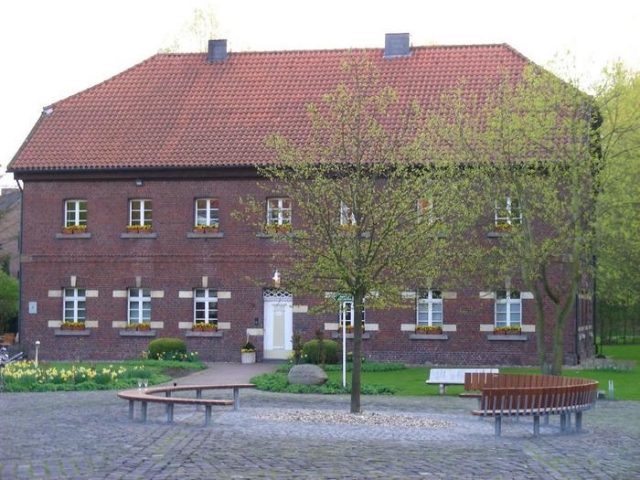
After a turbulent rise and fall of noble families and historical periods, which also severely affected Haus Leythe, contemporary pictures depict a manor house showing the typical Renaissance features of a Münsterland moated castle: a Leythe Castle that could certainly compete in size and beauty with castles like Herten and Berge Castle. It was built in the last quarter of the 17th century. Around 1800, the castle was no longer resided in. The Nesselrode-Reichenstein family preferred to represent in Herten and rented Leythe as a leased estate. This led to its decline, culminating in its complete demolition around 1860. A two-story brick manor house was built on the foundations, which in no way resembles the old castle. The Graf Bismarck colliery later acquired large parts of the property and began coal mining there in 1894 with Shaft 3 in the immediate vicinity of the manor house. A fire in 1955 destroyed the old pigsty that still existed until then, which was finally demolished in the early 1990s.
In 2002, a new clubhouse was built by the Golf Club Haus Leythe e.V. During the construction of the new clubhouse, a condition imposed by the city of Gelsenkirchen had to be met: the building had to be built in exactly the same place and to the same dimensions. The overall impression of the complete three-part ensemble (residential building/barn/stable) was to be preserved in its old dimensions.
The barn was built around 1600 and features a very rare timber-frame construction in this region, which was extensively restored in 1992, partly with state funds. The residential building and farm building were built around 1860.
Haus Leythe has been on the list of monuments as an archaeological monument since October 17, 1984.
Take Mobile History with you
You are reading this text for free. Premium adds what matters on the road: descriptions read aloud, sites found through your camera, whole regions taken offline.
14 days free, then from €2.99 a month. Cancel anytime.
Source: Wikipedia · Licence: CC BY-SA 4.0
This description draws on the facts documented in the linked Wikipedia article; Wikipedia content is licensed under CC BY-SA 4.0. Wording and editing: Mobile History.
Location: 51.5689, 7.0946