Cultural Events
CastleOsnabrück-Atter
Leye Castle
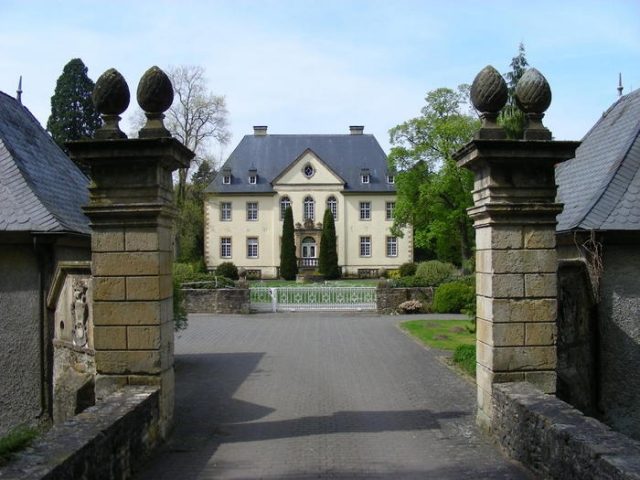
Gut Leye is a manor complex with a stately home in the large forest and landscape area "Leye" in Osnabrück-Atter. It has been owned by the Ostman von der Leye family since 1680.
The estate is one of a series of manor houses that the city nobility of Osnabrück had built around the city. Unlike the manor houses Honeburg, Sandfort, or Sutthausen, Leye more strongly reveals its representative baroque character. A straight avenue and a star-shaped network of paths lead to the freestanding manor house. With two symmetrically arranged side outbuildings, gatehouses, and a chapel, it forms a self-contained complex. The main house is no longer inhabited today, but it is used for representative events, especially for weddings. The large chapel is also available to the Eversburg parish.
The History of the Ostman von der Leye Family and Gut Leye+
On September 26, 1679, Johann Adolf Graf von Tecklenburg sold the agricultural area "Leye" for 3000 Thalers to the Canon Otto Heinrich von Oer and his brother Colonel Hermann Philipp von Oer, who was the city commander in Osnabrück.
The latter had come into possession of Gut Langelage through marriage and outlived his brother. Therefore, in 1680, he sold Leye to Franz Ostman, the privy councilor of the Prince-Bishop of Osnabrück and Vice-Chancellor.
In 1703, Franz Ostman (* 1645) built the manor house with its two side outbuildings on Leye. On September 24, 1705, he was granted the predicate "von der Leye" as hereditary imperial nobility, at which time he was already one of the most influential members of the prince-bishop's government of the "Hochstift Osnabrück" and one of the most important men of his time. On September 23, 1709, in his will, he made Leye the family seat. He was married to Catharina Jofina von Stael zu Sutthausen.
The Permanent Family Seat
On October 4, 1719, Franz Ostman died. He had bequeathed Gut Leye to his eldest son Sixt Anton.
Sixt Anton Ostman von der Leye was at that time already an imperial court councilor, privy councilor to the Prince-Bishop of Osnabrück, and chancery director, and married to Franziska Maria Freiin von Kerckerinck zu Borg. Together with his siblings, he expanded the family estate by incorporating real estate and movable property. On October 8, 1740, he was granted the hereditary imperial baronial title by the Emperor. He died in 1745.
His eldest son Stephan Florenz succeeded him, and on September 29, 1813, after his death, Leye was bequeathed to his only son Florenz Conrad. On October 29, 1831, Florenz Conrad died, and he was succeeded by his son Friedrich, who died just one year later. Friedrich had three sons, of whom the two eldest died underage. So the youngest son Ludwig became his successor.
Ludwig was a landscape councilor of the Osnabrück knighthood. He died on September 16, 1901. His eldest son Clemens-August Freiherr Ostman von der Leye inherited the property and married Eleonore Freiin von Fürstenberg-Stammheim. Clemens-August was a royal Prussian district administrator (retired) and privy government councilor, landscape councilor of the Osnabrück knighthood, as well as privy councilor and district administrator.
His wife brought a lot of money into the marriage, so Gut Leye was rebuilt. The hall in the manor house was redesigned, the entire roof truss was raised, the entire inner courtyard was renewed, and the two side wings could be converted into two-story structures. In the years 1905 and 1913, the side outbuildings of Gut Leye were completely restored and extended by Clemens-August Freiherr Ostman von der Leye. In 1911, Douglas firs were planted along the avenue at Gut Leye. The large chapel built on the east building in 1906 was already redesigned with a dome roof in 1912. An annex for carriages, motor vehicles, and agricultural vehicles was built on the west building. A park with English and French design elements was created behind the manor house. A tennis court, a pond, and a rock garden were also created.
The Second World War
During the Second World War, several bombs fell on Gut Leye in the immediate vicinity of the house. Windows shattered and some roofs were damaged. But the park behind the manor house was completely devastated. After the end of the war, Gut Leye was confiscated by a supply troop of the British military. Troops threw porcelain out of the windows and pierced the oil paintings of the ancestral gallery with their bayonets. The Ostman von der Leye family had to vacate the manor house within 24 hours and moved into the forester's house. In 1946, the British troops left the estate. The walls and doors decorated with paintings had suffered.
After the death of Clemens-August, the eldest son Franz Ludwig inherited the estate from his father. He was a landscape councilor and major in the reserve.
The Children's Home
After the troops moved out in 1946 until and including 1960, Gut Leye, with the exception of the stables, was leased entirely to the Episcopal See of Osnabrück.
The estate was fully utilized as a children's home until and including 1957, housing about 70 children aged 4 to 14, who had previously been inadequately accommodated in the mother house of the Franciscan Sisters in Thuine from 1943. Thus, the high, large hall (approx. 13 × 8 meters) was used as a dormitory for about 40 children. It was adorned with a respectable stucco ceiling and fireplace decoration. A family portrait from the last century had embellished the fireplace, and the wall paintings by Wilhelm A. Friesel were still present.
In 1956, Clemens Ludwig Ostman von der Leye moved from the forester's house to the western side building after marrying his wife. The many children of the home provided an extraordinary setting for this wedding, from decorating to performances and also as an accompanying background during the celebration. Through the carriages and the entire pomp of such a proper wedding, the celebration also became a unique great experience for all the children. From October 27, 1957, the still approximately 70 children left Gut Leye, staggered over several weeks. They moved into a new Don Bosco Children's Home at Moorlandstraße 50 Osnabrück-Dodesheide, which was inaugurated by Bishop Helmut Hermann Wittler.
First, the eastern side building was cleared as a children's home, and after appropriate alterations, these apartments could be rented out again. The chapel was taken over by the Eversburg parish, which still uses it today. The respective clergyman was at that time provided with an apartment on Gut Leye.
The Vacant Manor House
The manor house of Gut Leye has not been inhabited since 1962. In 1964, Clemens Ludwig, a reserve lieutenant and state-certified farmer, took over the management of Gut Leye. His father Franz Ludwig died in 1979.
To preserve the manor house, the state of Lower Saxony had provided half a million DM in the early 1980s. In 1982, restoration work began on the baroque manor house, which had been permanently placed under monument protection. The entire exterior facade, including the roof truss and the exterior paintwork, was renewed. The roof was covered with Spanish slate, and new windows and doors were installed. The cellar was drained by a drainage system, and an elevator shaft from the cellar to the attic was installed. The construction measures were supervised by the monument protection authorities.
All plans to re-inhabit the manor house as a family seat were abandoned again in 1984, when Clemens Ludwig's wife Roswitha, Freifrau Ostman von der Leye née Freiin von Canstein, died. The energy costs in the high, large rooms also made living there uneconomical. Structural changes were not permitted. In 1988, Clemens Ludwig remarried and continued to live in the western side building. The eastern side building was formerly inhabited by staff, from the forester to the garden boy. Today, apartments are set up there.
Already in 1992, Clemens Ludwig had handed over the management of Gut Leye to his son Dominik. In March 2004, Clemens Ludwig Ostman von der Leye died. His widow continues to live in the western side house. The manor farm, including its agricultural management, is largely leased.
His daughter Freiin Michelle Ostman von der Leye, who lives in Gut Altenhagen a.T.W., said on August 4, 2008:
"The only thing missing today is a lot of activity or real life in Gut Leye, which would be very positively noticeable, especially in the manor house."
Take Mobile History with you
You are reading this text for free. Premium adds what matters on the road: descriptions read aloud, sites found through your camera, whole regions taken offline.
- Every description, including the ~17,700 Premium sites
- Audio guide: have descriptions read to you on location
- AR finder: see sites through your camera, with distance and bearing
- Unlimited saved sites
14 days free, then from €2.99 a month. Cancel anytime.
Source: Wikipedia · Licence: CC BY-SA 4.0 · Image: http://www.wehrbauten.de/thread.php?threadid=590
This description draws on the facts documented in the linked Wikipedia article; Wikipedia content is licensed under CC BY-SA 4.0. Wording and editing: Mobile History.
Location: 52.2960, 7.9640