Foundation
CastleLetzlingen
Letzlingen Castle
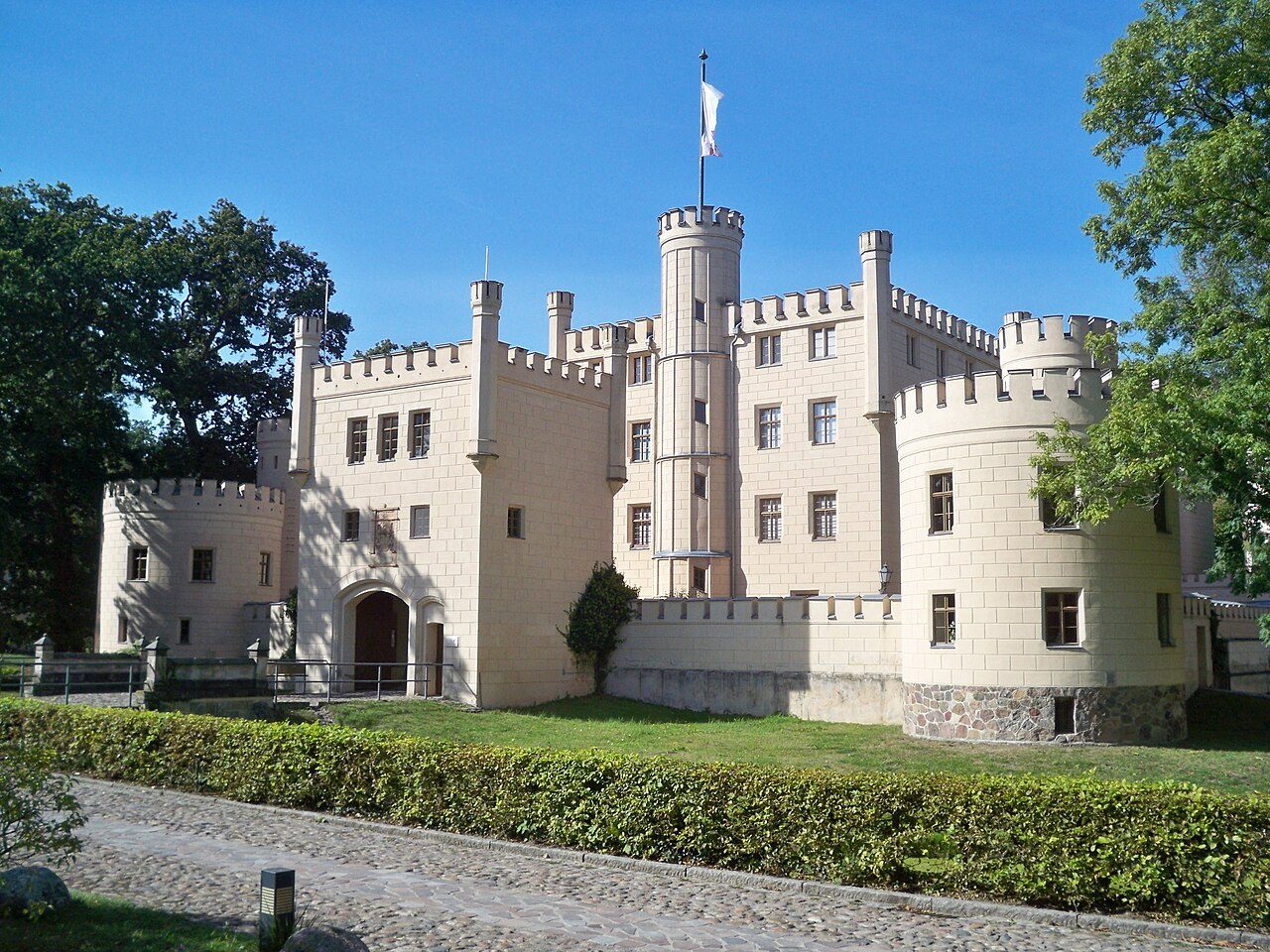
Letzlingen Hunting Lodge is located in the Letzlingen district of Gardelegen, in the south of the Altmarkkreis Salzwedel district in Saxony-Anhalt. It borders to the north on the Colbitz-Letzlinger Heide, a heathland area currently used for military purposes.
The hunting lodge was built by Prussian King Frederick William IV on the foundations of a previous building. According to the plans of architects Friedrich August Stüler and Ludwig Ferdinand Hesse, a castle complex in the Neo-Gothic style of English Tudor architecture was built starting in 1843.
Today, the castle ensemble is used for gastronomy, as a hotel, and as a museum. On the first floor, an exhibition on the "Hunting History of the Letzlinger Heide. Royal Prussian Court Hunt" takes place.
Until the mid-16th century, a simple hunting lodge stood on the site of the present complex. After the demolition of the old building, the Brandenburg Elector Prince Johann Georg had a hunting castle built by master builder Lorenz Arndt from 1559 to 1562. The "Hirschburg" (Deer Castle) with a game enclosure was a fortress-like complex. The residential building in the center was surrounded by a ring wall with corner towers and a moat. Johann Georg often stayed in the game-rich hunting grounds of the Letzlinger Heide and celebrated his marriage to Elisabeth of Anhalt, his third wife and daughter of Joachim Ernst of Anhalt, at the castle in 1577.
The subsequent Hohenzollern rulers preferred other hunting grounds or showed no interest in hunting until Frederick William IV rediscovered the castle in 1840. On the walls of the dilapidated hunting castle, he had a castle built in the style of English Neo-Gothic according to plans by architect Friedrich August Stüler. In 1843/44, Stüler carried out the reconstruction of the Corps de Logis. This main building with a square floor plan was raised by four stories. A round stair tower, which is situated in front of the building, overtops all buildings on the site. By rebuilding the high gatehouse in the east and the four corner towers of the ring wall, the buildings received a stylistic adaptation in the Neo-Gothic form. All buildings are crowned at the roof edge with a crenellated parapet. Presumably between 1851 and 1853, the dining room and kitchen were rebuilt according to Stüler's plans. The work was supervised by the architect's brother, building inspector Karl Askan Stüler, and the Magdeburg building councilor Karl Albert Rosenthal.
Also in the forms of English Neo-Gothic, Friedrich August Stüler designed a castle church, the construction of which Rosenthal supervised. After the laying of the foundation stone in 1857, the actual construction began only in 1859. In the year of Frederick William IV's death, 1861, the church was completed. The now reigning brother Wilhelm I participated in the inauguration on December 11. With the construction of a castellan's house according to plans by architect Ludwig Ferdinand Hesse, the construction measures were completed in 1868.
For the "Letzlingen Court Hunts" in late autumn, the Prussian kings invited hunting guests such as Archduke Franz Joseph, the later Emperor Franz Joseph I, Otto von Bismarck, Theobald von Bethmann Hollweg, Bernhard von Bülow, and Russian Grand Dukes. The last court hunt took place in November 1912 under Emperor Wilhelm II.
After the First World War and the end of the monarchy, the castle came into the possession of the new Prussian government. In 1922, the Free School and Work Community, founded by Bernhard Uffrecht and his wife Ini, independent of state and church, moved in. Already in April 1933, this school was closed by the National Socialists and it was subsequently used as an SA leadership school, and during the Second World War, the building was used as a military hospital. From 1945 to 1991, it housed an outpatient clinic of the Gardelegen hospital. After the fall of the Berlin Wall, the hunting lodge came under the care of the "Foundation for Castles, Palaces and Gardens of the State of Saxony-Anhalt," today the Foundation for Cathedrals and Palaces in Saxony-Anhalt.
Take Mobile History with you
You are reading this text for free. Premium adds what matters on the road: descriptions read aloud, sites found through your camera, whole regions taken offline.
- Every description, including the ~17,700 Premium sites
- Audio guide: have descriptions read to you on location
- AR finder: see sites through your camera, with distance and bearing
- Unlimited saved sites
14 days free, then from €2.99 a month. Cancel anytime.
Source: Wikipedia · Licence: CC BY-SA 4.0 · Image: Vanellus / CC BY-SA 4.0 via Wikimedia Commons
This description draws on the facts documented in the linked Wikipedia article; Wikipedia content is licensed under CC BY-SA 4.0. Wording and editing: Mobile History.
Location: 52.4456, 11.4810