To be privately owned
CastleLeipheim
Leipheim Castle
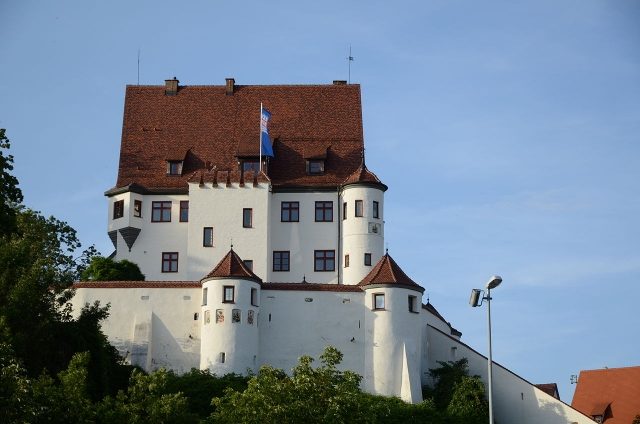
Leipheim Castle is a three-story, towering gabled building in the Renaissance style, with the ground floor dating back to the 11th century. It is situated on a steep hillside on the western edge of the town of Leipheim in the district of Günzburg. The coat of arms of the Lords of Güssen is depicted on the southeastern castle gable. The round tower attached to the south of the castle has a convex curved spire. The castle is surrounded by a front garden enclosed by a wall, as well as a stately castle wall with several round towers, featuring concave curved spires. The terrain, sloping steeply to the north and west, forms the castle garden.
Presumably, Gumbrecht von Lipheim, mentioned in a document in 1065, had his fortified residence here. In 1343, Leipheim Castle was first mentioned. From here, the lower nobility knightly family of the von Güssen, whose ancestral castle was near Hermaringen in the Brenztal valley, ruled. In 1373, the Counts of Württemberg bought the castle and the town (since 1330). They sold it on in 1453 to the Imperial City of Ulm, whose bailiffs governed the town of Leipheim from the castle.
Construction of the current castle began in 1559. By reusing the walls of the previous building, they were forced to build upwards, resulting in huge roof areas and towering gables. During the Thirty Years' War, Leipheim Castle was plundered and destroyed by imperial troops. As the city of Ulm lacked the necessary funds for the castle's repair, a comprehensive renovation never took place. In 1802, Leipheim became part of Bavaria as a result of mediatization, and the dilapidated castle became the seat and residence of the Royal Bavarian Gamekeeper.
In 1826, the property was auctioned and acquired by Samuel Schwab for 1460 Gulden. However, the new owner sold the castle just one year later for 2400 Gulden to Magdalena von Zöpfenhahn. The new owner married Baron Marquard von Stain in 1829. The castle remained in the possession of the baronial family for nine years. Many castle owners followed: including Baron Ferdinand Schilling von Cannstatt and Hans Panke, a merchant who emigrated to Brazil and spent the summer months at the castle, the rest of the year in South America.
In 2006, Liqui Moly CEO Ernst Prost acquired Leipheim Castle for €362,500 and had it extensively renovated.
Take Mobile History with you
You are reading this text for free. Premium adds what matters on the road: descriptions read aloud, sites found through your camera, whole regions taken offline.
- Every description, including the ~17,700 Premium sites
- Audio guide: have descriptions read to you on location
- AR finder: see sites through your camera, with distance and bearing
- Unlimited saved sites
14 days free, then from €2.99 a month. Cancel anytime.
Source: Wikipedia · Licence: CC BY-SA 4.0 · Image: https://commons.wikimedia.org/wiki/File:Leipheim_Schloss_003.jpg?uselang=de
This description draws on the facts documented in the linked Wikipedia article; Wikipedia content is licensed under CC BY-SA 4.0. Wording and editing: Mobile History.
Location: 48.4498, 10.2189