Hotel
CastleBad Friedrichshall-Kochendorf
Lehen Castle
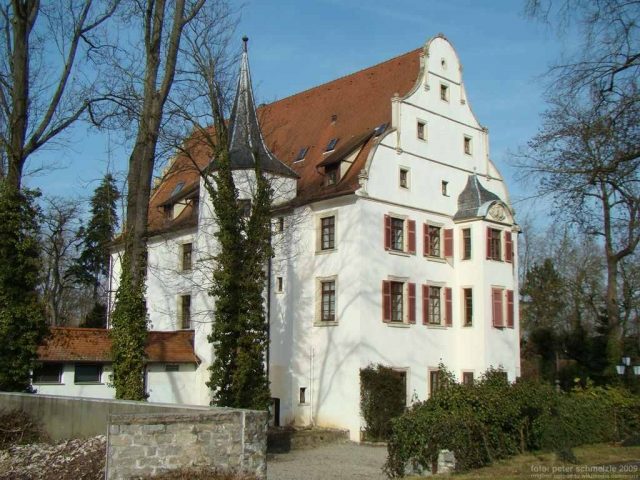
Lehen Castle is a Renaissance castle built in 1553 in the Kochendorf district of Bad Friedrichshall in the Heilbronn district in northern Baden-Württemberg. It is located in a small castle park on the banks of the Kocher, near the Kocher's confluence with the Neckar. The castle, as a single building, belongs to the Castle Road. The complex, which dates back to an older moated castle, received its name because the associated property had been a fief since 1294.
Where Lehen Castle stands today, there was already a Frankish manor in the early Middle Ages. Later, a moated castle was built in its place, which lay outside the village walls. The moated castle was first mentioned in a document in 1294, when Arnold von Kochendorf transferred the castle from his allodial property into a fief, while at the same time he ceded various goods and rights in Kochendorf to the Wimpfen Abbey, including the patronage right of the parish church.
The Lords of Kochendorf were vassals of the German Emperor or of his ministerials, the Lords of Weinsberg, but they became impoverished and eventually held only lower offices. In 1450, with the death of the spiritual brother Johann von Kochendorf, the line of the Lords of Kochendorf died out.
Their castle fief, which they last held from the Lords of Heinriet, passed to the Grecken von Kochendorf in 1440, who are documented since the late 13th century and had called themselves von Kochendorf since 1315. The first Greck in possession of the castle fief, which was granted as an imperial fief after the extinction of the Lords of Heinriet in 1462, was probably Kraft Greck († around 1480).
After the moated castle was probably devastated by peasants in the German Peasants' War in 1525 and Wolf Conrad Greck I had regained a share of Kochendorf property that had briefly passed to his stepsister through inheritance division in 1549, he had the castle rebuilt in the Renaissance style in 1553 on the site of the former moated castle. The coat of arms stone above the castle entrance shows his coat of arms and that of his wife Sibylla Greck née von Gemmingen († 1567), with a verse from Psalm 127 below. The adjoining dairy dates from 1568.
In 1606, Johann Philipp Greck sold his third of Kochendorf with Lehen Castle to Friedrich I of Württemberg, who wanted to build a trading port in Kochendorf. The purchase negotiations were conducted by four Württemberg councillors, including Georg Eßlinger, a native of Kochendorf. Further purchase negotiations for other parts of Kochendorf took place, but the port plans fell through with the death of Friedrich I in 1608. In the same year, the reversal of the purchase began, which was completed by 1615.
In a travel report from 1621/22, the castle (in distinction to the Grecken Castle, which had since been built) is referred to as the Old Castle. Regarding the castle's forecourt, whose fortifications are still largely preserved today, it is said that it was surrounded by a moat and defended by three towers.
The Grecken von Kochendorf held the castle fief for eight generations until the male line of the family died out with the death of Wolf Conrad Greck V in 1749. The imperial fief was confiscated and granted to Reinhard von Gemmingen-Hornberg (1677–1750), a scion of the old noble family of Gemmingen, who was director of three knightly circles. His namesake son Reinhard von Gemmingen-Hornberg (1710–1775) had a coat of arms stone (now illegible due to weathering) with his coat of arms and that of his wife Sophia Friederica vom Stein (1715–1776) placed on the gable of the bay window on the south side of the building. His son Franz Karl Friedrich von Gemmingen-Hornberg (1747–1814) initially acquired the fief and two-thirds of the blood ban like his father, but in 1784 the emperor granted the blood ban to the respective canton director of the Knightly Canton Odenwald, also residing in Kochendorf, so that only lower jurisdiction was associated with the possession of Lehen Castle.
In the late 18th century, the castle fief, in addition to the actual castle, also included larger estates. According to a report by Amtmann Schöpf from 1765, the land ownership comprised about 77 Morgen of land; a contemporary field book lists about 65 Morgen of land, of which about two-thirds were arable land, the rest meadows, vineyards, and gardens. From 1750 to 1766, the estate generated an income of 9,329 guilders, mostly from crops and wine. Expenses and building burdens in the same period amounted to over 9,900 guilders, so the estate was not always economically successful.
With the end of the Holy Roman Empire in 1806, the supreme feudal lordship passed from the Emperor to the King of Württemberg, who granted the castle fief after Franz Karl Friedrich's death in 1814 to the Württemberg General Johann Carl Georg Freiherr von Breuning (1785–1847). In 1818, Breuning had the curtain wall around the castle removed and the moat refashioned. Around 1825, he had to cede part of the castle garden for the construction of the approach to the new Kocher bridge.
In 1854, the castle fief was allodified, whereupon in 1863 Breuning's widow Sophie Valeska Freifrau von Beuting (1806–1890) acquired the castle from her two sons as a widow's residence. Breuning's youngest daughter Martha (1846–1874) married Heinrich Capler von Oedheim (1835–1914) in 1866. After Martha's death, Heinrich entered into a second marriage with her sister Camilla (1837–1917) and acquired the castle from his mother-in-law in 1886. The small alliance coat of arms Bautz/Breuning on the lower part of the southern bay window dates from that time. After 1881, the third round tower of the forecourt was demolished in favor of another gate entrance. After Heinrich Capler's death, Kochendorf Castle came to his younger son Dietrich Capler von Oedheim called Bautz (1876–1967), who had to sell his Kochendorf properties in 1928 for economic reasons, with the castle going to the market gardener Paul Mauk.
In 1948, the barn belonging to the dairy buildings was redesigned. Garages were installed on the ground floor and apartments on the first floor. When the manufacturer Karl Erwin Merkle from Neckarsulm acquired Lehen Castle in 1953, he had it converted into a hotel; the complex is still used as a castle hotel today. From 2001 to 2005, the listed building was extensively renovated.
Architectural Description+
Lehen Castle is a three-story stone house in Renaissance style. The show facade is adorned with a curved gable, while the opposite stepped gable is more simply designed. An octagonal stair tower protrudes from the side of the building, crowned by a pointed roof. The ground floor of the castle is vaulted. The knight's hall is also located there. The ornate coat of arms stone above the main portal shows the alliance coat of arms of the Grecken and the Lords of Gemmingen, as Wolf Conrad Greck I was married to Sybilla von Gemmingen. The date 1553 probably marks the completion of the new castle building. Below it is an inscription from Psalm 127.
South of the castle, the forecourt with the curtain wall and the former farm buildings adjoins. In front of the curtain wall there was formerly a moat, now filled in, over which a bridge led. Two massive round towers are located in front of the forecourt buildings (originally there were three round towers). A gate leads between these towers into the castle garden. Above it are the family coats of arms of the Grecken von Kochendorf and the Lords of Gemmingen; the year 1568 indicates the year the gate was built.
Take Mobile History with you
You are reading this text for free. Premium adds what matters on the road: descriptions read aloud, sites found through your camera, whole regions taken offline.
- Every description, including the ~17,700 Premium sites
- Audio guide: have descriptions read to you on location
- AR finder: see sites through your camera, with distance and bearing
- Unlimited saved sites
14 days free, then from €2.99 a month. Cancel anytime.
Source: Wikipedia · Licence: CC BY-SA 4.0 · Image: https://commons.wikimedia.org/wiki/File:Kochendorf-schlosslehen2009.jpg
This description draws on the facts documented in the linked Wikipedia article; Wikipedia content is licensed under CC BY-SA 4.0. Wording and editing: Mobile History.
Location: 49.2257, 9.2172