School
CastleBaden
Leesdorf Castle
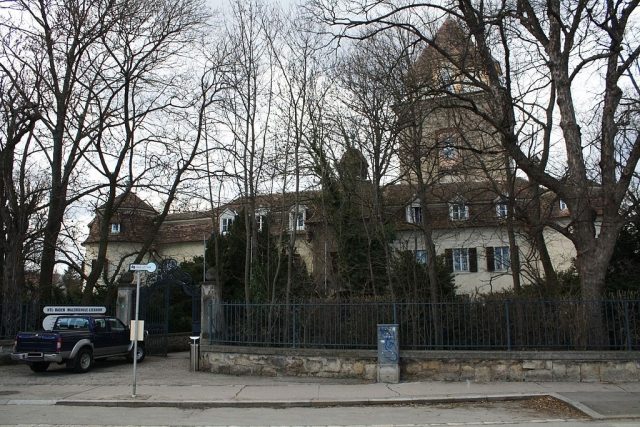
Leesdorf Castle is a castle in Baden bei Wien and today houses the HTL painting school. Leesdorf Castle is located in the former suburb of Leesdorf, which was incorporated into Baden in 1850 and comprised the former Leesdorf estate.
It lies between Schwechat and the Baden Mühlbach. The castle is surrounded by a wall. Access is through a wrought-iron gate over a stone bridge to the two-story tower. Passing through the baroque basket-arch portal leads into a rectangular inner courtyard.
Castle+
The former moated castle was first mentioned in 1114 with Hugo von Leuisdorf. Hugo's ministeriales are last mentioned in 1378. However, Leesdorf passed to Sigmund Kastner as early as 1312, who in turn sold it to his cousin Erhart von Leutfaringer. The Wallseer also appear as owners for a time before ownership passed to Stephan von Zelking. After him, Leesdorf became princely. In 1617, the estate was sold by Hans Friedrich von Kielmannsegg to Melk Abbey. During the subsequent Turkish wars around 1683, the castle was severely damaged.
Under Abbot Berthold Dietmayr, the Romanesque building was converted into a Baroque castle at the beginning of the 18th century. Speculations that Jakob Prandtauer was the architect are not proven. While the octagonal stair tower next to the chapel and a connecting building were demolished, the chapel wing was expanded and connected to the main building by a transverse wing. In this connecting wing there is a ballroom with a ceiling painting depicting the god Chronos, framed by the four seasons symbolized by groups of putti. Various Babenberg dukes are depicted on six canvas paintings.
The castle still had this appearance when the Melk Abbey chapter decided to sell it on January 31, 1851. – The Viennese court and judicial lawyer Dr. Stanislaus Neumister and his wife Anna acquired the castle and 5 Joch of land for 20,000 fl on May 1, 1852, had the already swampy moat of the former moated fortress filled in and partially planted with trees, replaced the old wooden bridge with a stone one, and demolished three of the four corner towers to the height of the surrounding wall: Neumister transformed the castle into a noble spa hotel with a park at great expense, estimated at 40,000–50,000 fl. Among the most distinguished spa guests staying here were Maria Pia of Savoy, the wife of King Louis I of Portugal (1869), who was visited by Emperor Franz Joseph I, and Prince Nicholas I of Montenegro (1870).
The economic success of the spa hotel does not seem to have met Neumister's expectations. He sold it on May 6, 1870, for 140,000 fl to the Viennese cattle dealer Andreas Pöhnl and his wife Eva, who in turn resold it after only 3 ½ years with a high profit – for 165,000 fl – to Johann Theodor Egger.
The new owner was an art-loving man, a collector primarily of old weapons, porcelain, and gems. From 1885, the castle was extensively restored, the frescoes of the ballroom were reinstated, and under the architect Humbert Walcher Ritter von Moltheim, it was adapted to the taste of the time. In the course of this, the wooden structure of the keep was removed and replaced with the existing finish. The last alterations took place in 1907 and 1908, except for the east wing, where the staircase was only installed after 1920.
On June 15, 1889, Egger sold the castle for 80,000 fl to Karl and Agnes Bai, who were apparently only intermediaries and resold it to Oskar Hüffel, a senior official of the Südbahn company. Hüffel kept Leesdorf Castle for ten years; on May 20, 1897, he sold it to Dr. Robert Freiherr von Bach, from whom Heinrich and Paula Baltazzi acquired it on October 15, 1907.
Heinrich Baltazzi ("Henry") completed the restoration in 1907, but from 1908 onwards, he and his wife, Paula Freiin Scharschmid von Adlertreu, continued to develop the building for residential purposes.
Baltazzi died on February 2, 1929, and his widow Paula sold the castle on January 2, 1934, to the Sisters of the Third Order of Saint Francis, called of Divine Love, who were commonly known as "Hartmann Sisters" in Vienna and Lower Austria. It was named Elisabeth-Heim and was primarily intended to accommodate sick and elderly members of the order in need of recuperation.
In 1938, the authorities of the National Socialist state forced the order to rent the castle to the municipality; on September 12, 1940, it was confiscated. The municipality and the NSDAP used the building to house refugees from Czechoslovakia, as a boarding school for difficult-to-educate girls and for students of the National Political Education Institute Traiskirchen, to quarter resettlers from Bessarabia, and from April 1942 as a reserve hospital for the Wehrmacht.
In 1945, it was plundered and served as quarters for soldiers of the Red Army. On January 20, 1948, the property was returned to the Hartmann Sisters, who leased it to the Guild of Painters, which established a master school there.
HTL Baden – Master School+
In 1948, the castle was leased by the board of the Vienna Painters' Guild. The guild established a master school for the painting trade here. In 1971, the lease agreement was transferred to the Federal Guild of Painters, Decorators, and Varnishers.
Today, the school is run as an HTL with a technical college and a college.
Take Mobile History with you
You are reading this text for free. Premium adds what matters on the road: descriptions read aloud, sites found through your camera, whole regions taken offline.
- Every description, including the ~17,700 Premium sites
- Audio guide: have descriptions read to you on location
- AR finder: see sites through your camera, with distance and bearing
- Unlimited saved sites
14 days free, then from €2.99 a month. Cancel anytime.
Source: Wikipedia · Licence: CC BY-SA 4.0 · Image: http://commons.wikimedia.org/wiki/File:Baden_Schloss_Leesdorf02.jpg?uselang=de
This description draws on the facts documented in the linked Wikipedia article; Wikipedia content is licensed under CC BY-SA 4.0. Wording and editing: Mobile History.
Location: 48.0047, 16.2505