To be privately owned
CastleEbersbach-Lauterbach
Lauterbach Castle
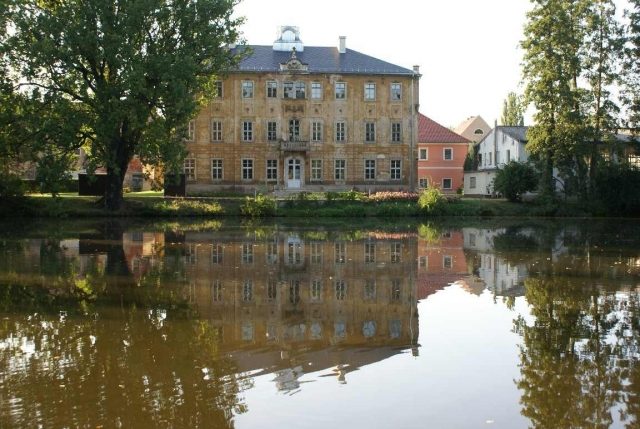
Lauterbach Castle is located in the Lauterbach district of the municipality of Ebersbach.
With its first documented mention in 1350, the village developed from an outpost of the March of Meissen, into a respectable knight's estate in the 15th/16th century, and then into a flourishing castle community in the 18th/19th century. The twentieth century brought several upheavals for the village of Lauterbach. First, the aristocratic property passed into bourgeois private ownership (1929), then into public and cooperative ownership (1946). Village life was re-shaped. From 1983 onwards, the castle no longer played a role in this daily life.
Castle and Park History+
In 1350, the Margrave of Meissen, Frederick the Strict, enfeoffed a Thimo de Grunrode with the Lauterbach outpost, of which it is said, "Luterbach, an outpost in the March of Meissen located on the Bindebach." Between 1408 and 1660, the outpost was expanded and consolidated into a knight's estate by the families of Lubin, Schönfels, Grünberg, and Polenz.
Jonas von Kirchbach was first mentioned in 1660 as the hereditary lord and electoral administrator. His son, Hans Gustav, began around 1700 with the construction of Lauterbach Castle, idyllically situated on the shore of a lake, a rather simple, two-story building.
In 1735, Leopold Freiherr von Palm acquired the knight's estate with the castle and developed it into his family seat. The family held important positions at the court of Empress Maria Theresia. Particularly the representative rooms of the castle were thus furnished with appropriate interiors. Portraits of the Empress and her husband, Francis of Habsburg-Lorraine, hung in the great hall.
In 1770, the castle park was laid out. Initially conceived as a park in the style of the late Baroque, it was later transformed into an English landscape garden with a large pond system. In 1895, renovation and remodeling work was carried out on the castle. It received the second upper floor and the Rococo-style facade that is still preserved today.
In 1929, Herbert von Palm sold the Lauterbach estate and castle for one million Reichsmark to Walter Wilhelm, who was a minister in the Saxon government cabinet in 1927. In 1933, the economically liberal Wilhelm was placed under house arrest. In 1945, Wilhelm was deported by the Soviet army and dispossessed as a large landowner. He is the last private owner of Lauterbach Castle.
In 1946, the castle became public property and was used as an apprentice dormitory. The estate was used by the Agricultural Production Cooperative (LPG) Naunhof. From 1963 to 1983, Lauterbach Primary School was located in the castle. In 1976, a gymnasium with 250 m² of usable space was built next to the castle. The hall is still in operation today. In 1983, a new school building was built at the south end of the park – with school operations until 2002. Since then, the castle has remained unused.
In 1996, the property was divided into castle and estate. The castle remained in the possession of the municipality, while the estate was sold to private individuals. In 2006, the Friends of Lauterbach Castle and Park e. V. was founded.
Take Mobile History with you
You are reading this text for free. Premium adds what matters on the road: descriptions read aloud, sites found through your camera, whole regions taken offline.
- Every description, including the ~17,700 Premium sites
- Audio guide: have descriptions read to you on location
- AR finder: see sites through your camera, with distance and bearing
- Unlimited saved sites
14 days free, then from €2.99 a month. Cancel anytime.
Source: Wikipedia · Licence: CC BY-SA 4.0 · Image: Roland Neubert, Halle (Saale)
This description draws on the facts documented in the linked Wikipedia article; Wikipedia content is licensed under CC BY-SA 4.0. Wording and editing: Mobile History.
Location: 51.2275, 13.6110