Museum
CastleAltenberg - Lauenstein
Lauenstein Castle
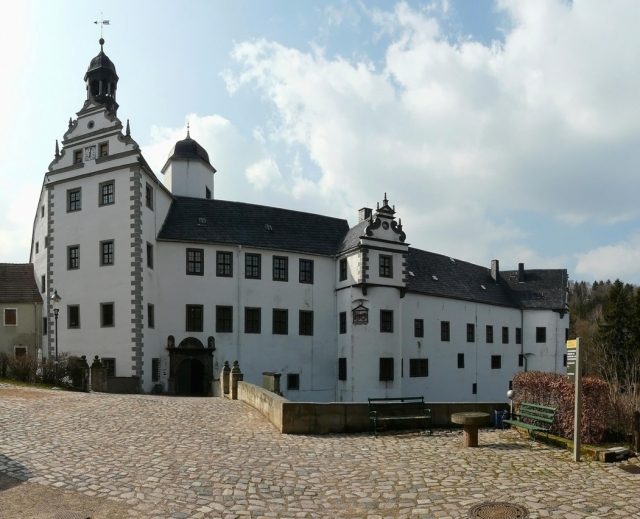
Uncertainty prevails in historical writing regarding the founding of Lauenstein Castle, which likely preceded the town's development around 1200. A number of authors (Schmidt 1927; Hammermüller 1964; Blaschke 1966) attribute the construction of the castle to the Margraves of Meissen, while ADAM (1994) sees Bohemian nobles as the founding fathers. If the former is true, then the complex probably served to protect the ore deposits discovered near Freiberg and Dippoldiswalde at the end of the 12th century. If, on the other hand, the foundation was initiated by the Bohemian Hrabischitz family, Lauenstein was probably more of an outpost of the castles in Graupen and Kulm.
It is certain that the castle was in the possession of the Margraves of Meissen at the time of its first mention (1289 as castrum Levensteyn). It was built as a border castle on a steep mountain spur above the Müglitz valley during an early phase of the development of the upper Eastern Ore Mountains. Since it was only accessible from the narrow mountain side, it could be particularly effectively fortified and protected. The castle was the decisive starting and supporting point for the knightly-peasant colonization of the surrounding region, which was driven from here up to the ridge areas of the Eastern Ore Mountains. The villages of Liebenau, Löwenhain, Fürstenau and Fürstenwalde emerged from this colonization. Lauenstein Castle protected these settlements and the Kulmer Steig routes to Bohemia running east of it, and at the same time secured the claims to dominion and ownership of the Margraves of Meissen over the border forest rich in mineral resources.
At the time of its creation, the complex probably only had a comparatively simple architectural form (triangular core castle without a keep with a gate tower). However, since Lauenstein is already mentioned as a castle in 1340, a rapid expansion of the buildings and a development towards a typical medieval castle can be assumed. However, only remnants of the actual castle remain today, as the complex burned down after a devastating town fire on May 2, 1594, and a Renaissance building was erected in its place as a residential castle until the 17th century. This involved the creation of several rooms richly decorated with sculptural, stucco and painting work, which still make the castle worth seeing today. Until the middle of the 19th century, Lauenstein Castle and town were also the centers of the extensive manorial estate of the same name, which already extended to the Ore Mountains ridge near Zinnwald in the 15th century. In 1835, this dominion covered an area of 94 km² with the town of Neugeising, 15 villages or smaller settlements, including Börnersdorf, Breitenau, Fürstenau, Fürstenwalde, Hennersbach, Liebenau, Löwenhain, Oelsengrund and Zinnwald, with a total of 5,219 inhabitants.
Compared to these subjects, the Lauenstein castle and manor lord had numerous rights and privileges, including the mining regale for base metals, inland fishing in all streams and rivers, compulsory milling in the mills of the manor, the payment of feudal fees for changes of ownership, hereditary rents, land tax, and low and high jurisdiction. The latter also included death sentences, executed, for example, on December 21, 1602: ...on December 21, the former mayor Phillipp Schelle and Stephan Richter's wife were beheaded in Launstein on the market for adultery, but Thomas Schmatz's wife, with whom the former also cohabited, was banished. Between 1607 and 1730, six death sentences were carried out on the market square in front of the castle, among other things for adultery, infanticide and murder. The economic significance of the manorial privileges is illustrated by the following figures: Even in the first half of the 19th century, the manor lord could claim annually 1,371 thalers in cash rents, 161 bushels of rent grain, 715 bushels of rent oats, 410 chickens and geese, over 2,500 eggs, and over 2,300 days of service obligations (field work, harvesting, craft services) from his dominion. From the middle of the 19th century, the manorial demands gradually fell into disuse. They were partly replaced by new laws, and payments in kind were replaced by cash annuities. With the Mining Regale Law of 1851, the Lauenstein dominion lost the lower mining regale, and the vassal mining office, which had its seat in Neugeising and whose district included the rich tin ore deposits on the Zinnwald, which had been exploited since the 16th century, was dissolved. After the end of the Second World War, the then manor lords of Hohenthal-Püchau were dispossessed as part of the land reform. Sudeten German expellees were temporarily housed in the castle and its outbuildings. Since 1980, the complex has been used as a museum (today the Eastern Ore Mountains Museum).
Lauenstein Castle and the town church are selected sites for the planned candidacy for the UNESCO World Heritage Montanregion Erzgebirge.
In the course of its centuries-old history, the following owners of Lauenstein Castle and dominion appeared (incomplete):
- 1320: Albert the Elder, Burgrave of Leisnig, pledges Lauenstein Castle to Margrave Frederick I (Meissen).
- 1340: Burgraves of Bergau
- 1372: Lauenstein becomes a Bohemian fief (until 1459).
- 1374–1436: The von Kürbitz family resides in Lauenstein as vassals of the von Bergau family.
- 1436: Elector Frederick II enfeoffs Nikolaus, Hans and Günther von Planitz with Lauenstein.
- 1449: Elector Frederick II acquires Lauenstein to gain a share in the emerging tin mining of Altenberg. He has Lauenstein administered by bailiffs. One of the first administrators was Kaspar von Schönberg auf Rechenberg.
- 1462: Electoral office under Franz von Körbitz
- 1464: Elector Frederick II sells Lauenstein to Hans Münzer, a wealthy mine owner and councilor from Freiberg. The purchase price was 700 Schock Groschen. Münzer was significantly involved in the mining development of the Lauenstein region. The first tin finds and the beginning of tin mining in and around Lauenstein probably fall into the period of his manorial rule. His son Erhard sells Lauenstein in 1490.
- 1490: Stephan Alnpeck the Younger, Landeshauptmann of Freiberg, acquires Lauenstein. He grants the place urban privileges.
- 1497 (according to other sources 1505): Friedrich von Saalhausen
- 1517: The von Bünau family (related to the von Saalhausen) acquires Lauenstein. The Bünaus were a widespread Saxon noble family, represented in Germany and Bohemia with 15 main branches and 28 collateral lines. For the Eastern Ore Mountains region, they exerted a decisive influence on cultural and economic development. They were also, among others, castle and manor lords of Weesenstein and Kuckuckstein Castle in Liebstadt. In 1821, due to economic decline as a result of the Seven Years' War, the War of the Bavarian Succession and the Napoleonic Wars of Liberation, the family was forced to sell the Lauenstein dominion.
- 1821: Lauenstein comes into the possession of Carl Ludwig August Count von Hohenthal of Dölkau Castle for a price of 175,000 Reichstalers.
- 1826: After only five years, the von Hohenthal family of Püchau Castle took over the complex and its possessions. The von Hohenthals remained castle owners until their expropriation and expulsion by the communists in 1945.
Take Mobile History with you
You are reading this text for free. Premium adds what matters on the road: descriptions read aloud, sites found through your camera, whole regions taken offline.
- Every description, including the ~17,700 Premium sites
- Audio guide: have descriptions read to you on location
- AR finder: see sites through your camera, with distance and bearing
- Unlimited saved sites
14 days free, then from €2.99 a month. Cancel anytime.
Source: Wikipedia · Licence: CC BY-SA 4.0 · Image: Thomas Eichler
This description draws on the facts documented in the linked Wikipedia article; Wikipedia content is licensed under CC BY-SA 4.0. Wording and editing: Mobile History.
Location: 50.7843, 13.8211