To be privately owned
CastleLauenau
Lauenau Castle
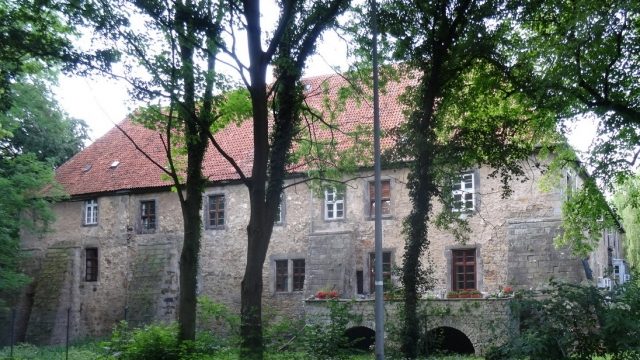
Lauenau Castle is a former moated castle in Lauenau, Lower Saxony, which was built in the 16th century in the Weser Renaissance architectural style on the remains of a 12th-century water castle.
Water Castle
Around 1190, Duke Henry the Lion had Lauenau Castle built as a water castle after his return from a crusade. It served as a border fortress against the Counts of Schaumburg, who had seized his lands during his absence. He drove out the Schaumburgers with his sons and established the castle, which soon also became a ducal court. In 1307, the castle was first mentioned in a document. The Welfs further pledged the castle to burgmanns, and in this way, it came into the possession of Count Adolf of Schaumburg in 1331. In the following centuries, the castle was regularly pledged by the Dukes of Braunschweig to burgmanns until 1512. There were frequent conflicts over the amount of the pledge and the political allegiance of the pledge holders. In 1512, ownership of the castle changed back from the Schaumburg Counts to the Welfs. During the Hildesheim Diocesan Feud, the castle was besieged by the Schaumburg field marshal Ludolf von Münchhausen. The castle garrison surrendered in exchange for free withdrawal. The Schaumburgers destroyed the castle down to its foundations so that it could not be used against them again.
Moated Castle
Count Otto IV of Schaumburg and Holstein had the reconstruction carried out from 1565 to 1572. A moated castle in the Weser Renaissance style was built on the foundations of the water castle. It was constructed as a two-story, four-wing complex. The enclosed inner courtyard measured 21 x 18 m. The castle was surrounded on three sides by a moat, which is visible in Merian's engraving from 1654. The west wing of the complex was the residential building, which had a cellar with a cross vault. A banqueting hall was set up in the east wing.
In 1694 and 1695, Princess Sophie Dorothee, as the wife of George Louis of Hanover, was held at Lauenau Castle for three months. During this time, her divorce proceedings took place due to an alleged love affair with Count Philipp Christoph von Königsmarck, after which she was banished to Ahlden Castle.
In 1727, the castle complex received lateral buttresses, as the foundations, which were built on oak piles, had been damaged by the weight of the building.
Until 1852, the Lauenau district office was located in the castle. In 1866, the castle with its agricultural domain was nationalized by Prussia and leased out. Around 1950, the castle complex came into private ownership. Plans to sell the complex failed in 1991. There are plans to demolish the agricultural farm, which formerly belonged to the castle complex, and to erect new buildings. The castle is currently rented out and is in need of renovation.
Take Mobile History with you
You are reading this text for free. Premium adds what matters on the road: descriptions read aloud, sites found through your camera, whole regions taken offline.
- Every description, including the ~17,700 Premium sites
- Audio guide: have descriptions read to you on location
- AR finder: see sites through your camera, with distance and bearing
- Unlimited saved sites
14 days free, then from €2.99 a month. Cancel anytime.
Location: 52.2742, 9.3640