To be privately owned
CastleRuppach-Goldhausen
Langwiesen Castle (Ruppach-Goldhausen)
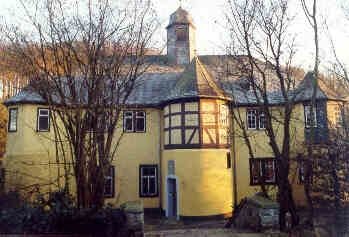
Hof Langwiesen, also known as Hofgut Langwiesen, is a small castle building in the Westerwaldkreis district between the towns of Boden and Ruppach-Goldhausen, located northeast of Montabaur. Politically, Hof Langwiesen belongs to the municipality of Meudt.
The grounds around the building reveal that the main structure was a moated castle. Thick round towers flank the four corners of the rectangular house, in front of whose northern long side stands a stair tower (dated 1608). The barn (dated 1750) and stables are of slightly more recent date. From a niche in the barn wall, a stone figure of St. Aloysius from the 18th century looks out over the courtyard.
The village of "Langewiese" was already known in 1444. Like many villages in the Westerwald, however, it gradually shrank until only the core, an agricultural estate, remained. Two mills still belong to the estate today; only in this century was one of them demolished due to dilapidation. Furthermore, there was a chapel and a priest on the estate.
In the mid-16th century, the estate passed by marriage to the von Irmtraut family, who shortly thereafter built a moated castle with four corner towers. Contrary to what the term "moated castle" might suggest, the wide moat certainly had a defensive function; the moated castle was a protective fortress.
In 1647, the house Langwiesen was sold to a "Kellner" (administrator) named Pergener from Montabaur, and in 1680, the entire estate was finally sold for 6000 Reichstaler to Eremund Reichsfreiherr von Esch, who had been elevated to the status of Imperial Baron by Emperor Leopold I in 1679 and became commander of Ehrenbreitstein Fortress in 1684.
Carl Wilderich Graf von Walderdorff, later Minister of State of the Duchy of Nassau and great-great-grandfather of the current Counts, bought the entire Hofgut Langwiesen with the moated castle in 1830. He had the moat drained and the estate's farm buildings expanded and rebuilt. Here, a clay deposit up to 100 m thick was found over 250 ha, which led to the founding of the Walderdorff clay pits.
Today, the castle and farm buildings are no longer owned by the Walderdorff family. The moated castle is in need of restoration.
Take Mobile History with you
You are reading this text for free. Premium adds what matters on the road: descriptions read aloud, sites found through your camera, whole regions taken offline.
- Every description, including the ~17,700 Premium sites
- Audio guide: have descriptions read to you on location
- AR finder: see sites through your camera, with distance and bearing
- Unlimited saved sites
14 days free, then from €2.99 a month. Cancel anytime.
Source: Wikipedia · Licence: CC BY-SA 4.0
This description draws on the facts documented in the linked Wikipedia article; Wikipedia content is licensed under CC BY-SA 4.0. Wording and editing: Mobile History.
Location: 50.4724, 7.8717