To be privately owned
CastleWendelstein-Röthenbach bei Sankt Wolfgang
Kugelhammer Castle
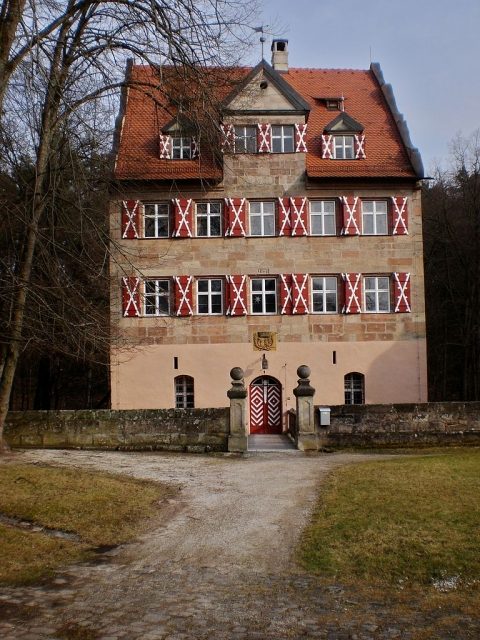
The Kugelhammer estate also originated from one of the old imperial fiefdoms of the Reichswald, which were Zeidelmuttergüter (bee-keeping estates). After Nuremberg citizens took an active part in the European mining business in the Middle Ages, it was inevitable that the Zeidelgut on the water-rich Gauchsbach would develop into an industrial settlement. At the latest in the early 14th century, the hammer mill was built with a stone house, which belonged to a Heinrich Kreutzer. Perhaps this building was already identical to the small, residential tower-like manor house, which is attested for around 1500 and served representative and protective functions for the hammer lord. The moat system, designed as an obstacle to approach, was fed by the water of the stream. The name Kugelhammer (ball hammer) only came into use in modern times, after iron balls were also produced in the factory.
For 1463 and 1512, a Heinrich Meichsner was recorded as the owner, who had acquired the hammer in 1463 - allegedly from the Halbwachs family, a Nuremberg citizen family. The Meichsners came from Styria and had immigrated to Nuremberg in 1396. In 1453, Heinrich Meichsner was first a member of the Inner Council. In 1530, Heinrich Holzschuher acquired the Kugelhammer and modernized the hammer mill. But already in 1539, the estate changed hands to the Fürer von Haimendorf family. Sigmund Fürer the Elder applied in 1539 and 1540 for oak wood from the Reichswald, probably for larger hydraulic engineering measures.
During the Second Margrave War, the property was set on fire on May 15, 1552. After the war, initially only the industrial plant was restored. In 1582, the factory was in operation under Carl Fürer von Haimendorf and was structurally maintained. Through the marriage of Felizitas Fürer, the Kugelhammer soon after passed to Hans Nützel the Elder. In 1584, he had the Voithaus built with an upper floor, in which stately rooms were to be furnished. The old manor house was still "in ashes" and was therefore referred to as a "Burgstall" (castle site).
It was not until 1607 that Hans Nützel applied to the Lorenzi Forest Office for the necessary timber for the "rebuilding of the old castle site", which was granted to him in December 1607. Accordingly, construction work probably began no earlier than 1608. After Hans Nützel's death in 1620, the seat and hammer mill passed to Hanns Albrecht Haller von Hallerstein (1569–1654), who had been married to his daughter Felicitas Nützel since 1613. In 1622, he had work done on a paper mill and the castle bridge. After 1662, Hanns Christoph Haller (1620–1671) followed, then his son Hans Jakob Haller, who died in 1692. In 1692, the Kugelhammer was handed over to Johann Carl Schlüsselfelder, born in 1653, who had married a daughter of Hanns Christoph Haller in 1678. Schlüsselfelder immediately invested again in hydraulic engineering in 1693 and had a sawmill built near the castle in 1704. Before his death in 1709, he converted the property into a family foundation, which was to be administered by administrators from related families after the death of his widow Maria Helena in 1713. The respective administrator was obliged to reside in the famous Nassauer Haus near Nuremberg's Lorenzkirche, Schlüsselfelder's city residence. He was and still is entitled to use the manor house in Kugelhammer.
In 1713, Christoph Michael Kreß von Kressenstein took office as the first administrator. He and his successors were plagued by several fires in the factory premises, for example in 1737 and 1786, during which the manor house fortunately remained undamaged. The iron hammer, a forge, and the sawmill were repeatedly repaired and were still in operation at the end of the 18th century. The hammer only ceased operation after the construction of the Ludwig-Donau-Main Canal (1836/45), because it deprived the factory of its water power.
The manor house, built of sandstone ashlar, has two upper floors on a high plinth floor. The building still shows its appearance shaped by the reconstruction in 1608, which is largely determined by the volute gables and the gabled roof structured with a dormer. The Schlüsselfelder-Haller alliance coat of arms above the main entrance still commemorates the marriage of the foundation's founder. Inside, stucco work, in particular, indicates modernizations of the 18th century. In the 17th century, the room structure corresponded to a frequently used solution: on the ground floor there was a large hall, while the living rooms were arranged on the first floor. The second floor is mainly occupied by the representative hall. The castle complex is still maintained with great effort by the Schlüsselfelder Family Foundation, which is currently administered by the Kreß von Kressenstein family.
Take Mobile History with you
You are reading this text for free. Premium adds what matters on the road: descriptions read aloud, sites found through your camera, whole regions taken offline.
- Every description, including the ~17,700 Premium sites
- Audio guide: have descriptions read to you on location
- AR finder: see sites through your camera, with distance and bearing
- Unlimited saved sites
14 days free, then from €2.99 a month. Cancel anytime.
Source: Wikipedia · Licence: CC BY-SA 4.0 · Image: http://commons.wikimedia.org/wiki/File:Kugelhammer_09.jpg?uselang=de
This description draws on the facts documented in the linked Wikipedia article; Wikipedia content is licensed under CC BY-SA 4.0. Wording and editing: Mobile History.
Location: 49.3635, 11.1806