Joseph Bernhart-Academy for Social Pedagogy
CastleKrumbach
Krumbach Castle
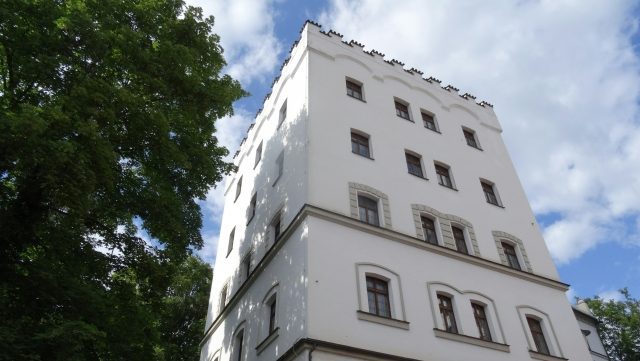
Krumbach Castle is a three-story Renaissance building constructed in 1530 in Krumbach, in the Swabian district of Günzburg. The castle and the adjacent Catholic parish church of St. Michael, built at the northernmost end of the narrow ridge between the valleys of the Kammel and the Krumbach, characterize the townscape of Krumbach.
The history of the castle dates back to 1125. In that year, the Lords of Krumbach and the castle site, where the castle stands today, were first mentioned. Between 1213 and 1301, the castle belonged to the Margraves of Burgau. After they died out, Krumbach, like the entire Margraviate of Burgau, belonged to the Habsburgs for over 500 years, until 1805, who mortgaged it several times. The castle always served as the official residence of the respective feudal lords.
The current Renaissance building was constructed in 1530 under the imperial councilor Hans Lamparter von Greifenstein. Later, the fief passed to the Weber von Pisenberg and even later to the Counts of Liechtenstein-Kastelkorn. Since the latter undertook renovations to the castle around 1700, the castle is often referred to as Liechtenstein Castle. These renovations involved the Baroque transformation of the building's interior; for example, the stucco ceilings that are still preserved today date from this period.
After Krumbach became Bavarian in 1805, the castle was actually slated for demolition. However, the castle was preserved because the municipality acquired the building from the Bavarian state to establish a school there, which until then had been housed in the already too small half-timbered building at the northern end of Kirchenstraße. Finally, the former castle housed the school from 1816 to 1838.
In 1837, the seat of the Ursberg District Court was moved to Krumbach Castle and accordingly renamed Krumbach District Court. Later, the Krumbach District Court became the Krumbach District Office and even later, in 1939, the Krumbach District Administration Office. Until the dissolution of the Krumbach district in 1972, the District Administration Office was located in Krumbach Castle. At the time the District Court moved into the castle, between 1835 and 1840, the Fronfeste (prison) was built at the southwest corner of the building in place of the so-called Bürgerturm (citizen's tower), where – also until 1972 – the district court had its seat. Initially, a prison was also set up in this annex.
Since 1975, the Joseph-Bernhart-Fachakademie for Social Pedagogy has been housed in the castle. A general renovation took place in the two preceding years, 1974/75. Since the structural stability of the building was insufficient for its future use, extensive stabilization measures had to be carried out during the renovation.
Architectural Description+
Krumbach Castle is a three-story Renaissance building with a steep gabled roof whose gables are crenellated. The Fronfeste, built between 1835 and 1840 on a square floor plan with a tent roof, has five stories at the same eaves height, as it no longer stands on the ridge like the castle, but already in the valley of the Krumbach. The original room layout inside the castle is probably still preserved, but due to multiple renovations, almost nothing of the furnishings, apart from some stucco ceilings, has survived to this day.
Miscellaneous+
The older part of Krumbach's town park, which is bordered by the Kammel, the Krumbach, and the hill on which the castle stands, is the former castle garden. For this reason, this area is also referred to as Schlossanger (Castle Meadow) in old maps of Krumbach.
Take Mobile History with you
You are reading this text for free. Premium adds what matters on the road: descriptions read aloud, sites found through your camera, whole regions taken offline.
- Every description, including the ~17,700 Premium sites
- Audio guide: have descriptions read to you on location
- AR finder: see sites through your camera, with distance and bearing
- Unlimited saved sites
14 days free, then from €2.99 a month. Cancel anytime.
Source: Wikipedia · Licence: CC BY-SA 4.0 · Image: Jörg Heldt
This description draws on the facts documented in the linked Wikipedia article; Wikipedia content is licensed under CC BY-SA 4.0. Wording and editing: Mobile History.
Location: 48.2448, 10.3629