Museum
CastleKremsmünster-Kremsegg
Kremsegg Castle
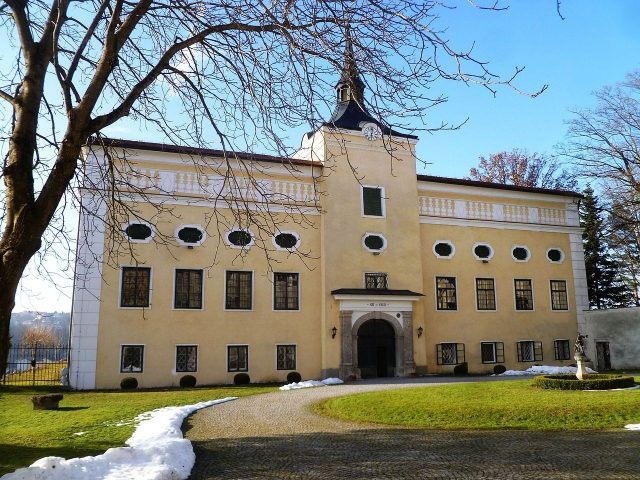
Kremsegg Castle is a castle in the Kremsegg district of the Upper Austrian municipality of Kremsmünster.
From the 13th century, the fortified settlement "Crembseck" served as a refuge for the population of the Krems Valley, with the von Roth family as the lords of the castle. In 1464, the castle passed into the possession of the noble Grünthaler family through the marriage of Barbara Rothin to Andreas Grünthaler. Around 1600, the locally historically significant "Haushaltungsbüchl der Grünthaler" (Household Book of the Grünthaler) was also created there. The Protestant Grünthaler family was forced to leave the country during the Counter-Reformation. In 1627, Anton Wolfradt, the abbot of the nearby Kremsmünster Abbey, acquired the estate with its manorial rights. The conversion into a castle was almost certainly carried out by Jakob Prandtauer on behalf of his successors.
In 1848, the abbey sold the castle, which subsequently experienced many changes of ownership.
In 1929, the castle came into the possession of Countess Kinsky. After the death of Baroness Therese Kinsky in 1973, her cousin and adopted son Count Cernyn sold the castle to the Lutzky family in 1976. The castle and the associated park grounds were extensively restored and restructured. A vehicle museum was set up in the castle, exhibiting cars and motorcycles. In 1996, the supporting association Musica Kremsmünster took over the castle, and in the same year, the first musical instrument exhibition was opened. The vintage car collection was sold to the Kröpfl Vintage Car Museum in Hartberg, Styria.
Architecture+
The access road to the gatehouse of Kremsegg Castle branches off from the Kremsmünster - Bad Hall road. An avenue leads to the castle, which passes in front of a transverse building that stands in front of the actual castle. Above the gate is the coat of arms of Abbot Anton Wolfradt, who became Prince-Archbishop of Vienna in 1631. Passing through the vaulted gate passage, one reaches a small square in front of the castle. In the middle of the square is a fountain with a hunter figure blowing a hunting horn and a dog.
The castle is a two-story, four-winged building. The gate access is formed by a mighty central risalit, which represents the remains of a tower dismantled in 1803. The transverse building is connected on the left side by a low wall and on the right by a higher wall, the latter leading through a wrought-iron gate to a park.
The castle courtyard is designed with arcades, which are glazed on the first floor. On both sides of the entrance gate are staircases to these arcades. A sundial adorns one side of the quadrangle.
Musical Instrument Museum+
Since 1996, the castle has housed the Kremsegg Castle Musical Instrument Museum, a large collection of musical instruments. The foundation is formed by the collection of over 1200 brass instruments from trumpeter Franz Xaver Streitwieser, whose wife Katherine financed this collection from family assets (General Motors). The collection remained in the USA until her death and was relocated to Bavaria and then to Upper Austria in 1996 due to her testamentary disposition. In 2001, Prof. Paul Badura-Skoda made parts of his large piano collection available to the museum on loan, and in 2007, the horn collection of Prof. Hans Pizka was acquired. Four permanent exhibitions are shown:
- an extensive collection of brass instruments (rare and historically significant wind instruments from all over the world)
- an outstanding collection of pianos (presentation of playable restored instruments)
- an exhibition about Franz Schubert, who demonstrably stayed in Kremsmünster three times during his life
- an exhibition about Friedrich Gulda, whose estate is archived by the museum's supporting association "Musica Kremsmünster"
Take Mobile History with you
You are reading this text for free. Premium adds what matters on the road: descriptions read aloud, sites found through your camera, whole regions taken offline.
- Every description, including the ~17,700 Premium sites
- Audio guide: have descriptions read to you on location
- AR finder: see sites through your camera, with distance and bearing
- Unlimited saved sites
14 days free, then from €2.99 a month. Cancel anytime.
Source: Wikipedia · Licence: CC BY-SA 4.0 · Image: http://commons.wikimedia.org/wiki/File:Schloss_Kremsegg.jpg
This description draws on the facts documented in the linked Wikipedia article; Wikipedia content is licensed under CC BY-SA 4.0. Wording and editing: Mobile History.
Location: 48.0543, 14.1451