To be privately owned
CastleNürnberg-Kornburg
Kornburg Castle
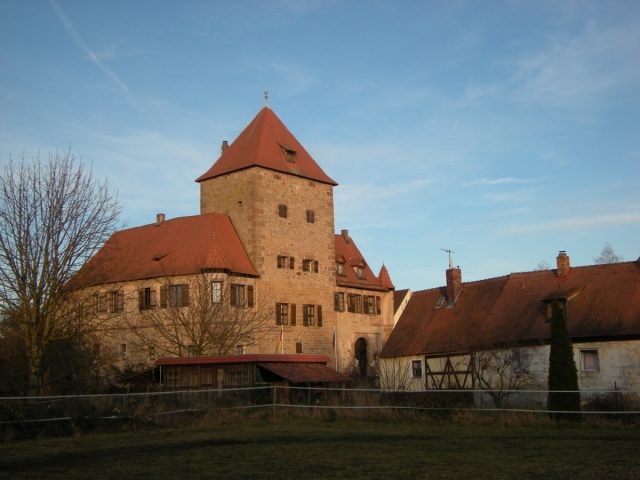
The castle was already named in 1236 by the Nuremberg Imperial Butler Chunradus de Churenburc in a deed of gift. The name of the castle is said to derive from the old word "Kürn" for mill. The imperial ministerial family of Kornburg can also be traced in the 1260s. A presumably younger Cunradus testified in 1272 for the imperial ministerialis Heinrich von Thann. In 1293, a deceased Konrad von Kornburg and his son Heinrich are mentioned. Perhaps Konrad was identical with the Nuremberg beekeeper of the same name, whose second son, also a Konrad, is said to have died in 1313. Johannes Müllner mentioned in his annals of 1623 the adoption of Nuremberg citizenship by "Cunradt von Eibach de Kürenburg" in 1308. Presumably, the Kornburgers were of the same lineage as the ministeriales of Eibach.
The exercise of manorial rights must have been considerably hampered for the Kornburgers when the village and court of Kornburg became an imperial pledge to Count Emicho von Nassau in 1299, then sold to the Burgraves in 1364. In 1347, a settlement between Anna Countess of Nassau, her son Emicho Jr., and the knight Heinrich von Kornburg was intended to regulate the situation. During the War of the Cities in 1388, the Kornburgers witnessed how the presumably still high medieval castle was burned down and razed by Nuremberg troops. Under Stephan von Kornburg, it was probably rebuilt soon after.
After the death of the last Kornburger in 1404, an inheritance dispute broke out, with the settlement of which in 1405 the Kornburg fell to the widow Katharina von Hohenfels, a born Kornburger. In 1405, Katharina was also enfeoffed with the Kornburg by King Ruprecht I. In 1422, she bequeathed the castle to her daughter Anna, who was married to Hans von Seckendorff zu Dettelsau. From Anna von Seckendorff, it then passed before 1445 to her son Georg von Seckendorff zu Dettelsau, who thereafter called himself zu Kornburg. He got into a dispute with the imperial city over the use of the Kornburg quarries, which was even brought before the royal court in 1446. In 1447, Seckendorffer, who probably foresaw eternal trouble with Nuremberg, sold the inherited imperial fiefs, including the famous sandstone quarries, to the Nuremberg citizen Peter Rieter, who was married to his aunt Barbara. The Rietter, probably descended from the ministerialis, had presumably adopted Nuremberg citizenship with Heinz Rieter in 1361 and had been admitted to the council of the imperial city for the first time in 1437. The castle remained in their possession thereafter until the extinction of the family, which called itself Rieter von Kornburg until the very end.
Peter Rieter transferred his Kornburg property in 1450 to the Rieter Family Foundation founded by him. It is not clear whether the war damage suffered in the First Margrave War in 1449 had already been repaired. After the extinction of the Kornburg line of the Rieter, the Kornburg foundation property was merged with the Rieter Foundation Kalbensteinberg around 1502 under Jörg Rieter von Boxberg. Since he resided near Bad Mergentheim, he left the administration and use to the Nuremberg Heilig-Geist-Spital in 1517 against an annual rent until 1585. The hospital had to witness in the Second Margrave War on May 15, 1552, how the castle and the farmstead were once again burned down. The war damage was repaired in the 1560s, also in 1563, when the forest office allocated timber from the imperial forest. However, as the Rieter themselves later stated, the repairs were rather provisional for economic reasons.
Under administrator Hans Rieter von Kornburg, the castle underwent major changes, especially after 1600, when people no longer wanted to put up with the cramped living conditions in the residential tower. Around 1607, the so-called long hall was built for his wedding in an annex to the curtain wall. In 1612, further annexes for living quarters were planned, because the lord of the castle was annoyed by the inconvenient access and heating of the superimposed rooms and chambers in the tower. In 1613, the demolition of a half-timbered building attached to the west of the residential tower was finally planned; it was intended to replace it with a solid structure leaning against the curtain wall. This was to completely cover the wall between the long hall and the tower. The major renovation was approved in 1613 on the condition that no additional fireplaces would be installed, and was probably carried out in 1614. Under Hans Rieter, the outer bailey was also largely renewed structurally: In addition to a modernization of the stables, two barns and the bailiff's house were newly built around 1608. From 1613 to 1615, the Voithaus, a cattle stable with staff accommodation, a carriage house, and a bakehouse were newly built or extensively rebuilt.
The soldiers of Imperial General Wallenstein, who systematically set fire to the villages in the southern Nuremberg area shortly before their departure from their camp at the Alte Veste in September 1632, largely destroyed the structural efforts of the Rieter family. The imperial city administration subsequently recorded a total of 83 burned down or destroyed buildings in Kornburg, including the parish church and the Rieter castle. It is not clear whether the moated castle actually remained devastated until 1686, as has been stated several times. A larger construction measure, which according to the forest office's records began in 1682, could only have been a renovation of the "old buildings" that had been repaired before. With 215 tree trunks of timber, the roofs of the buildings were probably to be repaired in 1682/83.
With the death of Johann Albrecht Andreas Rieter von Kornburg on February 13, 1753, the family died out. According to the statutes of the Rieter Foundation of the 15th century and contrary to the Rieter's will, the assets ultimately fell to the Heilig-Geist-Spital. As a result of protests from the Ritterkanton Altmühl, however, the latter retained the taxation of the estates, and at the same time a member of the Nuremberg Council was appointed as administrator, who was matriculated with the knighthood; they all belonged to the Haller von Hallerstein family, first Burkhard Albrecht (until 1763), then Christoph Joachim (until 1792) and finally his son Johann Sigmund Christoph Joachim Haller von Hallerstein (until 1807). At least the latter two often stayed with their families at Kornburg Castle in the summer. The hospital administration collected the rents from the knight's estate, but skimped on the structural maintenance of the old moated castle, which was protected by a lined moat.
In addition, it had to endure military billeting several times, during which the furnishings were damaged. In 1812, the complex was finally sold to the former Kornburg bailiff, who was overwhelmed with the building maintenance. In 1817, the old residential tower was so dilapidated that there was no other option but to demolish the upper floors.
In the 19th century, the castle first saw the establishment of a wallpaper factory, then a tobacco spinning mill. After 1860, it became quarters for low-income tenants. It can be assumed that building damage increased and valuable furnishings were lost. In 1922, the antique dealer and painter Heinrich Nüßlein acquired the rather dilapidated property and had the complex renovated with a very free reconstruction from 1923 to 1927. Nüßlein wanted to restore the moated castle to its old appearance and had the upper floors of the residential tower rebuilt. Large parts of the adjacent residential wing with the round bay turrets as well as the courtyard facades were also renewed at this time. The builder, who also did not shy away from redesigning the historic interiors, used them for painting exhibitions, so the complex was also known at the time as the "Castle of a Thousand Pictures".
After the Second World War, Ida Volkert acquired the castle. Her descendants still maintain it today. Medieval remains are probably only to be found in the lower areas. The buildings, shaped by the early modern alterations, enclose the inner castle courtyard and have half-timbered exterior walls here. The historicizing gallery with open staircase dates from Nüßlein's renovation. A northern roof dormer with a polygonal roof, pilasters and other carvings from around 1600 was probably translocated here from an unknown location around 1925. Above the portal is an alliance coat of arms of Paul Albrecht Rieter and his wife, a born Löffelholz, from 1686.
Take Mobile History with you
You are reading this text for free. Premium adds what matters on the road: descriptions read aloud, sites found through your camera, whole regions taken offline.
- Every description, including the ~17,700 Premium sites
- Audio guide: have descriptions read to you on location
- AR finder: see sites through your camera, with distance and bearing
- Unlimited saved sites
14 days free, then from €2.99 a month. Cancel anytime.
Source: Wikipedia · Licence: CC BY-SA 4.0 · Image: http://schloesserrundschau.de/bayern/schloesser01/nuernberg35.html
This description draws on the facts documented in the linked Wikipedia article; Wikipedia content is licensed under CC BY-SA 4.0. Wording and editing: Mobile History.
Location: 49.3553, 11.0985