To be privately owned
CastleKönigsbrück
Königsbrück Castle
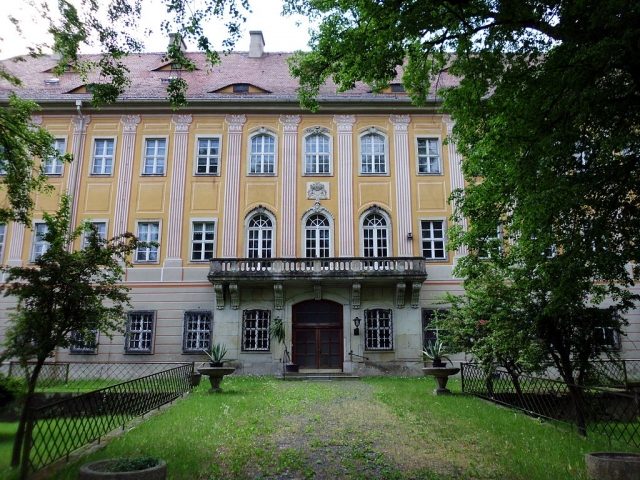
Königsbrück Castle is situated on a rocky spur in the Pulsnitz valley near Königsbrück and is partly surrounded by the Pulsnitz river.
The castle was originally a wooden border fortress, which became necessary to secure the border between the Saxon Margraviate of Meissen and the Bohemian Margraviate of Upper Lusatia. The Pulsnitz was the border river at that time. When the Frankfurter Gleis (Frankfurt track) later emerged, crossing the Via Regia here, bridge and escort tolls were collected for the Royal Bridge in Dresden.
At the beginning of the 13th century, Königsbrück was held as a fief by the Lords of Kamenz. This is evident from a foundation charter of the St. Marienstern Monastery dated October 13, 1248, which mentions the toll "de theoloneeo in Kunigesbruc". This is also the first mention of Königsbrück.
Under the protection of this border fortress, a settlement of craftsmen gradually developed for the trade wagons passing through here. A 65x75 m² square was laid out for resting and unhitching, which subsequently developed into a market square.
The first named owner, Heinricus de Konigesbruck, appears on September 8, 1298, as a witness in a document of the Margrave of Meissen. This Heinricus was certainly a vassal of the Lords of Kamenz and thus not yet in possession of the manorial lordship. This was only achieved by Hawlatsch von Dohna after the Kamenz lordship dissolved in 1438. Already in 1346, the Königsbrück main church is mentioned for the first time in a Meissen matricula.
In a special document dated January 11, 1351, issued by Charles IV for the city of Budissin, it states that the "oppidum" (town) and Königsbrück Castle should never be separated from the crown and the Vogtland of Budissin.
In 1454, Wladislaw, King of Bohemia, enfeoffed the Brothers von Dohna "[...] furthermore with the seat built by their father Hawlatsch von Dohna in front of the town." These brothers gradually assimilated the villages of the former Kamenz lordship located on the Upper Lusatian side.
From 1439–1579, the town was owned by the Burgraves of Dohna, whose possessions were first referred to as a lordship in 1527. After the death of Christoph von Dohna, the town and the manorial lordship of Königsbrück reverted to the Crown of Bohemia as an expired fief. However, Emperor Ferdinand I sold them again in 1562 to Caspar von Dohna zu Straupitz (Lower Lusatia), who had them elevated to the fourth manorial lordship of Upper Lusatia in the same year. In 1551, the designation "Herrschaft" (lordship) for Königsbrück appeared for the first time. In 1560, Christoph von Dohna was struck by lightning in Bautzen during a sermon. With him, this line of Dohna died out. Only the construction of the Baderbrücke and the renovation of the old part of the castle with coats of arms in the exterior plaster of the spiral staircase commemorate this family. In 1562, Casper von Dohna zu Straupitz was enfeoffed with the Königsbrück lordship. The hospital church, which he had built, still commemorates him.
In 1704, under the rule of Maximilian Freiherr von Schellendorf, the current main castle and the farm buildings with a nursery were built; the large terrace walls had already been added in 1703. In 1726, the manorial lordship passed to Heinrich Friedrich Reichsgraf von Friesen zu Schönfeld (near Dresden). During this time, an open staircase was created, which was later walled up. In 1752, large greenhouses were built.
In 1803, Count Peter Karl Wilhelm von Hohenthal took over the castle with all its appurtenances. During the Hohenthal rule, the orangery was demolished from the old castle, and the pilaster painting on the show side was created. In 1852, the castle passed from a bankruptcy proceeding of the Hohenthal family to Count von Wilding, who ran the building down almost to uninhabitability.
In 1893, the castle was purchased by Kommerzienrat Naumann. He was the founder of the company Seidel & Naumann in Dresden. After extensive renovations to the castle, the Naumann family was able to move in in April 1917. In April 1945, the Naumanns had to leave Königsbrück, and the property was expropriated by the communists.
The Lords of Königsbrück were:
- 1439–1579 Burgraves of Dohna
- 1579–1726 Lords of Schellendorf
- 1726–1773 Barons of Friesen
- 1773–1795 Counts of Redern
- 1795–1803 Count of Münster-Meinhövel
- 1803–1856 Counts of Hohenthal
- 1856–1893 Counts Wilding, Princes of Radali
- 1893–1920 Naumann Family
In 1945/46, the castle was used as a military hospital by the Russian occupation forces. In 1948, 32 bombed-out families from Dresden lived in the building. At the same time, applications were made for the demolition of the castle.
On July 13, 1948, the district decided to demolish only the castle tower for the time being. From 1952 to 1966, after extensive construction work, the castle was used as a recreation home. On November 1, 1966, the castle was opened as an outpatient clinic of the District Hospital for Neurology and Psychiatry Arnsdorf. The number of beds was initially 180, later increased to 220.
In 1985, the renovation of the castle's exterior facades began. In 1994, the Psychiatric Nursing Home was taken over by the Arbeiter-Samariter-Bund (ASB) as operator. On the initiative of the Königsbrück and Surroundings Local History Association e.V., the reconstruction of the castle tower began in 1997. For the 750th anniversary of Königsbrück, the turret was handed over on June 24, 1998. Due to the new construction of a retirement home in Königsbrück Castle Park and in Bernsdorf, the castle has no longer been used as a nursing home since January 2001. It is now in private ownership.
An attraction is the Königsbrück camellias in a greenhouse of the castle nursery, which are among the oldest camellias in Europe.
Take Mobile History with you
You are reading this text for free. Premium adds what matters on the road: descriptions read aloud, sites found through your camera, whole regions taken offline.
- Every description, including the ~17,700 Premium sites
- Audio guide: have descriptions read to you on location
- AR finder: see sites through your camera, with distance and bearing
- Unlimited saved sites
14 days free, then from €2.99 a month. Cancel anytime.
Location: 51.2625, 13.9000