To be privately owned
CastleKöditz
Köditz Castle
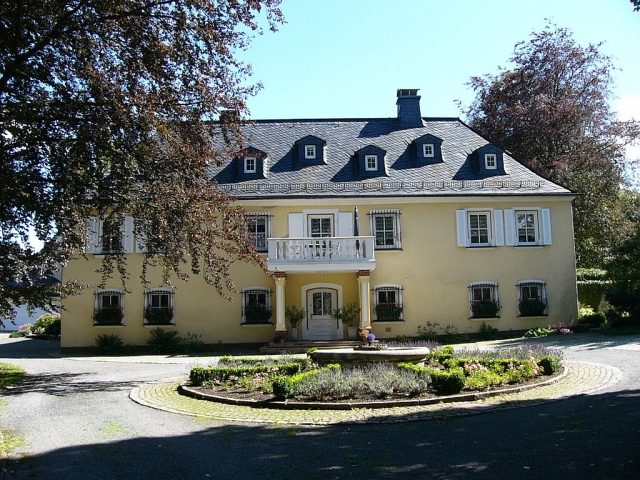
Radisborski von Sechzebus took over the estate from the Reitzensteins around 1620. In 1665, Johann Paul Joditzer from Hof acquired the estate. Joditzer is documented as the donor of the pulpit in Köditz's St. Leonhard Church by the inscription of 1641. Johann Christoph von Falkenstein, who descended from the ancient Vogtland nobility of Falkenstein (13th century), acquired the Köditz manor from Joditzer in 1666.
Following the example of noble estates, the Falkensteins created an elongated castle building with stables and farm buildings. They continuously expanded their property, buying additional estates and much land. Thus, from 1661, a large ornamental garden in the Baroque style was also created. By custom, people in the area only referred to it as the Köditz manor.
From the House of Köditz, through Johann Christoph and Erdmann von Falkenstein, sprang a Saxon, Württemberg, Prussian, and Oldenburg line. Also originating from the House of Köditz is Johann Paul Freiherr von Falkenstein, born in 1801, a grandson of the aforementioned Heinrich August Erdmann von Falkenstein. He was Royal Saxon Minister of the Interior, Justice, and Culture, Minister of the Royal House, Prime Minister, Dr.jur.h.c., Dr.phil.h.c., honorary citizen of the city of Leipzig, first honorary citizen of the capital and residential city of Dresden, holder of the highest Royal Saxon Order of the "Rautenkrone". He founded the Leipzig Music Academy with Robert Schumann and Felix Mendelssohn.
The coat of arms of the municipality of Köditz can be traced back to the Falkenstein family coat of arms with the ermine-trimmed princely hat. The family had a family crypt in the Köditz church. There is a Falkensteinstraße in both Köditz and Hof.
On February 21, 1764, the merchant Johann Georg Oerthel from Hof acquired the estates from Heinrich Erdmann von Falkenstein. In 1775, his brother Samuel Friedrich Oerthel, mayor in Hof, took over the Köditz manor for 6048 Franconian guilders. On July 1, 1783, both brothers (due to their enormous possessions!) were elevated to the Imperial nobility. After Samuel's death, the Köditz estate passed in 1802 to his grandson Georg Friedrich Samuel von Oerthel and in 1846 to his son-in-law Andreas Anton Waltz, who in turn passed it on to his son Robert Waltz (grandson of Georg Friedrich von Oerthel).
Dated March 29, 1811, there is a property register of the "merchant Georg Friedrich Oerthel zu Hof". The register, signed by Georg Friedrich, lists, among other things:
An estate in Köditz, to which belong:
a residential house No. 59, half solidly built,
a separate outbuilding,
two cattle stables,
a pig and a sheep stable,
a wagon shed, a wood shed,
2 barns, one of which is in the village,
two enclosed farmyards and
a garden house in the grass garden
To the estate belongs in land:
40 TW fields
44 TW meadows and pastures
17 TW wood
1 TW garden at the house
1 fishing water (Mollabächlein)
In the Köditz chronicle, under the year 1838/39, it states about Georg Friedrich: He is praised throughout the region as an "art gardener" for his garden designs in Köditz. The garden adjacent to the manor house consisted of "a fruit and flower garden, 1 ¾ Tagwerk in size, in four sections, with a greenhouse, warm beds, and various installations". The greenhouse must have been particularly dear to him, as Georg Friedrich took out a separate fire insurance for its contents. Georg Friedrich thoroughly renovated the estate and "rebuilt" the residential house, stables, and wood sheds. He leased the agriculture for 283 fl annual rent to Johann Thomas Klug in Köditz. Over time, Georg Friedrich increased the land belonging to the Köditz estate. When he died and the estate was put up for sale, fields, meadows, pastures, and forests together amounted to over 210 Tagwerk. This is double the area compared to 1811.
In 1889, the estate was acquired by Rittmeister Johann Curt Friedrich Hering, who donated the chandelier for the Köditz church in 1892. Hering's son-in-law Walther Eugen Würker acquired the estate in 1926. Today, the listed property is still owned by his grandson.
Take Mobile History with you
You are reading this text for free. Premium adds what matters on the road: descriptions read aloud, sites found through your camera, whole regions taken offline.
- Every description, including the ~17,700 Premium sites
- Audio guide: have descriptions read to you on location
- AR finder: see sites through your camera, with distance and bearing
- Unlimited saved sites
14 days free, then from €2.99 a month. Cancel anytime.
Source: Wikipedia · Licence: CC BY-SA 4.0
This description draws on the facts documented in the linked Wikipedia article; Wikipedia content is licensed under CC BY-SA 4.0. Wording and editing: Mobile History.
Location: 50.3296, 11.8493