Museum
Restaurant
CastleUhlstädt-Kirchhasel - Großkochberg
Kochberg Castle
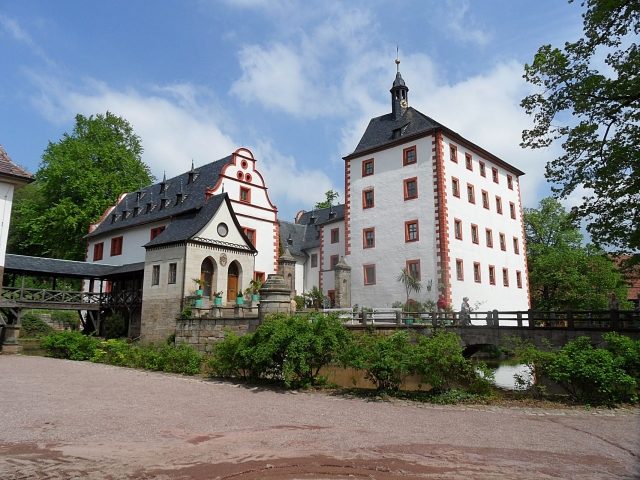
The former manor with Kochberg Castle is located in South Thuringia in Großkochberg near Rudolstadt and is primarily known for several visits by Goethe.
The complex is grouped around a central square, the "Plattenhof". The oldest part of the building is the "Hohes Haus" in the southeast, which dates back to the moated castle first mentioned in 1380. The earliest detailed description of the castle dates from 1659. It mentions a spring in the castle park and a pipe system that fed the square moat from the so-called Bergteich. The presumably only access to the castle at that time was a drawbridge in the east. The now dominant building, the "Hohes Haus" in the west of the complex, dates from the 17th century and is built in the Renaissance style. Later, a park was laid out to the west and north of the castle, which a bridge connects to the central building ensemble. Another bridge leads south to the farmyard.
A noble family of the same name, presumably originating from this castle, is already documented for the 13th century. In 1506, Hartmann von Kochberg died. His widow married Siegfried von Schönberg, who thereby also received the castle. His heir Georg von Schönberg sold the castle to Balthasar von Kochberg. In 1733, the Barons von Stein-Kochberg came into possession of the castle. Due to his friendship with Charlotte von Stein, Johann Wolfgang von Goethe visited Kochberg Castle several times, first on December 6, 1775, and for the last time on September 5, 1788. In 1938, Charlotte's last heir, Felix von Stein, died. In 1945, the owners were dispossessed and expelled by the communists. The current owner of the properties is the Klassik Stiftung Weimar. Descendants of the Stein family live in Denmark with restitution claims for parts of the furnishings. Negotiations aim to achieve a permanent loan for some parts and acquisition for other pieces.
Usage+
On August 27, 1949, a Goethe memorial was inaugurated. After extensive restoration, the castle was reopened to the public in 1975. Until the fall of the Berlin Wall, the castle was a recreation home of the Cultural Fund of the GDR. In the early nineties, an attempt was made to operate the castle as a hotel. In 2011, the castle was closed to the public for restoration work. In April 2012, the extensively restored castle ensemble, costing 2 million euros, was ceremoniously reopened. The castle houses a restaurant and a castle museum. Its most valuable exhibits are two of Goethe's desks.
Amateur Theater+
At the entrance to the castle park lies the amateur theater, which Carl von Stein had built around 1800, whereby the original two-story baroque garden house was converted, extended, and supplemented by a columned portico and a large, bright stage room. The interior was decorated with marble paper. Since its reopening after restoration in 1975, a lively theater and concert life with internationally renowned artists has taken place here between Easter and late autumn. The theater has 75 seats, thus offering a very unique, intimate atmosphere for theater and opera performances, chamber music events, and readings. In 1993, the premiere of Philipp Christoph Kayser's Goethe opera Scherz, List und Rache (1787) took place here.
Take Mobile History with you
You are reading this text for free. Premium adds what matters on the road: descriptions read aloud, sites found through your camera, whole regions taken offline.
- Every description, including the ~17,700 Premium sites
- Audio guide: have descriptions read to you on location
- AR finder: see sites through your camera, with distance and bearing
- Unlimited saved sites
14 days free, then from €2.99 a month. Cancel anytime.
Source: Wikipedia · Licence: CC BY-SA 4.0 · Image: Uwe Klimpke
This description draws on the facts documented in the linked Wikipedia article; Wikipedia content is licensed under CC BY-SA 4.0. Wording and editing: Mobile History.
Location: 50.7764, 11.3575