Prison
CastleBad Mingolsheim
Kislau Castle
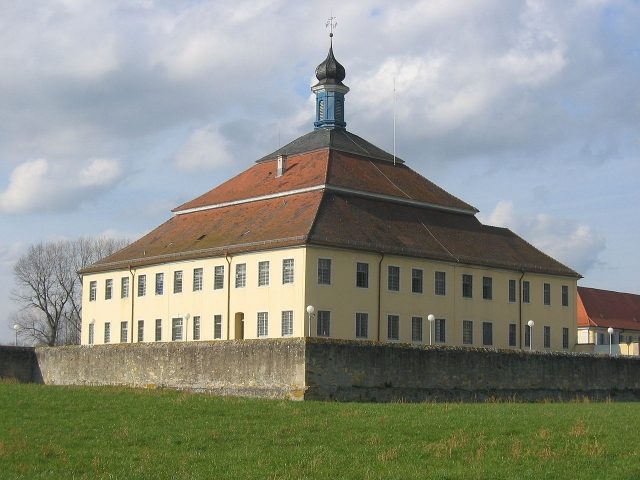
Kislau Castle is located in the district of Bad Mingolsheim in the municipality of Bad Schönborn, on the Rhine Valley Railway Heidelberg-Karlsruhe. Today it is used as a correctional facility.
The name Kislau comes from the old word Kislowe, which means "gravelly meadow". It thus describes the geographical location in the Bruhrain, the transition area between Kraichgau and Hardtwald, which stretches from Bruchsal to Wiesloch. In older documents, the spelling "Kißlau" or "Kieslau" can also be found.
Historically, Kislau is the medieval lordship of the same name, including the associated castle (Rudolf von Kislau was first mentioned in the Lorsch Codex in 1165). The origins of the complex probably date back to the 11th century, as the first reports about the Lords of Kislau, whose dominion also included the surrounding villages of Mingolsheim, Langenbrücken and Kronau, come from this period (1083).
Presumably around 100 AD, the Romans built a fort, located in front of the Limes and protected by moats, which was connected by roads to the nearby fortress of Burg Wersau near Reilingen and the towns of Weiher, Karlsdorf (Altenbürg), Staffort, Hagsfeld and Kleinrüppur.
After Hungarian horsemen repeatedly raided southern Germany around 930, the Count of Worms (Konrad the Red or Konrad the Salian), a son-in-law of Otto the Great, was responsible for a defense plan for the particularly afflicted Kraichgau. Under his leadership, the massive Romanesque ashlar building was constructed, the remains of which are still preserved. Kislau Water Castle was first mentioned in a document in the Sindelfingen Annals in 1083 as "Castrum Chiselowa" ("Chiselowa" or "Kisilowa" means "gravelly meadow" or "gravelly field" in Old High German). The name probably comes from the fact that the castle complex is founded on massive gravel deposits of the prehistoric Kinzig-Murg river. Kislau had its own castle nobility very early on. In 1116, an Adelbert von Kislau, a son-in-law of Count Werner von Worms, was mentioned. In the subsequent period, several Rudolfs von Kislau were mentioned.
Around the years 1232 to 1237, the Kislau knightly family died out. In 1252, King William of Holland enfeoffed this Kislau property, the "Castrum", to his chancellor, the Speyer bishop Heinrich II von Leiningen. Kislau thus came into the possession of the Prince-Bishopric of Speyer and then served as the official residence for the episcopal chief bailiffs in the Bruhrain for over 400 years. In a document dated April 20, 1366, in Prague, "Mingolzheim" is first mentioned as Speyerian when confirming the estates of Bishop Lambert of Speyer.
The Kislau office was staffed as a senior administrative district with a senior official and seven junior officials. It administered the surrounding communities: Forst, Hambrücken, Kirrlach, Kronau, Langenbrücken, Mingolsheim, Östringen, Rettigheim, Rot, St. Leon, Stettfeld, Ubstadt, Weiher and Zeutern.
Around 1415, Peter Luder was born in Kislau and worked as a university lecturer in Heidelberg from 1456–1460. He was one of the first humanists in Germany.
The most famous of the prince-bishops who gladly chose Kislau as a summer residence and for hunting trips in the game-rich Lußhardt was probably Bishop Georg von Speyer, who in 1525, together with his brother, Elector Ludwig of the Palatinate, suppressed the peasant uprising (Peasants' War) in the Kraichgau. Elector Ludwig V sent a force of 4500 landsknechts, 1800 horsemen with several cannons from Heidelberg via Malsch and Kislau on May 22, 1525, which arrived victoriously in Bruchsal on May 23, 1525. After a wave of arrests, the rebellious peasants were imprisoned in Kislau, and on May 24, 1525, the four known ringleaders were beheaded on the castle bridge by the executioner of Elector Marshal Wilhelm von Habern. Some had their swearing fingers chopped off, others were fined or banished from the country. The communities involved in the uprising in the episcopal offices of Udenheim (Philippsburg), Rotenberg, Kislau, Bruchsal and Grombach (Unter- and Obergrombach) were fined 40,000 gold guilders. From each house in the affected communities, 14 gold guilders had to be raised for the peasants' ransacking. Hostages had to be provided by all communities until the payment obligation was fulfilled.
The castle fief was held by, among others, the Lords of Stein, the Göler von Ravensburg, Wiprecht von Helmstadt and Franz von Sickingen. On September 27, 1529, Bishop Georg von Speyer died at the age of 43 in Kislau Castle. In 1532, Anabaptists were imprisoned.
A large part of the outbuildings was destroyed by a major fire in 1647. Despite the neutrality of the bishopric, the castle complex was razed in 1675 during the siege of Philippsburg by the troops of the Sun King Louis XIV. The defensive tower was blown up and the moats were filled in.
Hunting Lodge
Kislau was to become one of the country castles of the Speyer Prince-Bishop Damian Hugo von Schönborn. Kislau Castle was designed in 1721 by Damian Hugo von Schönborn, Prince-Bishop of Speyer, as a baroque hunting lodge. Initially with the master builder Ludwig Michael Rohrer and the master craftsman Johann Georg Stahl. The previously existing castle, a moated castle, had been severely damaged by French troops in 1675, with the exception of the large keep.
The keep, the medieval main building, remained the center of the new castle complex. For this purpose, it was encased with a sequence of rooms, in which mainly the lordly rooms and a chapel were housed. This created the characteristic view of the compact, monumental main house with its unusual pyramid roof. In front of this "Corps de Logis", a courtyard of honor with ornamental beds and fountains was laid out, flanked on both sides by cavalier houses. This representative center still found space within the inner moat; only beyond the bridge was a farmyard and buildings for the administration of the Kislau office created. These buildings were located in the area of the outer bailey, enclosed by the outer moat. Outside the castle complex, at the bridge over the moat, a lordly mill was built on the site where the medieval mill would also have stood. While the access to the complex and the outbuildings were in the north, a castle garden was laid out to the south of the main house, accessible via a bridge. From there, a straight poplar avenue led to Langenbrücken. Thus, the castle complex was retained and developed into an axially symmetrical complex in baroque taste. The moat, formerly a defensive element, blended well with the baroque preference for reflective water surfaces, and the old defensive tower was repurposed as the central staircase of the new castle building.
Schönborn's successor Christoph von Hutten continued the construction work and had his master builder Johann Leonhard Stahl execute, among other things, the cavalier building and the bishop's bath.
Military Hospital
Through the secularization of church property in 1803, Kislau came to Baden. In 1813, the castle was converted into a barracks and military hospital for the Grand Ducal Baden Invalid Corps. Construction reports complained about poor sanitary facilities and enormous pest infestation. At times, up to 500 mentally ill soldiers who had fought against Napoleon were housed there. For Kislau Castle and the remains of the moated castle, this resulted in significant losses to the existing structures. The outdoor facilities, with the exception of the wall, are lost, and the valuable Rococo interior decoration is largely destroyed. However, in recent years, the bishop's bath has been restored with great effort. The 18th-century buildings are largely preserved and still provide a vivid picture of the baroque country castle today.
Prison and Camp
In 1824, a state prison, a political detention center, and a workhouse were also established. After the defeat of the Baden freedom fighters, the castle was used as an internment camp in 1848 and 1849; among the prisoners were many students from Heidelberg.
In 1927, it was again used as a workhouse. Three years later, the castle was temporarily a nursing home for mentally disabled women. At the beginning of the First World War, in 1914, a military hospital was stationed on the premises.
After Hitler's seizure of power in 1933, an SS "protective custody camp" for political prisoners (especially from Mannheim) and a transit camp for former foreign legionnaires were established; the judicial administration was housed in part of the workhouse. Kislau was a central camp for Baden: various members of the previous Baden government were interned here in protective custody without trial, for example Interior Minister Adam Remmele, State Councilor and local writer Stenz, the Reichstag member and State Councilor Ludwig Marum, who was murdered in his cell on March 29, 1934. Temporarily, the father of the Scholl siblings (resistance movement "White Rose") was also imprisoned here. In 1939, it was closed again. The camp is also called KZ Kislau.
At the end of the war, it was occupied by French Spahis, colonial troops from Morocco, and then used as a reception camp for refugees and as a state old people's home for refugees.
1945 to Today
After the Second World War, in 1946, it briefly served as accommodation for displaced Sudeten Germans. Since 1948, the castle has been an external branch of the Bruchsal correctional facility for "rehabilitation of offenders". In 1970, an external branch of the Karlsruhe correctional facility was established as an institution for offenders with sentences of up to three months. Twelve years later, renovation of the entire complex began. Temporarily, a juvenile correctional facility was housed in the premises. In 1991, it was again used as an external branch of the Bruchsal correctional facility, this time as a detention center for offenders with sentences of up to one year. Since 1997, Kislau has practiced open prison with sentences to be served for up to seven years.
Take Mobile History with you
You are reading this text for free. Premium adds what matters on the road: descriptions read aloud, sites found through your camera, whole regions taken offline.
- Every description, including the ~17,700 Premium sites
- Audio guide: have descriptions read to you on location
- AR finder: see sites through your camera, with distance and bearing
- Unlimited saved sites
14 days free, then from €2.99 a month. Cancel anytime.
Source: Wikipedia · Licence: CC BY-SA 4.0 · Image: http://commons.wikimedia.org/wiki/File:Schloss_Kieslau_Kronau_Deutschland.JPG
This description draws on the facts documented in the linked Wikipedia article; Wikipedia content is licensed under CC BY-SA 4.0. Wording and editing: Mobile History.
Location: 49.2164, 8.6447