Youth hostel
CastleCoburg
Ketschendorf Castle
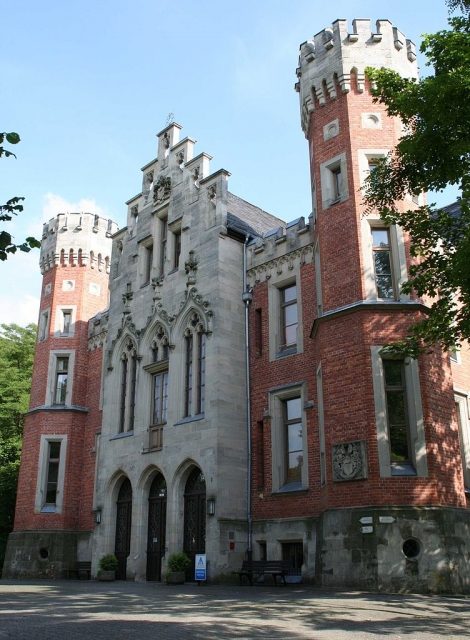
The Neo-Gothic Ketschendorf Castle is located in the Ketschendorf district of Coburg at the foot of the Buchberg.
Baroness von Stolzenau had it built at the beginning of the 19th century in the middle of an extensive park. The castle is one of the most perfect buildings of Coburg's Neo-Gothic Belt and has had nine different owners in its history. Since 1956, it has been used as a youth hostel, which was closed indefinitely on December 1, 2010, due to planned renovations.
Original Building
Keczendorff, as Ketschendorf was called about 900 years ago, was an unprotected village outside the city walls of Coburg on the western slope of the Buchberg. The few inhabitants suffered greatly in 1430 from Hussite invasions and in 1525 from the horrors of the Peasants' War. Twice, in 1567 and 1626, the plague swept through the village. In 1632, Wallenstein took up his personal quarters in Ketschendorf during the siege of Veste Coburg, making high demands, and only two years later, the imperial Colonel Schlitz and his Croats destroyed the entire village. It took a good 150 years for Ketschendorf to somewhat overcome the consequences of this catastrophe, but it was only when Duchess Auguste, the wife of Franz Friedrich Anton of Saxe-Coburg-Saalfeld, had a small Empire-style summer castle built in 1804 as the first noble residence of the old village that an economic boom began.
After the Duke's death, Ketschendorf Castle remained Auguste's widow's residence. In addition to her seven children, many princes visited the Duchess, including her sons-in-law Duke Alexander Friedrich Karl of Württemberg, Grand Duke Konstantin Pavlovich of Russia, and Edward Augustus, Duke of Kent and Strathearn. Friedrich Ludwig, Hereditary Prince of Mecklenburg-Schwerin, and Konstantin's parents, Paul I and Sophia of Württemberg, as well as his brother Tsar Alexander I of Russia, were also guests at the castle.
In 1831, after the death of Duchess-Dowager Auguste, Ernst I's second wife, Marie of Württemberg, moved into Ketschendorf Castle and lived there until her own death in 1860. The owner of the estate was now Duke Ernst II. In 1868, he sold the allegedly dilapidated building to the Frenchwoman Victorine Noël.
Rosine Stoltz
Born in Paris in 1815, Victorine Noël was already a celebrated opera singer at the age of 22 under her stage name Rosine Stoltz. She performed in famous houses such as the Théâtre de la Monnaie in Brussels, the Paris Opéra, the Teatro Municipal in Rio de Janeiro, and La Scala in Milan. Composers Giacomo Meyerbeer and Gaetano Donizetti are said to have composed roles specifically for her. Although known as an eccentric intriguer and notorious liar, she enjoyed the highest recognition among professionals and aristocratic audiences.
Duke Ernst II of Saxe-Coburg and Gotha was not only a friend of art and singers but also composed himself, including the opera Santa Chiara. Rosine Stoltz sang the main role in this romantic work at the Brussels Opera in 1856. It was here, at the latest, that Ernst met the scandalous diva. An intimate relationship developed, during which Rosine Stoltz stayed more and more often and for longer periods as a guest of the Duke of Coburg in Gotha, without ever having performed at the court theaters in Gotha or Coburg.
Ernst II finally elevated her to the nobility in 1865. She was now allowed to call herself Baroness von Stolzenau and, from 1868, Baroness von Ketschendorf. After 1865, she only fulfilled her guest contract at La Scala in Milan and thereafter no longer performed publicly as a singer.
Her great fortune enabled the newly ennobled Baroness to acquire Ketschendorf Castle with its associated park grounds for 100,000 francs, allegedly for her illegitimate son Charles, whose father, according to the Baroness, was none other than Napoleon Bonaparte, and who was now allowed to call himself Karl Freiherr von Ketschendorf, somewhat befitting his status. His real father could have been Ernst II, who publicly boasted of not having been childless outside of his marriage.
New Castle Construction
Still in 1868, the Baroness von Ketschendorf commissioned the Coburg building councilor Georg Konrad Rothbart, who had created the Edinburgh Palais two years earlier, to renovate the ducal Empire-style castle. Rothbart, however, designed a new, larger, and more solid castle next to the original building and condemned the only 63-year-old building to demolition, as its "enclosing walls were largely completely rotten." Within less than a year, he realized the new building with the help of 70 craftsmen, with the stonemasons having the hall in the old castle as a workshop, allowing work to continue even in the severe winter of that year. In June 1869, the new Ketschendorf Castle was completed, and the old one could be demolished. The demolition material was used to build a villa at Obere Klinge 3 in Coburg, which, in its overall design and through the use of the original preserved loggia with its classical columns, quite accurately reproduces the appearance of the old Ketschendorf building. This villa is therefore also called Old Ketschendorf Castle.
The new castle, with an almost square floor plan, was built of sandstone and red bricks and is considered a prime example of the Neo-Gothic castle style of Historicism in the Coburg region. All four sides are flanked by octagonal, crenellated corner towers and each has a projection in the middle that extends beyond the eaves line, with tracery-decorated stepped gables. The projection on the south side is particularly elaborately designed as a park entrance. Above the gate rises a loggia with an overlying terrace in front of the Baroness's bedroom. Columned loggias on the northern entrance front imitate the central risalit of the south side in a simpler way. On the northwestern corner tower, the builder had her new family coat of arms, carved in sandstone, installed. The shield of the coat of arms shows a harp and a helmet with a baron's crown and two closed wings. The motto below reads Vis in Corde (Strength in the Heart). In the gable, the coat of arms of the later owner, Baron von Mayer, can be seen; the coat of arms shows: split, on the left a rampant lion - on the right three ears of corn, above it a barred helmet with a crown and above it a rampant lion's torso. The motto below reads: Fortes Fortuna Adjuvat.
Inside the building, the staircase with its cast-iron ornamental railings and the view through the tracery church windows of the south front forms the representative center of the castle. Stuccoed ceilings in almost all rooms and a finely paneled large music room reflect the distinguished aspirations of the new lady of the castle. A dumbwaiter from the kitchen to the hall above, which she greatly valued, was also installed.
After only two years, in 1871, the Baroness von Ketschendorf sold the entire property for only 90,000 francs and moved back to Paris to dedicate herself to charitable services. At her death in 1903, she possessed not a single centime and was buried at the expense of the poor relief authority in Paris in a common pauper's grave. The new owner of the castle for a few months was the Coburg city architect Julius Martinet, known as the architect of the Luther and Rückert schools.
In 1872, the American William Tilden acquired the property and sold it already in 1873 to the commercial councilor Karl Rudolf Epner from Berlin. In 1891, the Jewish Baron von Mayer put an end to real estate speculation and bought the castle and park as a family residence. In 1893, he had Johannes Köhler build an open staircase with a tracery balustrade as a park entrance. In 1940, under the National Socialist administration of the district, a forced auction took place due to an alleged debt of 145,000 Reichsfluchtsteuer (Reich flight tax) and the expulsion of the von Mayer family. The city of Coburg bought Ketschendorf Castle, including inventory and park, for 45,000 Marks and set up accommodation for Bessarabian German repatriates. From 1942 until the end of the war, the castle was used as a partial hospital of the main hospital in the Coburg vocational school, then until 1955 as a TB ward of the district hospital.
Egon Freiherr von Mayer regained the family property through a restitution process in 1954, but did not move back to Ketschendorf, instead selling it again in 1955 to the city of Coburg, which has operated the property as a youth hostel in the DJH-Landesverband Bayern e. V. since 1956. On January 1, 1990, the responsibility for the architectural ensemble of the castle and the new/extension building from 1979 was transferred to the DJH-Landesverband. A part of the historic park, equipped with play, sports, meadow, and pond areas, remained with the city.
Park+
The castle park, which is now open, was significantly expanded in 1868 during the new construction of the castle by adding several newly acquired plots of land. This also incorporated the former communal well, important for the water supply of Ketschendorf households, into the area. The old spring feeds the castle pond located in the middle of the park. As a replacement for the no longer accessible communal well, the Baroness donated the Karlsquelle (Charles's Spring), named after her son, next to the former forge in Wassergasse. This charming facility bears the sandstone coat of arms of the Stolzenau-Ketschendorf family and an inscription tablet. This spring enclosure was moved there after the park was opened to the public after 1974.
At the edge of the castle pond stood the massive greenhouse, which belonged to the park. In the post-war years, it was left to decay and was finally sold in 1959 to the Ketschendorf sports club, which converted it into a training hall for weightlifters and a club restaurant, adding a large outdoor terrace to the restaurant on the lakeside in 1995.
Current Use+
Since 1956, the romantic Ketschendorf Castle has housed a youth hostel (130 beds until 1979). The historical furnishings in the entrance staircase (stucco lustro) and in the music room (wall panels) are partly still preserved, but completely so in the representative rooms of the bel étage, the magnificent, colorfully framed stucco and painted ceilings, as well as supraports. In 1960, the columned loggias on the northern entrance front were demolished due to dilapidation. In 1979/80, the current monument received a new building to the east. In addition to two new guest floors with 88 beds, guest catering, the manager's apartment, and the technical center were relocated here. Today, due to increased guest demands, approximately 130 guest beds are again available in the entire ensemble. The timely implementation of plans for a renovation costing approximately 7.1 million euros, including a refurbishment of the youth hostel, was not foreseeable in 2011 due to unresolved financing.
The villa called Old Ketschendorf Castle in Obere Klinge received two awards in 2005 for exemplary and detailed renovation in the spirit of monument preservation.
The former greenhouse by the castle pond, converted into a gymnasium, became the property of the city in 1996. In 2002, the Seemanns-Chor Coburg acquired the commercial part of the building and has since operated it as the "Kajüte," its club restaurant. The choir regularly holds summer concerts in the castle park.
For several years, the Coburg-Bamberg cycle path has run through the park.
Take Mobile History with you
You are reading this text for free. Premium adds what matters on the road: descriptions read aloud, sites found through your camera, whole regions taken offline.
- Every description, including the ~17,700 Premium sites
- Audio guide: have descriptions read to you on location
- AR finder: see sites through your camera, with distance and bearing
- Unlimited saved sites
14 days free, then from €2.99 a month. Cancel anytime.
Source: Wikipedia · Licence: CC BY-SA 4.0
This description draws on the facts documented in the linked Wikipedia article; Wikipedia content is licensed under CC BY-SA 4.0. Wording and editing: Mobile History.
Location: 50.2431, 10.9744