Apartments
To be privately owned
CastleKendenich
Kendenich Castle
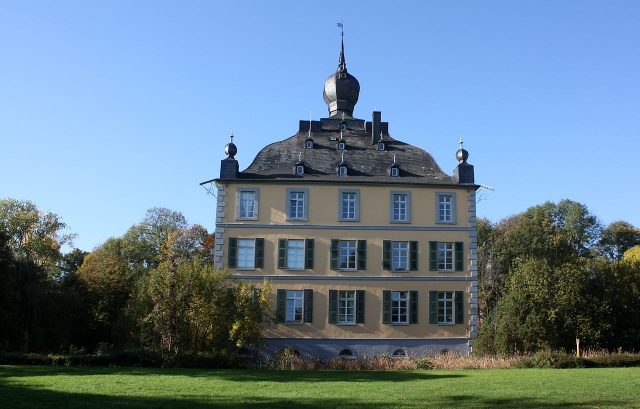
Kendenich Castle is a moated castle in Kendenich, a district of Hürth in the Rhein-Erft-Kreis. It is considered – not least because of its exposed location on the slope of the Ville – a landmark of the city.
First Mention
Roman wall and stone pavement remains found on the castle grounds attest to the great age of the settlement. The manor "zu Cantinich" in the Kölngau is first mentioned in 941 in a deed of gift from Archbishop Wichfrid, in which "all tithes" from the manor are granted to the Cäcilienstift in Cologne.
Castle and Lords of Kendenich
Middle Ages
The Lords of Kendenich were already mentioned in the 12th century as vassals of the Cologne Archdiocese. At this time, it was probably the lords of the Cologne patrician family "Birklin" who had the estate managed as feudal lords of Kendenich. An independent jurisdiction of the castle lords of this period was also repeatedly documented. For example, in 1269, Philipp as Vogt of Kendenich was mentioned as a witness in a document dated March 24, and in 1278, he and his wife Ida signed a contract by which the couple sold a plot of land in the "Kendenicher Feld" near Hermülheim to the Teutonic Order House "St. Catharinae zu Cöln". The Order had contractually stipulated that the lands should be free from taxes and the secular jurisdiction of Kendenich. In 1285, Philipp's son, Heinrich von Kendenich, was appointed Burgrave "there" after Archbishop Siegfried fortified the castle and town of Brühl. Their Kendenich property itself then passed in 1475 to the "Noble" Mathias, a member of the Cologne patrician family Walrave, who then called himself Lord of Kendenich.
Modern Era
In 1517, Dahm von Orsbeck and his wife presumably became the new owners of the castle complex through purchase. The property was divided into the later Orsbecker Hof and the castle, which his sister received. Through the marriage of this sister Agnes von Orsbeck to Adolf Freiherr Raitz von Frentz, the castle came into the possession of the Frentz family, who then added "zu Kendenich" to their name.
Construction of the Manor House
Johann Sigismund von Frentz had a manor house built as a baroque moated castle on the south side of the castle between 1660 and 1664. Through Sigismund's daughter, the castle then passed in the second half of the 17th century to Ambrosius Alexander von Reuschenberg zu Setterich. His construction measures included the erection of the first part of the outbuildings and the eastern wing that followed shortly thereafter, on which he had a Reuschenberg coat of arms and the year 1667 affixed. A descendant, probably Freiherr Franz Karl von Reuschenberg, built part of the north wing of the complex, which received the year 1734 embedded in the masonry as iron clamps. The last lord of this family, Franz Edmund von Reuschenberg, sold the estate in 1766 to the Cologne mayor Jakob Gabriel de Groote.
This de Groote, who, however, resided predominantly in Cologne at Glockengasse 3 and had his family build their own church in Cologne, the Elendskirche, was the builder of part of the north wing of the outer bailey. He had the year 1771 affixed in iron clamps in the masonry of the inner courtyard. The design of the east gate in its current form is also said to have been carried out at his instigation. In 1821, the property passed by marriage to the Philipp von Kempis family, who in 1842 had the entrance portal redesigned in the Neoclassical style by the Cologne architect and Schinkel student Johann Anton Wallee, who also worked for Schloss Gracht. The alliance coat of arms Groote-Kempis was also placed above the portal. The von Kempis, who, like their predecessors at Kendenich Castle, also financially supported the St. Johann Baptist church adjacent to their seat, were buried on the west side of the outer bailey, directly on the churchyard wall.
Von Kempis Family Grave
- Philipp v. Kempis 1794- 1881
- Theresia v. Kempis née von Groote 1800-1881
- Maximilian v. Kempis 1824-1914
- Caroline v. Kempis 1838-1901, née von Solemacher
- Carl v. Kempis 1867-1869
- Carl v. Kempis 1869- 1873
- Franz v. Kempis 1825-1899
In 1964, the historic knight's seat of Kendenich passed from the von Kempis community of heirs to the city of Hürth.
Architectural Description
The complex consisted and still consists of a three-winged outer bailey, which opens in a U-shape towards a manor house located to its south. The entire complex was formerly completely surrounded by moats and ponds, which are now only partially filled with water. Today, only the manor house is completely surrounded by water and is only accessible via a bridge from the inner courtyard of the outer bailey.
Manor House
The square 17th-century manor house is accessed via this stone arched bridge with a balustrade, which leads directly from the castle courtyard to the main entrance of the manor house on the north side. The bridge was formerly flanked at its beginning by two seated lions, which were adorned with the alliance coat of arms of the de Groote family and that of his wife's family, a née zum Pütz, also from a Cologne mayoral family. At the end were two lions, each symbolically protecting one of the two escutcheons.
The three-story manor house has six windows on the west side and five windows per floor on the other sides. The slate-covered hipped roof of the building is multi-curved and has small onion-shaped tower attachments at its corners. The dormer-studded roof was crowned by the construction of a widely visible onion dome.
Outer Bailey
The north and west wings, which formerly served as outbuildings of the outer bailey, were built in the 18th and 19th centuries, while the east wing dates from 1667. All corner towers of the outer bailey were designed analogously to the manor house tower, thus forming a unit with the manor house. In contrast to the plastered masonry of the manor house, the brick buildings remained in their natural state. The former west gate provided a direct path to the church and the village. In the gable field of the eastern gate access, the alliance coat of arms of the two families "von Groote" and "von und zum Pütz" can be found, and a Reuschenberg coat of arms stone from 1695 is now embedded in the southeastern outer wall of the corner building below the roof cornice.
Restoration in the 20th Century+
The castle and 200 acres of land were acquired by the city of Hürth at the end of 1964, primarily through an exchange for the equally large Horbell estate on the border with Cologne and Frechen, from the von Kempis community of heirs. The Franz-Josef von Kempis family had already withdrawn to their property Haus Rankenberg in Brenig in 1947. The areas located in the middle of the community were to serve as a disposal mass for urban development. The castle, in need of renovation, was a free addition. The community had no conclusively realizable concept for it. Despite expert opinions and resulting security measures amounting to 359,763 DM, the castle visibly deteriorated. The necessary evacuation followed by vacancy then led to vandalism. In 1976, the castle was offered for free with the obligation to renovate, and the "castle king" Herbert Hillebrand took it over in November 1978. For an investor, he had extensive renovation and conversion work carried out on the buildings in 1981/82 (slab foundation, insulation of the outer walls, concrete ceilings on a solid staircase core, etc.) and apartments set up in the manor house and the outer bailey, which were then rented out from summer 1983.
Legend+
An old legend about the "Night Spirit of Kendenich" is also handed down about the castle:
On the old knight's seat of Kendenich, about two hours from Cologne on the Rhine, there is a marshy swamp densely overgrown with reeds and alder bushes. A nun sits hidden there, and no one dares to pass her in the evening without her trying to jump on their back. Whoever she reaches must carry her, and she drives and chases him through the whole night until he collapses to the ground unconscious.
Take Mobile History with you
You are reading this text for free. Premium adds what matters on the road: descriptions read aloud, sites found through your camera, whole regions taken offline.
- Every description, including the ~17,700 Premium sites
- Audio guide: have descriptions read to you on location
- AR finder: see sites through your camera, with distance and bearing
- Unlimited saved sites
14 days free, then from €2.99 a month. Cancel anytime.
Source: Wikipedia · Licence: CC BY-SA 4.0
This description draws on the facts documented in the linked Wikipedia article; Wikipedia content is licensed under CC BY-SA 4.0. Wording and editing: Mobile History.
Location: 50.8640, 6.8884