To be privately owned
CastleJerichow-Karow
Karow Castle
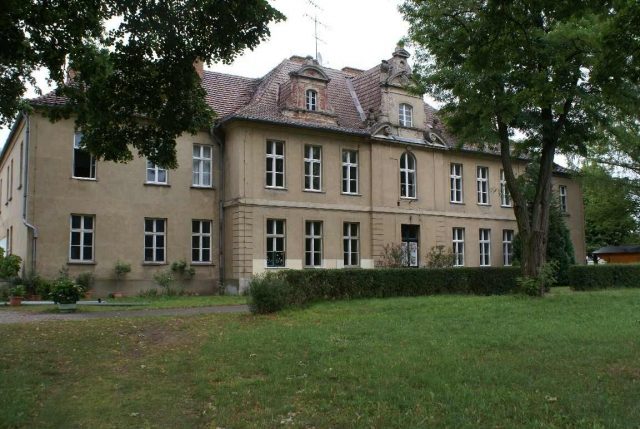
The place name is of Slavic origin, so the settlement likely existed as early as the 9th century AD. The settlement of the region by Germanic immigrants took place in the 12th century, and a Bartholomäus de Chare is mentioned as the founder of the town for this period. As was customary, the Germanic settlements were built in the vicinity of existing Slavic towns, which grew together over time. The village was first mentioned in a document as Kare in 1191 (1193?). In the 15th and 16th centuries, the place names Carov (1459), Chare (1600), or Kara (1562) also appeared. By the 14th century at the latest, Karow belonged to the Archbishopric of Magdeburg, whose feudal register from 1370 lists it as belonging to the Burgward Plaue. Already in the Middle Ages, Karow was referred to as a parish village, and the existence of a manor was mentioned.
The first lord of the manor known by name was Friedrich von Caro at the beginning of the 13th century. Later, the von Alvensleben family managed the estate, followed in 1455 by the von Bardeleben family and by Joachim von Byern in 1574. In 1690, the later Brandenburg minister Friedrich Wilhelm von Grumbkow became co-owner of the estate. He is considered the initiator of the new construction of the Karow church, which began in 1703. In 1708, the Grand Marshal and Privy Councillor Baron Marquard Ludwig von Printzen (1675-1725) acquired the Karow estate. King Frederick I of Prussia granted him the patronage over the Karow church. Von Printzen completed the new construction of the church, which was finished in 1712. In 1708, the lord of the manor had begun the construction of a two-story manor house in the Baroque architectural style. A 15-hectare park was added to the three-winged building, initially in the form of a French garden. Then the son of the Grand Marshal, Friedrich Wilhelm von Printzen, inherited. In 1774, his only daughter Elisabeth Luise Sophie (born 1742 in Karow, died 1811 in Potsdam) inherited the estate. She married the Marshal Wilhelm Friedrich Heinrich Ferdinand Graf von Wartensleben (born 1740, died 1776), whose family owned the estate until 1945. The subsequent lords of the manor were:
- Castle Captain Christian Ludwig Gr.v.W. (1767-1833),
- Lieutenant General Gustav Graf von Wartensleben (1796-1886),
- General of the Cavalry Hermann Wilhelm Graf Wartensleben-Carow (1826-1921),
- Lieutenant Colonel Friedrich Wilhelm Gr. v.W. (1873-1954)
With the draining of the Fiener Bruch initiated by King Frederick II of Prussia, the construction of the Plauer Canal, and the associated settlement program, farmers and craftsmen settled in Karow as new inhabitants in the first half of the 18th century. Since the secularization of the Magdeburg Archbishopric in 1680, the village belonged to the Brandenburg Duchy of Magdeburg and was subordinate to the Jerichow district. With the Prussian administrative reform of 1815, Karow became part of the Jerichow II district with the district town of Genthin. Count Hermann Wilhelm von Wartensleben, residing in Karow, was district administrator in Genthin from 1872 to 1901. In the course of the 19th century, Karow's infrastructure improved. With the brandy distillery, which began operation in 1840, new jobs were created, and the Genthin-Karow-Zitz chaussée, completed around 1890, improved traffic conditions. The Karow estate district remained an independent unit until the municipal reform of 1928. In 1910, it had 117 inhabitants, while 814 people lived in the rural municipality of Karow. The united town had 849 inhabitants in 1939. From 1912 to 1951, Karow had a railway connection via the Rogäsen–Karow railway line.
After the end of the Second World War, the manor family von Wartensleben was expropriated in 1945 as part of the land reform ordered by the Soviet occupation forces. The land was parcelled out and distributed to new farmers. The manor house was transferred to municipal use and served as a school until 1999. Its regionally renowned rich furnishings, which included paintings by Antoine Pesne and the Berlin School of painting, were lost shortly after the end of the war. Some of the paintings and parts of the household goods were later found in the Genthin local history museum. Only the Wartensleben family crest above the entrance area now commemorates the builder of the house, which also had to undergo value-reducing alterations during the GDR era. The manor park, redesigned in the English style at the beginning of the 19th century, was no longer maintained; part of the area has been used for a sports field in the immediate vicinity of the manor house. The completely devastated family burial sites, the crypt under the church, and the so-called "Ruhegarten" (garden of rest) behind the cemetery, were restored to a dignified condition after the reunification in 1990.
Take Mobile History with you
You are reading this text for free. Premium adds what matters on the road: descriptions read aloud, sites found through your camera, whole regions taken offline.
- Every description, including the ~17,700 Premium sites
- Audio guide: have descriptions read to you on location
- AR finder: see sites through your camera, with distance and bearing
- Unlimited saved sites
14 days free, then from €2.99 a month. Cancel anytime.
Source: Wikipedia · Licence: CC BY-SA 4.0 · Image: Roland Neubert, Halle (Saale)
This description draws on the facts documented in the linked Wikipedia article; Wikipedia content is licensed under CC BY-SA 4.0. Wording and editing: Mobile History.
Location: 52.3402, 12.2608