Restaurant
CastleKalchreuth
Kalchreuth Castle
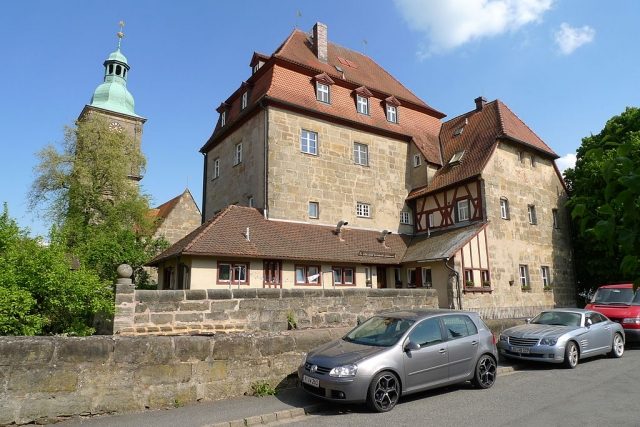
A manor house, a "seat" in Kalchreuth, is not mentioned in the sales and enfeoffment documents of the 13th and early 14th centuries, and thus probably did not yet exist. It was only when Burgrave Johann enfeoffed the sons of the deceased Ulrich III. Haller with Kalchreuth in 1395/98 that a "dwelling" is mentioned in documents.
However, according to a note from around 1500, the "old" Ulrich Haller († 1357) and his children are said to have committed themselves, because of "the moat that goes around the castle," not to damage the moat around the churchyard wall and to maintain a distance of at least six feet (approx. 1.8 meters) "with building and digging." If the report is true, Ulrich must have begun building a manor house in the immediate vicinity of the church soon after acquiring Kalchreuth in 1342.
In the first description of the seat from 1425, it consisted of the dwelling with a bailey, moat, small garden, and stable. Along with the village of Kalchreuth, the seat was severely damaged in the First Margrave War in 1449. In the following decades of fragmented property rights, the documents speak of "house and castle site," so it can be assumed that the destroyed seat was only partially restored. Individual property rights to the place and the castle came into the hands of foreign families through purchase or inheritance. In 1473, King Frederick III allowed the Nuremberg Balthasar Pömer to register a mortgage on the "dwelling and the (imperial fief-eligible) Seldengütlein zu Kalkenrewt." A quarter of "moat and bailey" remained in the possession of Thomas Haller, who in 1476, against the resistance of his cousin Jobst, wanted to erect another building, a second, "smaller dwelling," presumably on the site of the later south wing. After his death in 1508, his share of the property passed to Hans Truchsess von Wetzhausen, in 1528 to Konrad Haller, and was finally bought for 100 guilders by Jobst III. Haller, who thus reunited all shares of the castle in his hand.
Since 1497, the castle belonged to Wolf III. Haller, who was married to Ursula, a daughter of the printer Anton Koberger. Albrecht Dürer, Koberger's godson, visited Kalchreuth in the following years and drew one of his most famous watercolors from one of the castle windows. In view of the impending Landshut War of Succession, Wolf Haller opened his seat to the villagers in 1504. On this occasion, the manor house was also described in more detail: The three-story "Kemenate" (manor house) was secured by bailey and moats, accessible only via a drawbridge secured with two gates, and well supplied with cannons, powder, lead, crossbows, spears, and halberds. On each of the three floors, Haller reserved a lockable chamber for himself; the farmers were allowed to use the other rooms but were not to smash the stairs, benches, and ovens in the castle. In 1517, his son Martin Haller had to open the seat to the imperial city of Nuremberg, i.e., make it available in case of war.
When the Second Margrave War broke out in 1552, the castle owner Jakob IV. Haller actively fought against the Margrave as a cavalry ensign of the "Hauptfahne" (main banner). Although no war damage to the manor house is known, Jakob carried out extensive construction and renovation measures with a total expenditure of 1,200 guilders and expanded the narrower castle district. He probably built the third upper floor, constructed in half-timbering with a gable roof. Incorporating the bailey walls, he erected the southern transverse wing with a plastered half-timbered upper floor, presumably on the site of the "smaller dwelling" and directly adjacent to the three-story main building. Above the round-arched gate, he had the year MDLX (1560), his coat of arms, and that of his wife Ursula Letscher affixed.
Only in the 18th and 19th centuries were there again major construction measures, after the castle had largely survived the Thirty Years' War (in contrast to many rural properties in the village) unscathed. Around 1775, the gable roof and the third half-timbered upper floor on the main building were demolished and replaced by a mansard roof; in 1802, the two bridges over the (now dry) moat were renewed.
The castle remained in the possession of the Haller family, passing in 1663 to the Catholic branch of the Sigmund line in the Upper Palatinate and, after their extinction in 1779, to the Protestant branch in Nuremberg. With the end of the Old Empire and the dissolution of the feudal system, profound changes occurred after 1806: The feudal relationship of the castle complex was abolished in 1819/23, and it became free property; in 1821, the lower jurisdiction was lost to the state.
The manor house itself was hardly used by the Hallers since the 18th century; for their rare stays, the castle administrator – who lived on the upper floor of the attached south wing – had to prepare and heat the main building. In 1848, the Hallers leased, and in 1850, sold the castle to the Wölfel family, who also only used a part of the rooms themselves, rented out individual rooms, and refrained from major construction measures. In 1907, the master plumber Wilhelm Schenk from Nuremberg acquired the castle for 15,200 Goldmark. Schenk capitalized on the increasing excursion traffic from Nuremberg and immediately began appropriate modernization and expansion measures: guest rooms and "summer apartments" were set up in the main building as well as in the attic of the south wing, a viewing platform (removed after 1968) was created, and a kitchen and guest rooms were installed. After the high expectations were not met, the business, which had existed since 1911, was closed in 1923, and in 1927, the castle was sold to Heinrich Sörgel. His son-in-law Leonhard Böhm received new liquor licenses in 1929/32 and was able to successfully continue the business. In 1968, the Scheer family acquired the castle and restaurant, which they renovated and expanded.
Take Mobile History with you
You are reading this text for free. Premium adds what matters on the road: descriptions read aloud, sites found through your camera, whole regions taken offline.
- Every description, including the ~17,700 Premium sites
- Audio guide: have descriptions read to you on location
- AR finder: see sites through your camera, with distance and bearing
- Unlimited saved sites
14 days free, then from €2.99 a month. Cancel anytime.
Source: Wikipedia · Licence: CC BY-SA 4.0 · Image: http://de.wikipedia.org/wiki/Datei:KalchreuthSchlossWest.jpg
This description draws on the facts documented in the linked Wikipedia article; Wikipedia content is licensed under CC BY-SA 4.0. Wording and editing: Mobile History.
Location: 49.5575, 11.1321