Hotel
CastleWeitendorf-Kaarz
Kaarz Castle
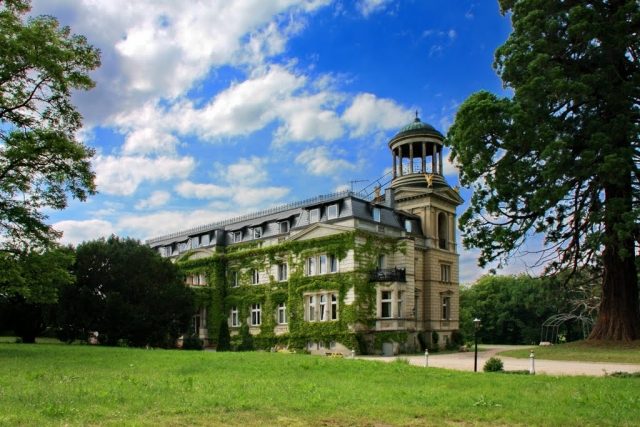
The manor house Schloss Kaarz near Weitendorf forms the center of an estate, located in Mecklenburg-Vorpommern between Schwerin and Güstrow. The castle is used for tourism and serves as a hotel and café.
The Kaarz estate was founded in the 17th century and was owned by the von Bülow family until 1869, after which it was bought by the Hamburg shipowner and merchant Julius Hüniken, who had the current manor house built by architects Saniter and Becker and the park laid out.
By drawing lots, Julius Hüniken (the Younger) took over the estate and had alterations made to the castle and the park redesigned into an English landscape park. During the Second World War, Hüniken took in family members from Hamburg to protect them from bombing raids. When the Red Army occupied the area in April 1945, he initially remained in Kaarz, unlike his family members, but fled to the West in September after humiliations.
After the Second World War, the building was occupied by the Red Army for a time, after which the manor house was used, among other things, as a reception camp for refugees from the eastern territories. Until 1945, the one-class village school for the children from Kaarz was located in the small district of Hütthof. In October 1945, school lessons resumed after the war in the Hütthof school. Due to the influx of many refugee children, the classroom in Hütthof was overcrowded. After the withdrawal of the Red Army's local commandant's office in 1946, two classrooms and a teacher's apartment were created on the lower floor of the castle. In 1946, the two-class Kaarz primary school was established in the lower rooms for children from Kaarz, Necheln, Schönlage (temporarily) and Weitendorf (temporarily). Later, the castle was repurposed and converted into a retirement home, during which time the house increasingly fell into disrepair. In 1992, the Gaertner/Hüniken family bought the castle back, the building was extensively renovated and is now used as a castle hotel.
In addition to various new leisure facilities, the castle now offers a restaurant and a wellness area. Furthermore, regular readings by well-known writers take place.
Buildings+
The Castle
The neoclassical manor house, mostly referred to as a castle, is situated on a small hill, the facades are subtly decorated, and the large tower in the style of a monopteros with its original, cast-iron spiral staircase is striking. Inside, only a few original furnishings have been preserved, such as the fireplace in the Red Salon and the ceiling painting in the foyer. Interruptions in the stucco of the small library indicate the alterations for the retirement home, when some walls were built in at this point.
The Castle Park
The castle park was laid out as an English landscape park by Carl Ansorge, a student of Lenné, starting in 1873. The grounds are equipped with rare trees and plants, including several oaks, Douglas firs and cypresses over 500 years old. Hidden in the park are also the neo-Gothic chapel of the Bülow family and the mausoleum of the Hüniken family in the Neo-Renaissance style. In the upper part of the castle park, to the left of the road to Weitendorf (upper Pappelberg), there was a small tea pavilion until 1946, built in a Far Eastern architectural style. The entire castle park was surrounded by a metal fence. At the entrances to the castle, various life-size animals stood on stone pedestals. At the main driveway from Weitendorf, two magnificent deer, at the entrance from the manor house, two lions, and on the path to Hütthof, two foxes. The entrances were made of ornate metal gates. After 1945, the slow decay of the facilities began, or parts were shredded for scrap. The park area is open to visitors.
Take Mobile History with you
You are reading this text for free. Premium adds what matters on the road: descriptions read aloud, sites found through your camera, whole regions taken offline.
- Every description, including the ~17,700 Premium sites
- Audio guide: have descriptions read to you on location
- AR finder: see sites through your camera, with distance and bearing
- Unlimited saved sites
14 days free, then from €2.99 a month. Cancel anytime.
Source: Wikipedia · Licence: CC BY-SA 4.0 · Image: Rainer Gindele
This description draws on the facts documented in the linked Wikipedia article; Wikipedia content is licensed under CC BY-SA 4.0. Wording and editing: Mobile History.
Location: 53.6986, 11.7283