Cultural Events
Restaurant
Hotel
CastleKreuztal-Junkernhees
Junkernhees Castle
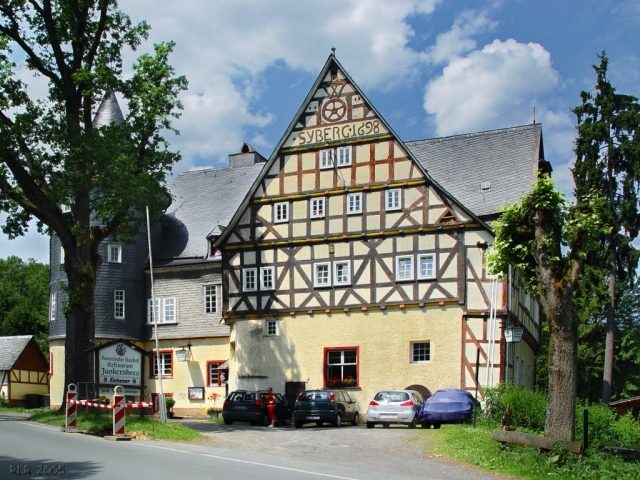
Junkernhees Castle is a Renaissance castle in the North Rhine-Westphalian city of Kreuztal in the Siegerland region. It is located in the Kreuztal district of Junkernhees, which shares its name. Parts of the castle in their current form date back to 1523, when the building was constructed as a moated castle by Lord Adam von und zu der Hees, a knight; other alterations and extensions date from 1698.
The Junkernhees area lies within the watershed between the Ferndorfbach and Bigge rivers. The property is situated on a slate bank of a mountain spur, approximately 300 m above sea level, of the 375-meter-high Katzenhain, which extends with a gentle slope, protected from floods, into the Heesbach valley. Towards the end of the 13th/beginning of the 14th century, the marshy terrain of some valleys in the area was drained, and new trade routes emerged. A road led through the Heesbach valley towards Oberholzklauer Schlag, a border crossing in the Kölsches Heck landwehr. There, this Heestal road met the old road between the cities of Siegen and Cologne.
According to research, the noble family von der Hees originated from the area around the city of Attendorn in Electoral Cologne's Westphalia. In 1294, the family first acquired rights to Siegerland property and thus political influence through the purchase of a share in the tithe of the city of Netphen. Further purchases of land rights by the noble family von der Hees, between Ferndorfbach and the Sieg river, are documented for the year 1362.
Predecessor Building Heesburg+
At the strategically located site in the Heestal, a fortified country estate, the Heesburg, is first documented for the year 1372: On June 28, 1372, Knight Gottfried III von der Hees and his wife Meckel confirmed in a document that they had received the house "zur Hese" including its moat as a fief from Count Johann I of Nassau. In return, the Nassau count was granted the right of access to the house. In the following almost 100 years, the Heesburg changed owners several times. In 1468, the feudal relationship between the descendants – Count Johann IV of Nassau (1410–1475) and Philipp von der Hees – was renewed under the conditions of 1372, and again in 1476 with Johann V of Nassau (1455–1516).
Construction and Ownership History of Junkernhees Castle+
Junkernhees Castle, in its form partially preserved to this day, was built in the first quarter of the 16th century by Philipp's younger son, Adam von der Hees (1475–1531), approximately 250 meters from the older Heesburg. The exact year of commencement and duration of the construction work can no longer be determined today; construction is estimated to have begun around 1514. The owners moved in on December 1, 1523; the occupation of the new building was documented with a coat of arms stone placed above the portal, bearing the coats of arms of Adam von der Hees and his second wife Margaretha Schutzbar. In the 16th century, Junkernhees Castle was a defensive castle made of rubble masonry with four towers, loopholes, and a moat.
The ownership of the noble family von der Hees ended with the death of Johann Stephan von und zu der Hees (1615–1634), great-grandson of Adam von der Hees. The new owner was Johann Stephan's daughter, Anna Maria, who married Junker Heinrich von Syberg zu Schwerte before 1650. From this period, the new name of the estate, Junkernhees, is documented for the first time.
In 1698, the purely defensive character of Junkernhees was abandoned. The main building was extended with a half-timbered superstructure on a rubble stone plinth floor with two large roof gables. The inscription on one gable, "D W Syberg 1698" with an illustration of a five-spoked wheel, points to Junker Dietrich Wilhelm von Syberg (1650–1742) as the builder. The house is considered today one of the oldest preserved houses of this construction style in the Siegerland.
Current Use+
Among the outbuildings, the former brandy distillery and the former mill from 1796 have been preserved. Both are now used as residential buildings. The round tower was restored in 1999. Today, the listed building houses a hotel and a restaurant in the knight's hall. Art exhibitions are also held at the castle at irregular intervals. According to information from the Siegener Zeitung, there were plans to sell the castle to an investor by early 2012, who intended to convert it into a hotel with 100 rooms. These plans were later shelved, and the castle has been for sale since 2013.
Take Mobile History with you
You are reading this text for free. Premium adds what matters on the road: descriptions read aloud, sites found through your camera, whole regions taken offline.
- Every description, including the ~17,700 Premium sites
- Audio guide: have descriptions read to you on location
- AR finder: see sites through your camera, with distance and bearing
- Unlimited saved sites
14 days free, then from €2.99 a month. Cancel anytime.
Source: Wikipedia · Licence: CC BY-SA 4.0 · Image: Rainer Gindele
This description draws on the facts documented in the linked Wikipedia article; Wikipedia content is licensed under CC BY-SA 4.0. Wording and editing: Mobile History.
Location: 50.9514, 7.9583