Nursing home
Public library
CastleJesberg
Jesberg Castle
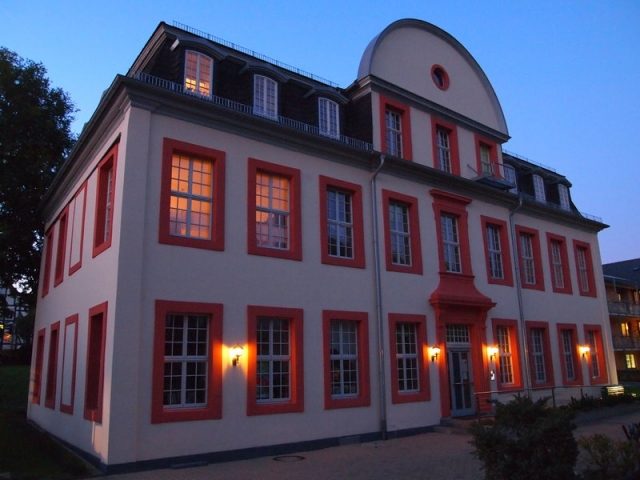
Jesberg Castle (also known as Maximilian's Castle or Maximilian's Little Castle) in Jesberg, in the Schwalm-Eder district of northern Hesse, was built in 1723 as a summer residence for Prince Maximilian of Hesse. Today, the building, restored in 2006, houses senior apartments, a community center, and a library.
The castle is a simple main building with a mansard roof. Architecturally, it is related to the Kassel palace buildings of the early 18th century. The central axes are elevated on the courtyard side and crowned by a round gable. On the garden side, the building projects on three sides and features a balcony. The name of the architect is not known. The castle included two outbuildings, one of which is still preserved today, as well as a garden in the Dutch style, which no longer exists, and ended with a menagerie.
In 1721, with the death of Ludwig Eitel von Linsingen, the Hessian branch of the Linsingen family died out. Thus, Jesberg Castle, with its associated land, reverted to the Landgraviate of Hesse-Kassel as an expired fief. Landgrave Karl enfeoffed his ninth son Maximilian with it. Maximilian acquired additional land and had the castle built in 1723 in the Treisbachgrund below the castle hill as a summer residence. He lived there with his wife, Princess Friederike Charlotte von Hessen-Darmstadt (1698–1777), the "Princess Max" who was viewed with displeasure in both Hessian princely houses due to her extravagant lifestyle, with whom he had four daughters. For his daughters, Maximilian had the Princess Garden built in a nearby wooded area.
After Maximilian died heavily indebted in 1753, Landgrave Wilhelm VIII of Hesse-Kassel acquired the castle. The remaining assets were parceled out and sold to the highest bidder. Between 1800 and 1807, the castle was owned by a citizen of Jesberg, and thereafter by the public. Over time, it served as a prisoner-of-war camp, barracks, cell block, district court, retirement home, apartment building, and asylum seeker accommodation.
After standing empty for a long time and threatening to fall into disrepair, it was acquired by the German Red Cross and thoroughly renovated in 2006.
Take Mobile History with you
You are reading this text for free. Premium adds what matters on the road: descriptions read aloud, sites found through your camera, whole regions taken offline.
- Every description, including the ~17,700 Premium sites
- Audio guide: have descriptions read to you on location
- AR finder: see sites through your camera, with distance and bearing
- Unlimited saved sites
14 days free, then from €2.99 a month. Cancel anytime.
Source: Wikipedia · Licence: CC BY-SA 4.0 · Image: http://www.wehrbauten.de/thread.php?threadid=1367
This description draws on the facts documented in the linked Wikipedia article; Wikipedia content is licensed under CC BY-SA 4.0. Wording and editing: Mobile History.
Location: 50.9960, 9.1466