School
CastleIsing
Ising Castle
The Historic Building: A Journey Through Time+
From the Middle Ages to the Renaissance+
The Foundation and Early Construction Phases
The origins of the historic building, often referred to as "Alte Komturei", date back to the 13th century. The first documented mention of a "Komturei" (commander's residence) in this location appears in a document from 1270. Initially, it served as a residence for the Knights Templar, who played a significant role in the region during the Crusades. The original structure was likely a fortified complex, typical for the period, consisting of a main building, defensive walls, and possibly a chapel.
Archaeological findings suggest that the initial construction was primarily made of local stone and wood. The architectural style was Romanesque, characterized by thick walls, round arches, and small windows, designed more for defense than for comfort or aesthetics. Over the next two centuries, the building underwent several modifications and expansions, reflecting the changing needs and increasing wealth of its occupants. Records indicate the addition of a larger hall in the 14th century, likely for administrative purposes and gatherings.
The Transition to the Teutonic Order
In the early 14th century, after the dissolution of the Knights Templar, the property was transferred to the Teutonic Order. This marked a new era for the Alte Komturei. The Teutonic Knights, known for their military prowess and organizational skills, further expanded and fortified the complex. During this period, the building began to take on a more Gothic appearance, with the introduction of pointed arches and larger windows, though still maintaining its defensive character.
The 15th century saw significant construction activities, including the addition of a new wing and the renovation of the existing structures. These changes were partly driven by the need to accommodate a growing number of knights and administrative staff, and partly by the desire to reflect the Order's prestige. The building served not only as a residence but also as an administrative center for the surrounding lands, managing agricultural estates and collecting tithes.
Baroque and Rococo Eras+
Architectural Transformations in the 17th and 18th Centuries
The 17th century brought about a profound transformation of the Alte Komturei. With the decline of the Teutonic Order's military significance and the rise of new architectural styles, the building was converted into a more comfortable and representative residence. The Baroque era, characterized by grandeur, drama, and elaborate ornamentation, left a lasting mark on the Komturei. Extensive renovations were undertaken, including the enlargement of windows, the addition of decorative facades, and the creation of spacious interiors with high ceilings and stucco decorations.
During this period, the defensive elements of the building were largely removed or repurposed. The old defensive walls were either torn down or integrated into new garden designs. The focus shifted from fortification to aesthetic appeal and comfort. The 18th century, influenced by the lighter and more playful Rococo style, saw further refinements. Interiors were decorated with delicate frescoes, intricate wood carvings, and elegant furniture. The gardens were redesigned to include parterres, fountains, and sculptures, transforming the surroundings into a picturesque park landscape.
The building became a hub for social and cultural life, hosting balls, concerts, and theatrical performances. It served as a summer residence for noble families and high-ranking officials, reflecting the changing social dynamics and the growing importance of leisure and entertainment among the aristocracy.
19th and 20th Centuries: From Residence to Museum+
Restorations and New Uses
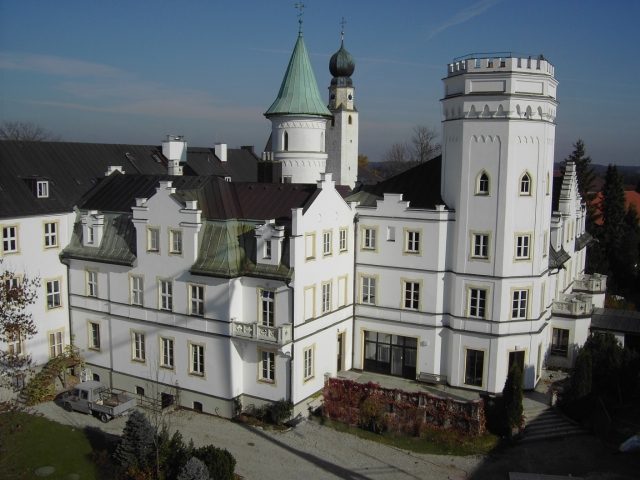
The castle was built in the early 19th century. Around 1870, an expansion took place. Another Gothicizing expansion with a crenellated tower, dormer houses, and roof dormers followed in 1892. After the fire of 1923, the castle was renovated in 1934.
Take Mobile History with you
You are reading this text for free. Premium adds what matters on the road: descriptions read aloud, sites found through your camera, whole regions taken offline.
- Every description, including the ~17,700 Premium sites
- Audio guide: have descriptions read to you on location
- AR finder: see sites through your camera, with distance and bearing
- Unlimited saved sites
14 days free, then from €2.99 a month. Cancel anytime.
Source: Wikipedia · Licence: CC BY-SA 4.0
This description draws on the facts documented in the linked Wikipedia article; Wikipedia content is licensed under CC BY-SA 4.0. Wording and editing: Mobile History.
Location: 47.9235, 12.5050