To be privately owned
CastleIrnsing
Irnsing Castle
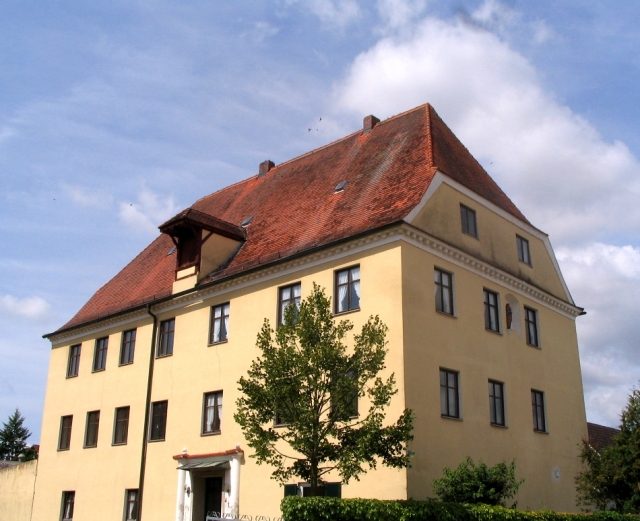
The village of Irnsing is a district of the town of Neustadt an der Donau in the district of Kelheim, Lower Bavaria. The place was first mentioned in the year 900 as “Eringisingun”, which means among the relatives of “Eringis”. “Eringisingun in pago Kelescove” was located in the Kelsgau and in the county of the first Wittelsbach Otto I of Scheyern. The second documentary mention followed in 1012, when Emperor Heinrich II, born in nearby Bad Abbach, as he had previously done with the village of Pförring, gifted the place with all its appurtenances to his newly founded diocese of Bamberg.
Over the centuries, Irnsing was the seat of a noble house and an independent Hofmark, which included a strongly fortified castle. The Lords of Irnsing, who named themselves after “Irensingen” and “Pferingen” (Pförring), are documented from 1109 to 1470. The “Irnsinger-Pförringer” were followed by the knightly family of Prantl. Through the marriage of the widow of the court chief judge Franz Adam Prantl,
the property came into the possession of Marquard Ludwig Ferdinand Freiherr von Nothaft around 1690. After his death, the estate complex passed to the Cammerloher von Weiching, who also exercised lower jurisdiction over the village of Hienheim. Under Josef Freiherr von Speidel von Adlerskron, the heir of Marquard Eustachius von Cammerloher, who died in 1774, the judicial powers were temporarily lost to the courts of Kelheim and Neustadt. In 1783, the chamberlain and administrator of Mindelheim, Reichsfreiherr von Lerchenfeld, acquired the seats of Irnsing and Hienheim and thus regained the associated jurisdictional powers. Through marriage to Anna Reichsfreiin von Lerchenfeld, the property passed to Major Joseph Freiherr von Schleich, who had been taken prisoner of war in Russia during the 1812 Russian campaign. In 1822, the royal chamberlain Franz Freiherr von Gruben bought the Hofmark Irnsing. It remained in his possession until the abolition of manorial jurisdiction in 1848.
Irnsing Castle was demolished in the 17th century and the current village church was built in its place. The adjacent Sedelhof was converted to create Irnsing Castle, which still dominates the silhouette of the village today as an imposing three-story building with a half-hipped roof. The castle's encircling walls are still preserved in the lower part of the church hill.
Take Mobile History with you
You are reading this text for free. Premium adds what matters on the road: descriptions read aloud, sites found through your camera, whole regions taken offline.
- Every description, including the ~17,700 Premium sites
- Audio guide: have descriptions read to you on location
- AR finder: see sites through your camera, with distance and bearing
- Unlimited saved sites
14 days free, then from €2.99 a month. Cancel anytime.
Source: Wikipedia · Licence: CC BY-SA 4.0
This description draws on the facts documented in the linked Wikipedia article; Wikipedia content is licensed under CC BY-SA 4.0. Wording and editing: Mobile History.
Location: 48.8365, 11.7424