To be privately owned
CastleIrmelshausen
Irmelshausen Castle
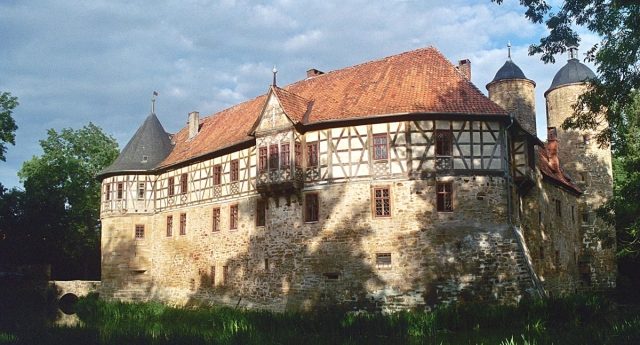
Irmelshausen Water Castle is one of the most beautiful, well-maintained, and remarkable castles in Lower Franconia. For 600 years, it has been continuously in the hands of the Barons von Bibra, and has happily survived various wars and upheavals, never being abandoned or even neglected for extended periods. Much admired and frequently described, and repeatedly used as a romantic film set, one must rely on the older "Kunstdenkmäler von Bayern" (Art Monuments of Bavaria) if one wishes to describe the castle in more detail.
Irmelshausen was first mentioned in the year 800, when Abbess Emhild of Milz, a relative of Charlemagne, gifted estates to Fulda Monastery. Poppo II of Henneberg (+ 1078) named himself after Irmelshausen. He was the founder of the Henneberg-Irmelshausen and Sternberg line. Through the marriage of Countess Elisabeth of Henneberg to Count Eberhard of Württemberg, Irmelshausen came into the possession of the latter, who sold it along with other properties in 134 to the Prince-Bishopric of Würzburg (under Prince-Bishop Albrecht II von Hohenlohe). In 1376, his successor, Bishop Gerhard von Schwarzburg, the bishop of the Franconian Cities' War (1372 – 1400), sold the Irmelshausen fortress for 480 guilders to the bailiff of Mellrichstadt, Berthold von Bibra, with a right of repurchase. Prince-Bishop Rudolf von Scherenberg (1466 – 1495) attempted to repurchase the now greatly expanded Bibra property in 1481.
The lengthy process ended in 1500 with a settlement that left the water castle to the von Bibra family as a prince-episcopal fief. The aforementioned settlement between the Prince-Bishopric under Prince-Bishop Lorenz von Bibra (1495 – 1519), who was born in Mellrichstadt, states: "Irmelzhausen, the entire fortress and castle with its confines (perimeter), moats, zwinger, walls and other." At this time, it must have been a considerable complex of estates and buildings. The owners at that time were Valentin von Bibra, knight, and Brigitta, née von Schaumberg.
The water castle is located on the southern edge of the village. The Milz river separates the village and the castle. The castle lies on a, perhaps artificially raised, plateau between the Milz and a stream flowing further south, which flows into the Milz. The small lake, in the form of an irregular ring moat, which closely surrounds the castle, is fed by numerous springs. The area between the castle lake and the waterways is surrounded by an extensive zwinger system with formerly 5 towers, two of which on the east side have been demolished. The Milz bridge on the north side, towards the village, was fortified by a gatehouse. The gatehouse is only preserved in its enclosing walls. Gatehouse, corner towers, and zwinger have small late Gothic loopholes. The two-story zwinger towers have tent roofs. This zwinger system in its current form probably dates from the 15th century.
The castle forms an irregular pentagon and also encloses a picturesque, pentagonal inner courtyard in its typical Renaissance architecture. Outside, above the gate entrance, a three-part window projects on a cross-arch arcade, which dates from the time of Valentin von Bibra, 1514. We can still visually distinguish the castle of that time in its early components from today's castle complex, which appears so harmonious and unified. These are the entrance, the thick tower to its left, and the elongated western residential wing to its right. All of this, of course, without the later half-timbered superstructures that adorn the north and west sides and give the entire complex a romantic touch.
The two older wings, with the half-timbered floor, comprise three stories. The eastern tower of the entrance area, the strongest tower of the entire complex, also has three stories. From 1556 to 1561, Hans von Bibra had the three wings located to the east, south, and southwest additionally built, which connect to the older building with spiral staircases and perhaps only then made it possible to add stories to the old castle and also expand the living possibilities here. This is the Hansen building. With these larger additions, the transformation of the old castle into a more modern and comfortable palace began, although the castle character was preserved due to its enclosed nature.
This Hansen building, to the east and south, has two stories and three towers, two smaller ones, which contain the spiral staircases with access to the corridors. The south tower, with five stories, is the tallest tower and bears the castle clock. During the Thirty Years' War, in which the Bibra, like almost all Franconian noble families, sided with the Swedes, the castle was damaged several times. This certainly led to further changes and improvements to the complex. In particular, the old drawbridge was replaced by the stone bridge that still stands today.
The old half-timbered floor from an unknown period was demolished on both sides of the gate in 1808. It was not until 1854 that the half-timbered superstructure of the old wing on the northeast and west sides, which is so characteristic of the castle today and appears so harmonious, was renewed to the same height.
Since Irmelshausen Castle is still privately inhabited by two noble families, it cannot be visited at all times. It should only be noted that the interiors partly contain valuable fittings, fireplaces and portals, paintings, coats of arms, wall hangings, and other furnishings dating back to the Renaissance, which can only be viewed by invitation from the families. The village of Irmelshausen and especially the Protestant parish church of St. Jakobi are worth seeing. The church is particularly interesting because of the tombstones of the von Bibra family and the noble coats of arms visible on them.
Take Mobile History with you
You are reading this text for free. Premium adds what matters on the road: descriptions read aloud, sites found through your camera, whole regions taken offline.
- Every description, including the ~17,700 Premium sites
- Audio guide: have descriptions read to you on location
- AR finder: see sites through your camera, with distance and bearing
- Unlimited saved sites
14 days free, then from €2.99 a month. Cancel anytime.
Source: Wikipedia · Licence: CC BY-SA 4.0
This description draws on the facts documented in the linked Wikipedia article; Wikipedia content is licensed under CC BY-SA 4.0. Wording and editing: Mobile History.
Location: 50.3627, 10.4690