To be privately owned
CastleMünzbach
Innernstein Castle
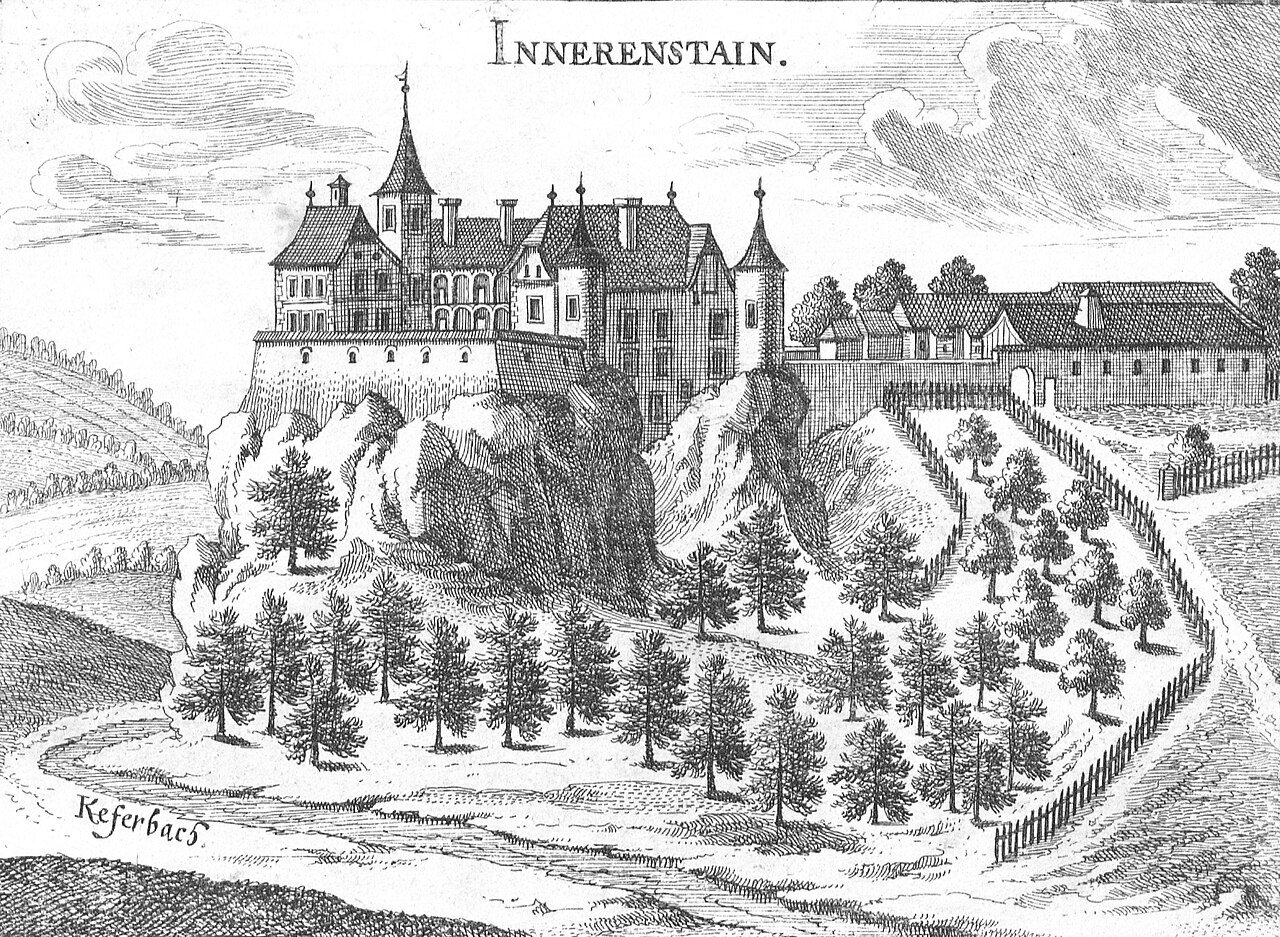
Innernstein Castle (also Veste Stain, Kaiserstein Manor) is located in the village and cadastral community of Innernstein, two to three kilometers east of the center of the market town of Münzbach in the Perg district of Upper Austria.
The former castle stands on a rock outcrop high above the Klambach valley. Vertically dropping cliffs made the castle impregnable from the north side.
In the southwest of the castle stands a massive round tower, whose original height, as well as that of the gate tower, was reduced during a renovation. The gate tower has a slightly curved tent roof, with a clock beneath it.
Adjoining it are two residential wings with irregular facades, as they were built on the ring wall of the old fortress. A drawbridge led over the moats, which are now filled in.
Through the wide, cross-vaulted gate hall, one enters a square inner courtyard with arcades on three sides.
The arcades on the upper floor were walled up in 1589. On the resulting wall surfaces are the coats of arms of the former lords of the castle and manor.
In 1906, Baron Hermann von Tinti had the courtyard on the north side enclosed with a neo-Gothic residential building made of quarry stone. In the west wing, a single-pillar hall with a cross-rib vault is preserved. The upper floor is largely Baroque inside. Several doors date from around 1700.
From 1996 to 1998, concerts were held at Innernstein Castle as part of the Danube Festival Weeks. At that time, the Salzburg Residence Soloists, among others, performed there. The privately owned castle underwent extensive renovation in the 2010s.
In 1209, a Chunradus de Staine was first mentioned in a document from Baumgartenberg Abbey. His castle, which remained in the family's possession until the 15th century, stands on a rock outcrop above the Klambach and is still inhabited. The Renaissance complex acquired its current form in the second half of the 16th century. The year 1589 is documented on a sgraffito on the west side.
The Stainers held the castle as free property, serving as vassals of the Lords of Machland and later the Lords of Clam-Velburg. In 1292, they pledged parts and later the entire property and became liege tenants of the Kapellers and later the Liechtensteins.
Innernstein was a Liechtenstein knight's fief until the end of the manorial system in the 19th century. In 1710, a land register of the Baron Kaiserstein lordship of Innernstein, comprising 58 pages, was compiled.
Lords of the Castle
- 1209 to 1292 Chrunradus de Staine
- 1292 to 1407 Kapeller (including Ulrich II von Kapellen, Hans I von Kapellen)
- 1407 to 1850 Liechtensteiner (including Hartmann von Liechtenstein)
- 1850 to 1876 Counts of Clam-Martinic
- 1876 to 1897 Prince and Altgraf Salm-Reifferscheid
- 1897 to 1969 Baron von Tinti
- 1969 to 1994 Elisabeth Brandner
- 1994 to 2002 Walter Nossek
- 2003 to present Franz Greisinger
Liege Tenants
- 1292 to 1424 Stainer (Herborg, Hanns, Friedrich Stainer, Jörg der Stainer)
- 1424 to 1499 Steinböck, Schweinböck
- 1499 to 1517 Ulrich II von Liechtenstein
- 1517 to 1611 Veit I to Veit III Flusshart (Protestant)
- 1611 to 1625 Sebisch (Protestant, including Hans Georg Sebisch, Elisabeth Sebisch)
- 1625 to 1633 Court Chamber Councillor von Mühlheim
- 1633 to 1731 Barons von Kaiserstein (including Tobias Hellfried von Kaiserstein, Johann Georg von Kaiserstein and his wife Sophia, Ernst von Kaiserstein and his wife Katharina, Ernst Johann von Kaiserstein zu Innerststein, Pottendorf, Ulm and Bohemian Hörschlag)
- 1731 to 1804 Barons von Stiebar (including Johann Friedrich von Stiebar)
- 1804 to 1820 Baron von Rosenberg
- 1820 to 1850 Counts of Clam-Martinic
Innernstein Castle Chapel+
The All Saints' Chapel in Innernstein Castle had a mass license under Baron Hermann Tinti. The chapel was renovated in 1991. It is unclear which of the originally present art objects are still there.
Crypt Chapel of the Barons von Tinti+
The former crypt chapel of the Barons von Tinti on the west side of the Münzbach cemetery was built in 1906 by the Linz cathedral master builder Matthäus Schlager as a neo-Gothic natural stone building with a two-bay nave, cross-rib vault, and a single-bay choir with a triangular apse. The filial church is dedicated to the Holy Cross. On the south wall are the tomb and gravestone of Elisabeth von Schöller-Szüts, née Tinti (* 1900; † 1969) and Leopold Tinti (* 1904; † 1977). Above the church portal is a relief of the Tinti family coat of arms.
Take Mobile History with you
You are reading this text for free. Premium adds what matters on the road: descriptions read aloud, sites found through your camera, whole regions taken offline.
- Every description, including the ~17,700 Premium sites
- Audio guide: have descriptions read to you on location
- AR finder: see sites through your camera, with distance and bearing
- Unlimited saved sites
14 days free, then from €2.99 a month. Cancel anytime.
Source: Wikipedia · Licence: CC BY-SA 4.0 · Image: Georg Matthäus Vischer / Public domain via Wikimedia Commons
This description draws on the facts documented in the linked Wikipedia article; Wikipedia content is licensed under CC BY-SA 4.0. Wording and editing: Mobile History.
Location: 48.2699, 14.7540