To be privately owned
CastleInching
Inching Castle
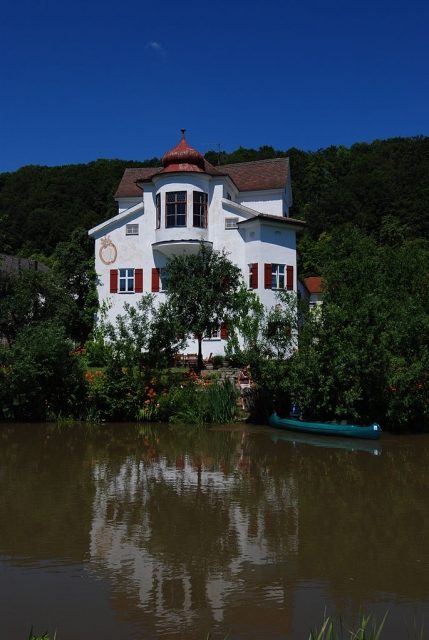
Inching Castle is a small Baroque castle in Inching, Upper Bavaria. It is located on the Altmühl, 100 kilometers north of Munich, built at the beginning of the 18th century as a summer residence for the canons and auxiliary bishops of Eichstätt.
Even today, the small castle, together with St. Martin's Church and the outbuildings, forms a unique historical ensemble on the Altmühl.
The castle in its current form was created between 1710 and 1720 by the Eichstätt court architects Jakob Engel (1632 to 1714) and Gabriel de Gabrieli (1671 to 1747), who came from Graubünden. Some remains of the original house, probably built in the 11th or 12th century, are still located on the ground floor of the part facing the street. Around 1710, Jakob Engel added a square building facing the Altmühl with a corner oriel extending from the ground and the flat roof of a Jura house.
Gabriel de Gabrieli replaced most of the attic with a Baroque hall with an oriel and side cabinets, thus creating the unique architectural form. Only the four corner areas of the original roof remained; they contain three chambers and the staircase.
"The three-story castle, provided with a charming little garden, presents a pretty front towards the Altmühl" can already be read in the Geographical Lexicon of Franconia in 1801.
The stucco ceiling in the semicircular oriel of the Gabrieli Hall is adorned with the coat of arms of the builder Ignatz von Pfürdt. Remarkable and described by art historians as unique are free-hanging stucco festoons with roses, which optically connect the hall and the oriel. The two side cabinets with flat domes and skylights show acanthus tendrils and strapwork from around 1715.
The salon in the southeast corner of the first floor contains ceiling stucco from around 1710. The walls are covered with a canvas wallpaper showing a lattice of ornaments – so-called rocaille – made of shells and plant tendrils on a light background. It is still in its original condition and probably dates from the same period as the cast-iron stove from Obereichstätt (cast in 1805). Since the mid-20th century, the salon has been furnished with original Biedermeier furniture.
The rustic, former administrator's apartment on the ground floor is now used as a holiday apartment. From the "charming little garden" mentioned above, with a still preserved small Rococo pavilion, a few steps lead down to the Altmühl.
Inching – still a small village with about 100 inhabitants in the Altmühl Valley – was already mentioned in documents in 1055. At that time, Emperor Henry III granted the Eichstätt church the right to cultivate wine between Rebdorf and Inching. A nobleman Adalbert von Inchingen was mentioned in 1166.
As early as 1260, the then Bishop of Eichstätt, Engelhard von Tollingen, transferred the church of Inching to the Eichstätt Cathedral Chapter, which exercised village and municipal rule until the secularization in 1806.
As owner of the castle estate, Cathedral Dean Rudolf Dietrich Freiherr von Freyberg sold his "fishing estate in Inching with gardens, meadows, fields, and fishing waters" in 1714 to the Eichstätt canon Freiherr Gottfried Ignatz von Pfürdt. His magnificent epitaph can be admired in the cloister of Eichstätt Cathedral. Tombs of other ecclesiastical owners can be found there. Later owners include Cathedral Provost Franz Heinrich Freiherr von Kageneck, Canon Heinrich Benedikt von Andlau, and as the last princely owner before secularization, Canon Maria Casemir Graf Schenk von Castell. The epitaph of Graf Schenk von Castell hangs in the Eichstätt cemetery chapel.
After that, the castle estate had several rapidly changing owners, individual buildings and areas were sold separately, and the condition of the buildings deteriorated.
In 1919, the monument conservator, architect, painter, and photographer Heinrich Ullmann acquired the property. He made significant contributions to the research, documentation, and preservation of the typical Altmühl Jura houses and left behind an extensive body of work. Historical photographs and drawings are published in the illustrated book "Im Altmühltal". Today, his great-grandson, together with his wife, operates a holiday apartment on the ground floor.
Take Mobile History with you
You are reading this text for free. Premium adds what matters on the road: descriptions read aloud, sites found through your camera, whole regions taken offline.
- Every description, including the ~17,700 Premium sites
- Audio guide: have descriptions read to you on location
- AR finder: see sites through your camera, with distance and bearing
- Unlimited saved sites
14 days free, then from €2.99 a month. Cancel anytime.
Source: Wikipedia · Licence: CC BY-SA 4.0
This description draws on the facts documented in the linked Wikipedia article; Wikipedia content is licensed under CC BY-SA 4.0. Wording and editing: Mobile History.
Location: 48.8984, 11.2752