To be privately owned
CastleIckelheim
Ickelheim Castle
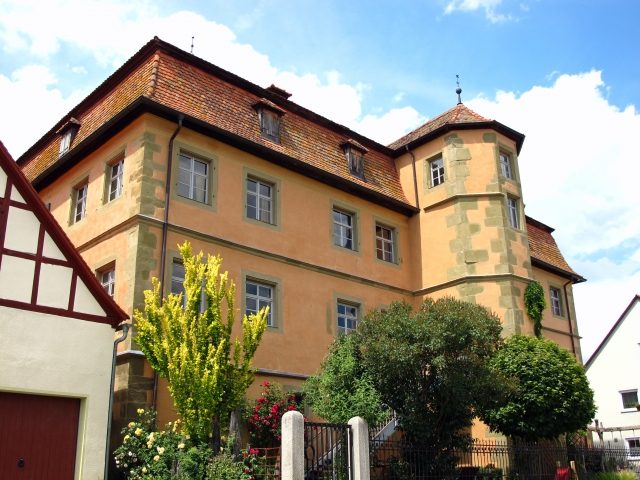
Ickelheim is one of the so-called mother settlements in the Windsheim Bay and has been documented as a Franconian royal court since 889. The first documented mention of the place dates back to 741.
Ickelheim was for a long time the seat of the Teutonic Order, had an independent parish church and at times its own jurisdiction. In 822, it was documented that Ickelheim was subject to tithes to the Diocese of Würzburg. In 1249, the Pope placed the Heilsbronn monastery and Ickelheim under his protection. On October 16, 1259, a contract was concluded in Ickelheim between the city of Uffenheim and the Nuremberg burgraves, which regulated the sale of a part of Virnsberg Castle to the Nurembergers and the Nurembergers' possessions in Ickelheim to the Uffenheimers.
From 1294, the fate of Ickelheim lay in the hands of the Teutonic Order, which shaped the history of the place for 500 years. In 1347, the Bishop of Würzburg elevated the Ickelheim church to an independent parish church. In 1394, the Teutonic Order expanded its properties by purchasing the villages of Breitenau and Westheim. A serious dispute between the Teutonic Order and the city of Windsheim occurred in 1349; the city was sued before the Roman Curia for an infringement of jurisdiction. After Windsheim lost this dispute, some Windsheim citizens were excommunicated, including councilor Peter Kumpf. In 1403, the Birkenfeld monastery sold its Ickelheim possessions to the Windsheim Augustinian monastery. From 1411, the bailiffs of the Teutonic Order are mentioned by name. The Ickelheim office possessed considerable powers. The Vogt and Kastenamt (bailiwick and treasury office) was responsible not only for the Order's estates in Ickelheim but also for Ergersheim and the so-called Gau. In 1565, the Order built a fortified official residence for the bailiff, the official servant, and the domestic staff. This castle can still be seen in Ickelheim today.
On March 16, 1648, the village was set on fire by Swedish troops withdrawing from Windsheim. Many buildings were destroyed. From 1649, Ickelheim was Protestant. In earlier times, 3 mills belonged to the village: the Dorfmühle, which was severely damaged in a major fire in 1972. With the death of the last miller in 2005, this mill disappeared. The Wasenmühle, this mill also burned down in 1947; it was operated as a sawmill until 1990. The Linkenmühle, it is still in operation today; it was first mentioned in 1347.
In the 18th century, Ickelheim had 8 Bavarian subjects, 52 subjects of the Teutonic Order, and 4 subjects of the Imperial City of Windsheim. From 1799 to 1804, Ickelheim was a Deutschmeister village belonging to the Virnsberg office. In 1806, Ickelheim became part of Bavaria. A great catastrophe occurred in 1856 due to arson. A large part of the village burned down; unfavorable wind fanned the fire, which was visible for kilometers. 42 buildings burned down: 10 residential houses, 11 barns, and 21 outbuildings. The savings and loan association was founded in 1892. The first land consolidation took place in 1896. The schoolhouse was built between 1904 and 1905. In 1925, a water supply system was installed.
Take Mobile History with you
You are reading this text for free. Premium adds what matters on the road: descriptions read aloud, sites found through your camera, whole regions taken offline.
- Every description, including the ~17,700 Premium sites
- Audio guide: have descriptions read to you on location
- AR finder: see sites through your camera, with distance and bearing
- Unlimited saved sites
14 days free, then from €2.99 a month. Cancel anytime.
Source: Wikipedia · Licence: CC BY-SA 4.0
This description draws on the facts documented in the linked Wikipedia article; Wikipedia content is licensed under CC BY-SA 4.0. Wording and editing: Mobile History.
Location: 49.4775, 10.4315