To be privately owned
CastleFrauenstein-Hunnenbrunn
Hunnenbrunn Castle
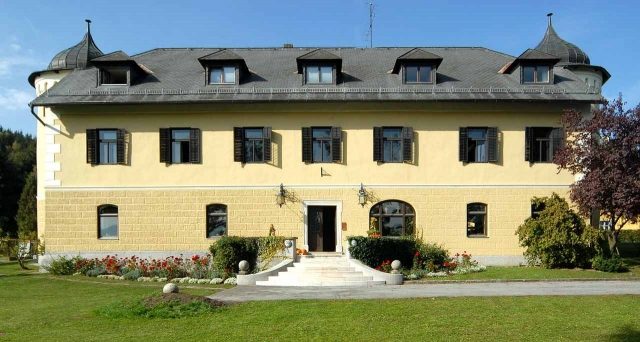
Hunnenbrunn Castle (also: Hungerbrunn) is a listed building in the village of Hunnenbrunn, which today belongs to the municipality of Frauenstein in Carinthia. It was built in the second half of the 16th century in the Renaissance style, but has lost much of its original character due to numerous additions and alterations. The listed building is now used by an agricultural vocational school.
The name of the castle allegedly comes from the spring that rises here, which dried up in dry periods and thus predicted a bad harvest - a so-called hunger year. At the site of the present building originally stood a farmstead belonging to the Hunnerbrunner family. Originally part of the Kraig dominion, the estate passed to their heirs, the Counts of Hardegg zu Glatz and Machland, after the Kraigers died out in 1564. In 1570, Georg Freiherr von Khevenhüller acquired the estate and had a small castle built and furnished here in place of the farmhouse. The property remained in the possession of the Khevenhüller family until Paul Freiherr von Khevenhüller, as a Protestant, had to emigrate in 1619 during the Counter-Reformation. Subsequently, the castle was predominantly owned by St. Veit's merchant and burgher families.
The Khevenhüllers were followed by the wealthy merchant family Zenegg. In 1642, the imperial mint master Hans Georg Pero was the owner of the castle. In 1659, his son Georg Balthasar von Pero sold the property to Johann Jakob Kärner, mayor and city judge of St. Veit. In 1671, Hans Christoph von Zenegg, administrator of Taggenbrunn, took over the manor. In 1686, Franz Andreas von Mayerhoffen bought the castle and the dominion, which was now also equipped with a regional court, and which remained in the possession of his descendants until 1806. After another change of ownership, Peter Graf von Goëss acquired the castle in 1822, after which the owners changed rapidly. Anton and Anna Eibl, who acquired the castle in 1876 at a forced auction, had the name changed from Hungerbrunn to Hunnenbrunn. In 1929, Josef Klimbacher was the owner of Hunnenbrunn. In 1943, the Deutsche Umsiedlungs- und Treuhandgesellschaft briefly took over the castle, which already had a new owner, Walter Klimbacher, the following year.
In 1964, the Province of Carinthia acquired the estate to establish a vocational school for women here. In 1971, the extension facing away from the valley side became necessary, and an extensive restoration followed the year after. The castle is currently used by an agricultural vocational school.
Architectural Description+
The castle is located at the southwestern exit of Hunnenbrunn on the road to St. Veit. It is shielded by a wall. The building is a small Renaissance castle from the late 16th century. Two projecting round towers, crowned by Baroque onion domes, are attached to the narrow sides of the two-story building with a rectangular floor plan. The castle has largely lost its original character due to renovations and modern additions.
In the former enclosing wall of the castle, to the south, there is a corner pavilion built in Baroque style with an onion dome. In the castle courtyard, there are remains of a marble fountain with two male busts. The fountain, adorned with a Khevenhüller coat of arms and marked with the year "1585", which was made by the builder of the Friesach town fountain, was dismantled in 1948 and rebuilt in the courtyard of Karlsberg Castle. At the north entrance of the castle stands a niche chapel built in the mid-18th century, in whose niche there is a crucifixion group carved by Johann Pacher.
Take Mobile History with you
You are reading this text for free. Premium adds what matters on the road: descriptions read aloud, sites found through your camera, whole regions taken offline.
- Every description, including the ~17,700 Premium sites
- Audio guide: have descriptions read to you on location
- AR finder: see sites through your camera, with distance and bearing
- Unlimited saved sites
14 days free, then from €2.99 a month. Cancel anytime.
Source: Wikipedia · Licence: CC BY-SA 4.0 · Image: http://commons.wikimedia.org/wiki/File:Hunnenbrunn_Schloss_05.jpg
This description draws on the facts documented in the linked Wikipedia article; Wikipedia content is licensed under CC BY-SA 4.0. Wording and editing: Mobile History.
Location: 46.7814, 14.3722