To be privately owned
CastleLeutkirch
Hummelsberg Castle
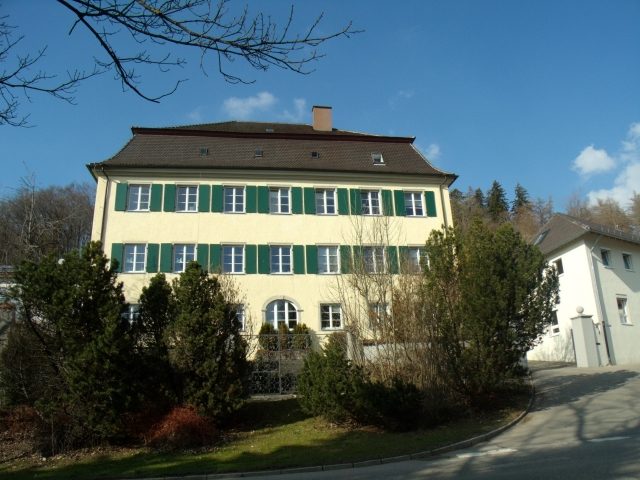
The Hummelsberg Manor – A Jewel of Renaissance Architecture+
The Hummelsberg Manor, often affectionately called "Schlösschen Hummelsberg" (little castle Hummelsberg), is a significant historical building located on the outskirts of Ulm. Its rich history and remarkable architecture make it a prominent landmark in the region.
History of Origin and Early Years+
The manor was built in 1636 by the influential Ulm patrician family Furttenbach. The Furttenbachs were a wealthy merchant family with extensive international connections, and their prosperity is reflected in the grandeur of the building. It served primarily as a summer residence and a place for recreation, away from the bustling city life of Ulm.
The Furttenbach Family and Their Influence
The Furttenbach family played a crucial role in the economic and cultural life of Ulm during the Renaissance and Baroque periods. Lukas Furttenbach, a prominent member of the family, was known for his extensive travels and his interest in architecture and engineering. It is believed that his experiences and knowledge influenced the design and construction of the Hummelsberg Manor.
Architectural Features+
The Hummelsberg Manor is an excellent example of late Renaissance architecture with early Baroque elements. Its symmetrical facade, the elaborate gables, and the decorative window frames are characteristic of the period.
Exterior Design
The building features a rectangular floor plan with two main floors and an attic. The most striking elements of the exterior are the stepped gables, adorned with obelisks and volutes, which are typical for the German Renaissance. The main entrance is emphasized by a richly decorated portal.
Interior Design
While much of the original interior has been altered over centuries, some elements still hint at its former splendor. Historical records describe richly decorated rooms with stucco ceilings, wall paintings, and valuable furnishings. The large hall on the first floor was likely used for banquets and social gatherings.
Later Owners and Uses+
Over the centuries, the Hummelsberg Manor changed hands multiple times. After the Furttenbach family, it was owned by various noble and bourgeois families, each leaving their mark on the building.
From Private Residence to Public Institution
In the 19th century, the manor was acquired by the city of Ulm and subsequently used for various public purposes. It served, among other things, as a school, a hospital, and an administrative building. These different uses led to numerous structural changes, some of which significantly altered the original character of the building.
The Hummelsberg Manor Today+
Today, the Hummelsberg Manor is a protected historical monument and houses a cultural institution. Extensive renovation work in recent decades has helped to restore much of its historical appearance and preserve it for future generations.
Cultural Significance and Future
The Hummelsberg Manor is not only an architectural masterpiece but also an important witness to the history of Ulm and the surrounding region. It serves as a venue for exhibitions, concerts, and other cultural events, making it a vibrant center of cultural life. Its preservation and continued use ensure that this historical jewel remains accessible to the public.
Take Mobile History with you
You are reading this text for free. Premium adds what matters on the road: descriptions read aloud, sites found through your camera, whole regions taken offline.
- Every description, including the ~17,700 Premium sites
- Audio guide: have descriptions read to you on location
- AR finder: see sites through your camera, with distance and bearing
- Unlimited saved sites
14 days free, then from €2.99 a month. Cancel anytime.
Source: Wikipedia · Licence: CC BY-SA 4.0
This description draws on the facts documented in the linked Wikipedia article; Wikipedia content is licensed under CC BY-SA 4.0. Wording and editing: Mobile History.
Location: 47.8244, 10.0286