College
CastleDatteln - Horneburg
Horneburg Castle
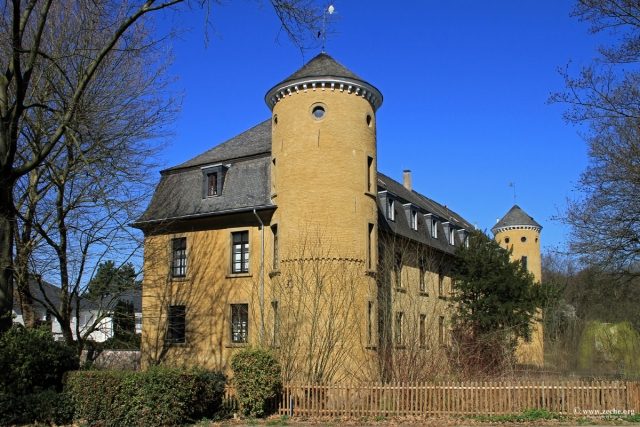
Horneburg Castle is a former noble residence in Datteln. It was the seat of the Lords of Oer until 1418.
The first documented mention of Horneburg can be found in 1220 in the Great Vogteirolle of Count Friedrich von Isenberg-Altena. It states that Horneburch belonged to the Oberhof Richrode. In a peace treaty between the Archbishop of Cologne Friedrich III. von Saarwerden and Count Engelbert IV. von der Mark dated October 29, 1384, Horneburg was mentioned in the Vest Recklinghausen.
At the latest since the end of the 12th century, the family von Oer headed the imperial court of Oer, to which Horneburg belonged. The income of the court flowed to the Cologne Cathedral Chapter. In 1389, Heydenrich von Oyre (Heidenreich von Oer) was able to acquire the imperial court of Oer, including Horneburg, from the Cologne Cathedral Chapter. He had the castle expanded and heavily fortified. His son Heinrich von Oer tried to exercise sovereign rights over the surrounding localities. He was defeated in 1418 and had to leave Horneburg.
The extensive landholdings of the Elector of Cologne included fields, pastures, forests, buildings, mills, and farmsteads. The private and public uses required a special administrative office. Initially, this was located in Recklinghausen. The administrator was the cellarer. In 1410, the clergyman Johann Droege was mentioned as cellarer. The relocation of the cellarer's office to Horneburg (after 1420) was a severe blow to merchants and tradesmen, as farmers, who delivered their dues or fulfilled their service obligations, often made various purchases on these occasions and now stayed away from the city. Reasons for the relocation included the crooked and winding streets of Recklinghausen, the cramped urban conditions, and the lack of suitable buildings for storing grain and housing numerous livestock. Horneburg, on the other hand, offered favorable space conditions and spacious farm buildings. It became the center of regional and estate administration, the electoral rentmaster's office in the Vest. Ludolf Hechelen was mentioned as the first cellarer at Horneburg Castle in 1425. In 1431, Horneburg with its chapel was fully taken into possession by the Archbishop of Cologne. In 1473, Dirick van der Knippenborch was Drost zu Horneburg, and in 1522, Cordt vom Darle held the office.
Gebhard Truchsess von Waldburg (1547–1601) was elected Archbishop of Cologne in 1577. In 1583, he became Protestant. His successor, Ernst von Bayern (1554–1612), waged a war against him, which he won in 1589. This Truchsessian or Cologne War was about whether the Archbishopric of Cologne, and thus also the Vest, would remain Catholic or become Protestant. Horneburg was occupied by the Truchsessian Colonel Engelbert von der Lippe on May 31, 1583. However, the Vest was recaptured. Ernst von Bayern held a Landtag at Horneburg in May 1584.
Horneburg was the scene of several witch trials between 1588 and 1590. It was the seat of the Vestian Criminal Court and the prison.
On July 25, 1646, the French Marshal Henri de La Tour d’Auvergne, Vicomte de Turenne, had the castle and the freedom burned down to avenge a military defeat in the area of Lünen-Hamm, but also an attack on his rearguard. On October 22, 1658, Johan [sic] Mathias Pranghe was appointed as the new cellarer at Horneburg. He said he had entered an inhospitable house, devastated, with demolished windows and doors. In the cattle shed, he had not even found a feeding trough, the cellarer's apartment had only a small room, and the smoke from the kitchen drifted there. For his efforts to reorganize the administration, he was awarded the title of Chief Cellarer in 1665.
After the Thirty Years' War, the destroyed main castle was not rebuilt. The former outer bailey, however, was rebuilt as a manor house in the dimensions of a castle and later also used as an administrative building. On May 23, 1698, Tsar Peter I was in Horneburg on his journey from Amsterdam to Vienna. From 1907 to 1959, a domestic science school for farmer's daughters was located at the castle. From 1959 to 1965, the Diocesan Caritas Association of Münster maintained a mothers' convalescent home in the castle. The building belongs to the district of Recklinghausen and has been used as a boarding school for special needs education since 1965.
Explanation of Name+
Horn appears in place names and refers to a tapering piece of land. For example, a field can extend into a forest. Another interpretation speaks of a ground threshold or dry hill projecting into marshland. A third interpretation sees it as a water name meaning dirty, dark, gray, and due to environmental influences also white and pale blue. When assessing the etymology, it should be noted that the predecessor building of Horneburg, arx Horneburgensis, was located north of the later main castle. It is possible that Saxons brought a place name from their original homeland on the Lower Elbe. Legend mentions a knight Goddert von Horne.
Castle Chapel+
In the document of January 8, 1332, a witness was mentioned: Lord Engilbertus, called Pastor of Hornenburg (dictus de Hornenburg). This was a modesty phrase. Bernhard von Clairvaux wrote: Bernhardus, abbas dictus de Claravalle (Bernhard, called Abbot of Clairvaux).
In 1610, the church in Horneburg received the right to administer baptism, under Heinrich Barckhoff (approx. 1610–1650), who later also became dean and Vestian commissioner. Under this capable and energetic pastor, the church was rebuilt and expanded. In the school that H. Barckhoff founded in 1610, he himself was a teacher for the first two years. He taught, among other things, grammar, Latin, and religion, but also gave an introduction to philosophy. In 1632, he and the cellarer were abducted as prisoners by Hessian troops, and in 1635, he was imprisoned in Dorsten for three weeks. In the same year, he was appointed pastor.
In 1672, the church received unrestricted parish rights. Until 1965, it was the parish church of St. Mary Magdalene; since 1968, it has been the church of the Russian Community of Saints Boris and Gleb.
The church is single-nave, two-bay, and has a flattened five-eighths choir apse. It is 17.7 m long and nine m wide. Nave and choir are fitted with buttresses. A slated roof turret, carrying three bells, sits on the west side of the roof. The interior of the church is covered with groin vaults resting on ribs between round-arched transverse arches and on consoles, some adorned with angel heads. The windows are pointed-arched, tripartite, and fitted with heavy masonry from 1654, patterned in the shape of fish bladders.
The church is equipped with a Baroque altar. The heavy framework of the high altar with acanthus tendrils and putti, as well as a depiction of the penitent Mary Magdalene from the end of the 17th century, enclosed a crucifixion group in the central field. Mary and John from this group are now in the Vestisches Museum, Recklinghausen. This was replaced by a Sacred Heart statue, after 1925 by a painting with Mary Magdalene, Mary, and John under the cross (now in the new church), and finally by a Byzantine Pantocrator. On the left side of the altar area is a Rococo sacrament niche made of sandstone, a 17th-century wall tabernacle with a paneled wooden door between stone pilasters. All around is cartouche work with angel heads. The baptismal font dates from 1618. It is a round basin with a leaf frieze and an angel head. The statue of Anna selbdritt is made of oak wood and dates from the 15th century. Its painting has been renewed. The baptismal font and Anna selbdritt are now in the New Church.
Take Mobile History with you
You are reading this text for free. Premium adds what matters on the road: descriptions read aloud, sites found through your camera, whole regions taken offline.
- Every description, including the ~17,700 Premium sites
- Audio guide: have descriptions read to you on location
- AR finder: see sites through your camera, with distance and bearing
- Unlimited saved sites
14 days free, then from €2.99 a month. Cancel anytime.
Source: Wikipedia · Licence: CC BY-SA 4.0 · Image: http://www.zeche.org/
This description draws on the facts documented in the linked Wikipedia article; Wikipedia content is licensed under CC BY-SA 4.0. Wording and editing: Mobile History.
Location: 51.6314, 7.2951