To be privately owned
CastleHonhardt
Honhardt Castle
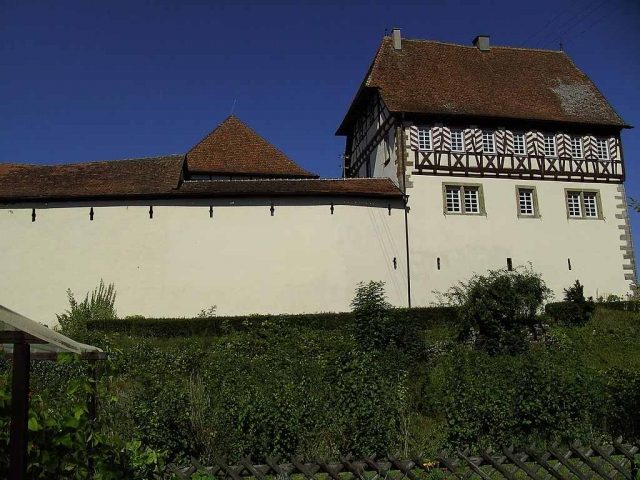
Honhardt Castle (also known as Honhardt Water Castle or Honhardt Fortress) is a former moated castle built on a natural rock formation in Honhardt. It stands in the center of the village of Honhardt, formerly the seat of an independent municipality, today a district of the municipality of Frankenhardt in the Hohenlohe region in the district of Schwäbisch Hall in Baden-Württemberg.
The enclosed defensive complex with a battlement was rebuilt by the Imperial City of Hall after its destruction in 1444. The oldest part, the keep, is dated to the 11th century. The origin of the place is assumed to be the 8th century. A first written mention of Honhardt can be found in a document of Emperor Henry II, from the year 1024.
The first predecessor of the later castle, from which the present castle emerged in the 15th century, probably also originated during this period. The complex initially consisted only of the preserved keep, a residential tower, merely surrounded by a palisade fence. Subsequently, the fortification was expanded into a castle by the construction of a main house, the erection of a ring wall with a battlement, the creation of a moat with an outer rampart, and the installation of a drawbridge.
Honhardt was initially, alongside Crailsheim, one of the two main towns of the Lohr lordship. Around 1300, it passed into the possession of the Counts of Oettingen for a few years, but became Hohenlohe property as early as 1314.
In the 14th century, the castle was the center of the Hohenlohe office of Honhardt and remained in the possession of the House of Hohenlohe until the end of the century. At the same time, however, the Counts of Flügelau also had shares in the Honhardt district. The castlemen from the 13th to the 15th century were a lower noble ministerial family, who called themselves Lords of Honhardt and were vassals of the Counts of Flügelau and then of Hohenlohe.
In 1398, Ulrich von Hohenlohe sold the feudal sovereignty over Honhardt to Brandenburg-Ansbach and the place itself to the three Imperial Cities of Hall, Dinkelsbühl, and Rothenburg.
In 1399, the ownership of the town passed completely to the city of Hall, which in turn transferred the property to two of its resident patrician families. In 1413, these sold Honhardt, including the castle, to the Lords of Bebenburg, vassals of the Margrave of Ansbach. The castle was thus again detached from the dominion of the Imperial City of Hall. In 1444, in a war between the Imperial Cities and the surrounding noble lordships, troops from Hall conquered Honhardt Fortress, and the castle was burned down and destroyed. After a complaint by the House of Bebenburg and the Ansbach Margrave against Hall, a judicial settlement was reached in 1446, as a result of which the city subsequently bought the Honhardt office, including the destroyed castle, from the Bebenburgs for a high compensation.
In the same year, Hall transferred the lordship over Honhardt to the Hall Hospital. This had a castle-like residential building erected in place of the former castle in the second half of the 15th century and used it as a hospital office and seat of the Hall office of Honhardt.
In 1677, Hall had the castle fortified with palisades and the fortifications renewed. In 1700, the present main house of the castle was newly built. The corresponding years can be found in the timberwork in the hall, on the Gothic fireplace on the first floor, and on the cornerstone on the south side.
Around 1730, an elaborate stucco ceiling was completed on the bel étage on the second floor. In its center, a dove can be seen as a symbol for the Holy Spirit, the patron saint of the hospital.
At the beginning of the 19th century, with the end of the Imperial City of Hall, the castle passed into Württemberg state ownership in 1803 and was used for several years as the official seat of the Württemberg Oberamt Honhardt, until this merged into the Oberamt Crailsheim, founded in 1810.
In 1815, the castle was sold to civilian buyers. Until 1980, the complex and its outbuildings were used as a rural estate with livestock farming, stables, and barns.
In 1981, the complex was renovated true to its historical style. The Chamber of Architects Baden-Württemberg awarded a prize for "exemplary building" for this.
Description+
The property consists of the main house, a side wing, the surrounding battlement, an enclosed inner courtyard, and the high medieval keep.
Current Use+
In 2009, the castle was acquired and reconstructed by an art dealer. During this renovation, old building sins from previous uses were consistently removed. Today, the castle houses the art dealer's private weapon collection and sales rooms. The castle is not accessible to the public.
Take Mobile History with you
You are reading this text for free. Premium adds what matters on the road: descriptions read aloud, sites found through your camera, whole regions taken offline.
- Every description, including the ~17,700 Premium sites
- Audio guide: have descriptions read to you on location
- AR finder: see sites through your camera, with distance and bearing
- Unlimited saved sites
14 days free, then from €2.99 a month. Cancel anytime.
Source: Wikipedia · Licence: CC BY-SA 4.0
This description draws on the facts documented in the linked Wikipedia article; Wikipedia content is licensed under CC BY-SA 4.0. Wording and editing: Mobile History.
Location: 49.0700, 10.0389